
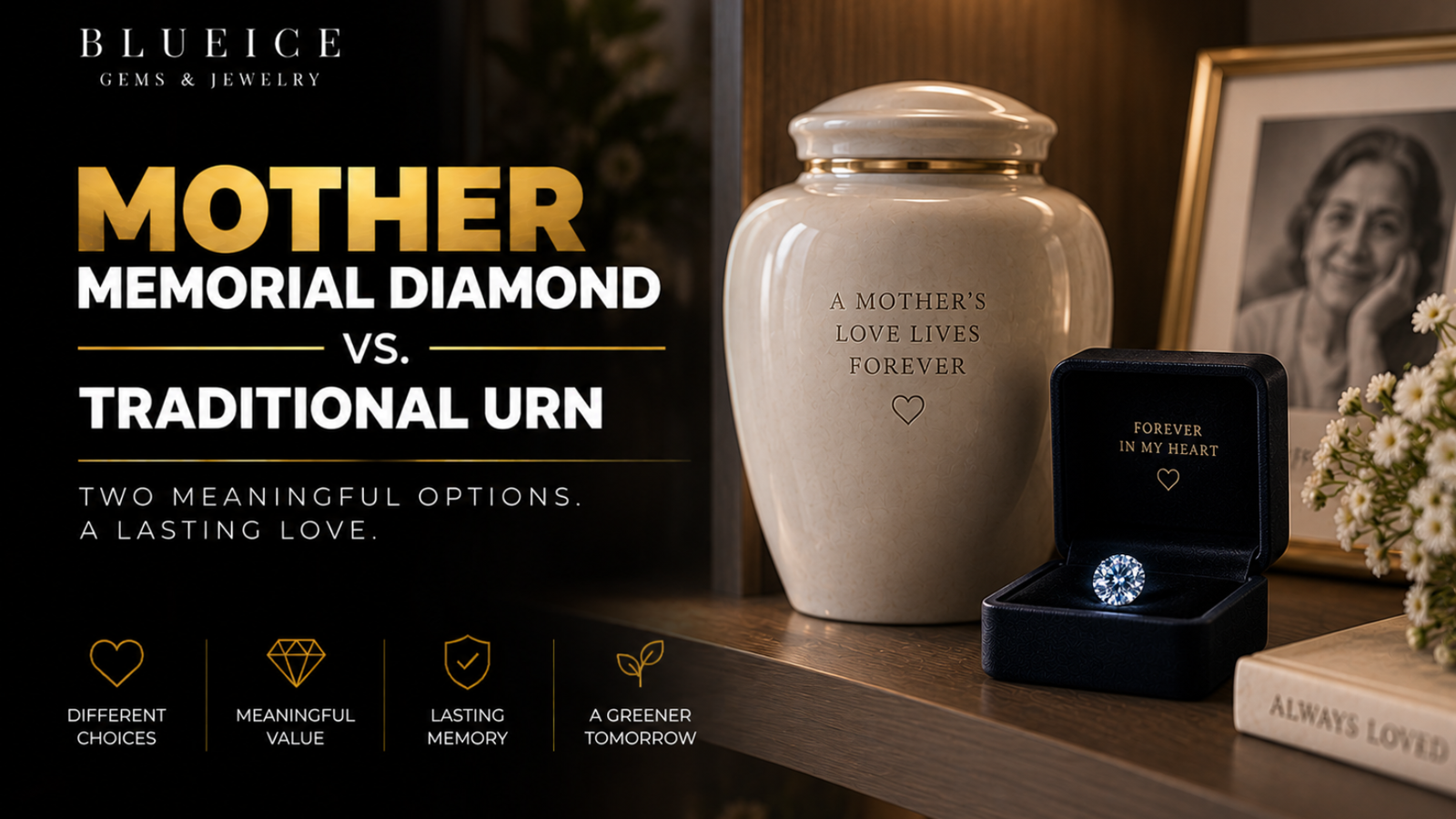
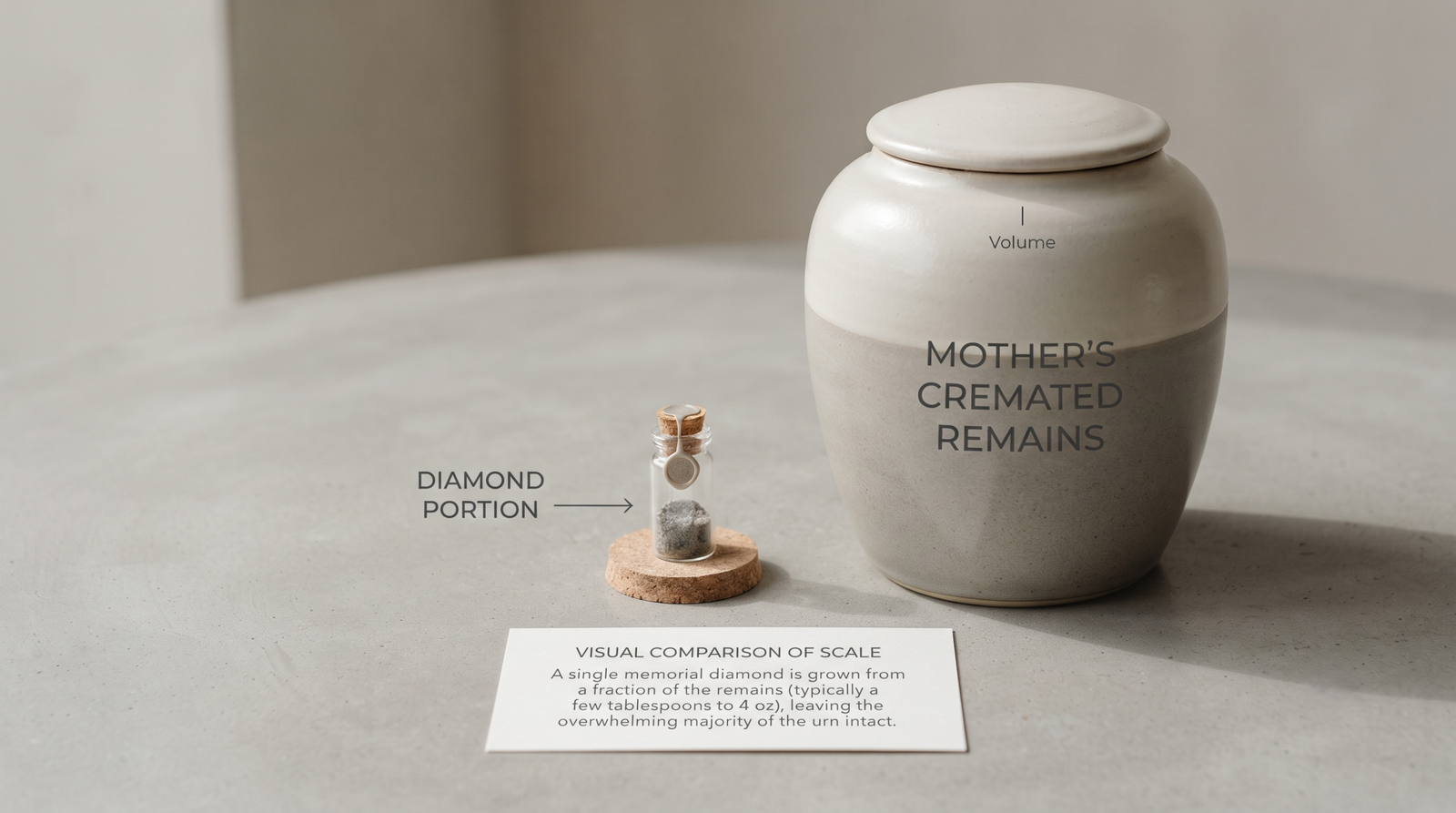
A memorial diamond is grown from a small fraction of a cremation, typically a few tablespoons to around 4 oz. That single number is why the comparison is so rarely an either/or choice: the urn on the shelf generally survives the decision intact.
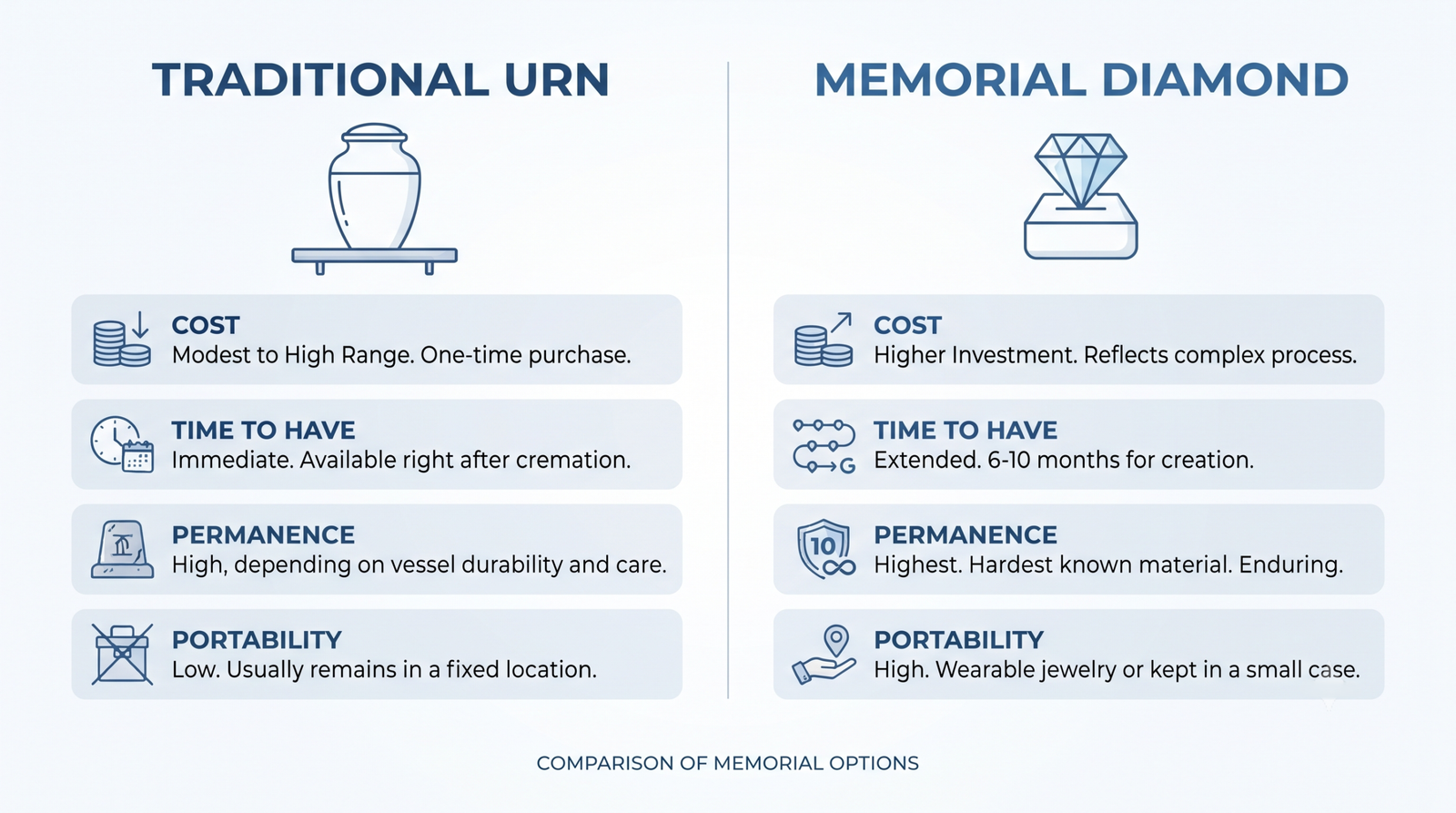
Where the two genuinely differ is in cost, time, portability, divisibility, and what happens to each in fifty years. An urn is immediate, inexpensive, whole, and reversible. A diamond takes the better part of a year, costs thousands, is wearable, and cannot be undone.
Disclosure: memorialdiamond.us is a company that makes memorial diamonds. This page compares two options honestly, including where an urn is the better answer, but it is not written by a neutral third party.
What Is Actually Being Compared?
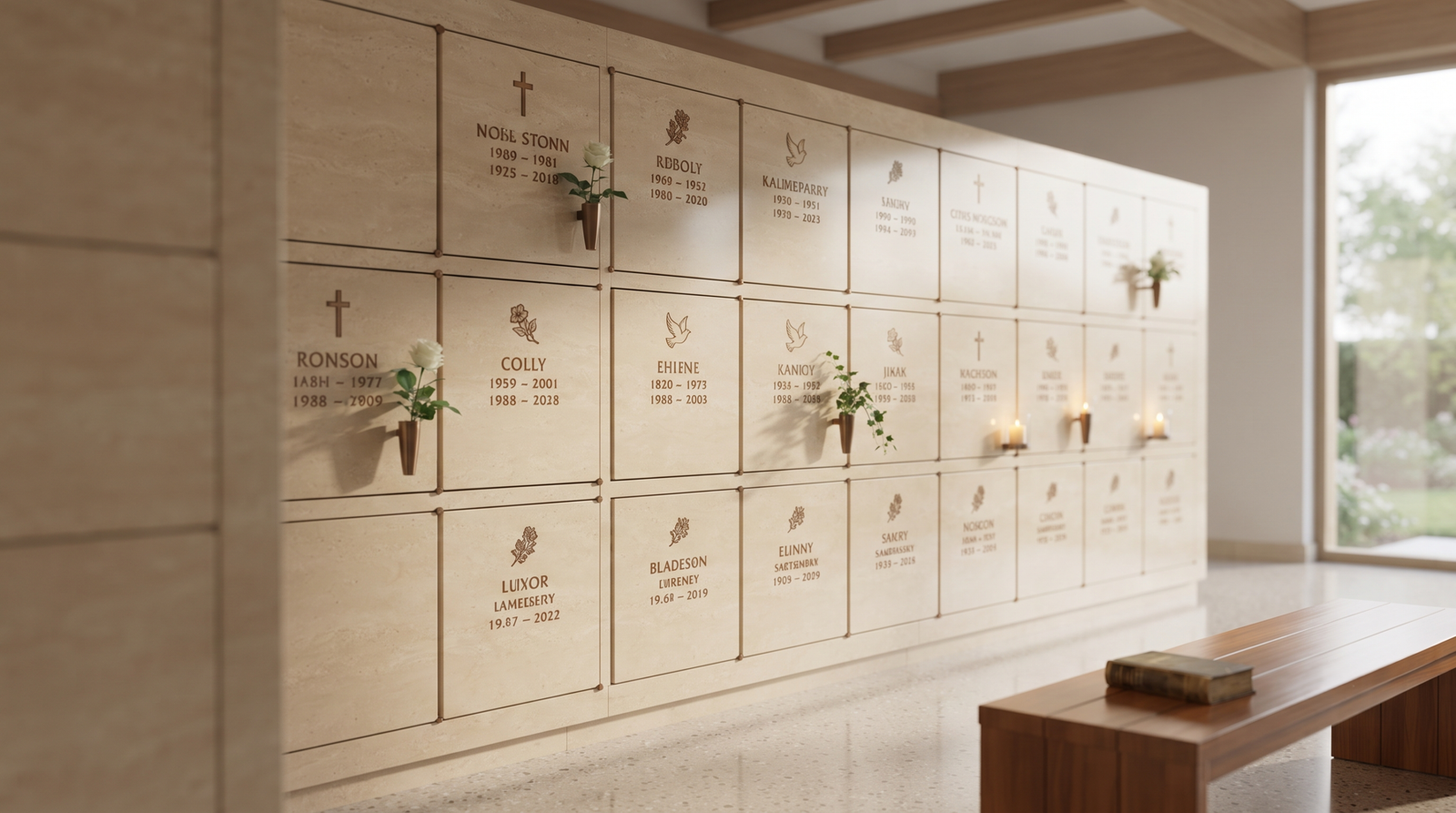
A traditional urn holds the whole of a person’s cremated remains in one container in one place, such as a home, a columbarium niche, or a grave. It requires no further decision, costs comparatively little, and can be revisited because ashes can later be scattered, interred, divided, or used for something else.
A memorial diamond is a real lab grown diamond, chemically identical to any other diamond, grown in part from carbon extracted from a portion of those remains. It takes 6 to 10 months of production, costs thousands, and is portable and wearable. It is also irreversible, as the extracted carbon cannot become ash again, explained further under how a memorial diamond is made from your mother’s ashes.
How Do They Compare Directly?
| Traditional urn | Memorial diamond | |
| How much of her it holds | All of the remains | Carbon from a small portion; typically around 10 to 15 percent of the finished stone is her own carbon, blended with lab carbon |
| Cost | Substantially less than a memorial diamond; urns span a wide range and are widely available at modest cost | Roughly $750 at entry weights and scaling upward depending on the bracket |
| Time to have it | Immediate | 6 to 10 months of production, longer end to end |
| Where it lives | A shelf, a niche, a grave | Worn, carried, or kept in a case |
| Can several people have one? | One object, one location | Several stones from one submission, usually |
| Reversible? | Yes, can be scattered or interred later | No, extraction is permanent |
| Durability | Depends on the vessel and where it is kept | Hardest known material, 10 on the Mohs scale, the same as any mined diamond |
| Needs a decision from the next generation? | Yes, eventually | Yes, but it is a jewellery decision rather than a remains decision |
| Requires cremation? | Yes | Not if hair is used instead |
Why Is This Rarely an Either/Or Choice?
Because the quantities do not conflict. A family that commissions a diamond from a few tablespoons of ashes still has the overwhelming majority of the cremation available for whatever they had planned: the urn on the shelf, the scattering at a place she loved, or interment beside her husband, as reviewed under how much ash you need.
That is the single most useful thing to know before weighing the two, and it dissolves most of the argument. The realistic decision is not urn or diamond; it is whether to also do this, using a portion, while everything else proceeds as planned.
The exception is a family whose ashes have already been fully scattered or interred. There, the question becomes whether any hair exists, since a hair based diamond needs no cremated remains at all, detailed under how to turn your mother’s hair into a diamond.
When Is an Urn the Better Answer?
- When the family wants her kept whole, in one place, undivided. That is a coherent and widely held position, not a failure of imagination.
- When cost matters. An urn is affordable in a way a grown diamond is not, and there is no version of a memorial diamond that competes on price.
- When a decision is needed now. A diamond cannot exist for months; a memorial service happens next week.
- When there is disagreement. An urn keeps every option open, including a diamond later.
- When the burial or columbarium arrangement is already settled and dividing the remains would unsettle it.
When Is a Diamond the Better Answer?
- When more than one person wants something of her, and a single urn cannot be in several homes.
- When someone wants her with them rather than in a room they visit.
- When there was no cremation, and a lock of hair is what exists.
- When an urn has become difficult to live with, as some families find a container of remains in the house harder than they expected, and a stone offers a different kind of presence.
- When it is intended to outlast the arrangements. Vessels get moved, homes get sold, and niches get relocated, though a small stone is also far easier to lose than an urn, which makes this a trade rather than a straight advantage.
What Happens to Each in Fifty Years?
This dimension gets less attention than cost and time, and it is the one that only becomes visible later.
An urn eventually requires someone else to make a decision about it: a grandchild who inherits a container of a person they may not have met and must choose whether to keep it, inter it, or scatter it. That is not an argument against urns; it is simply the obligation that comes with them.
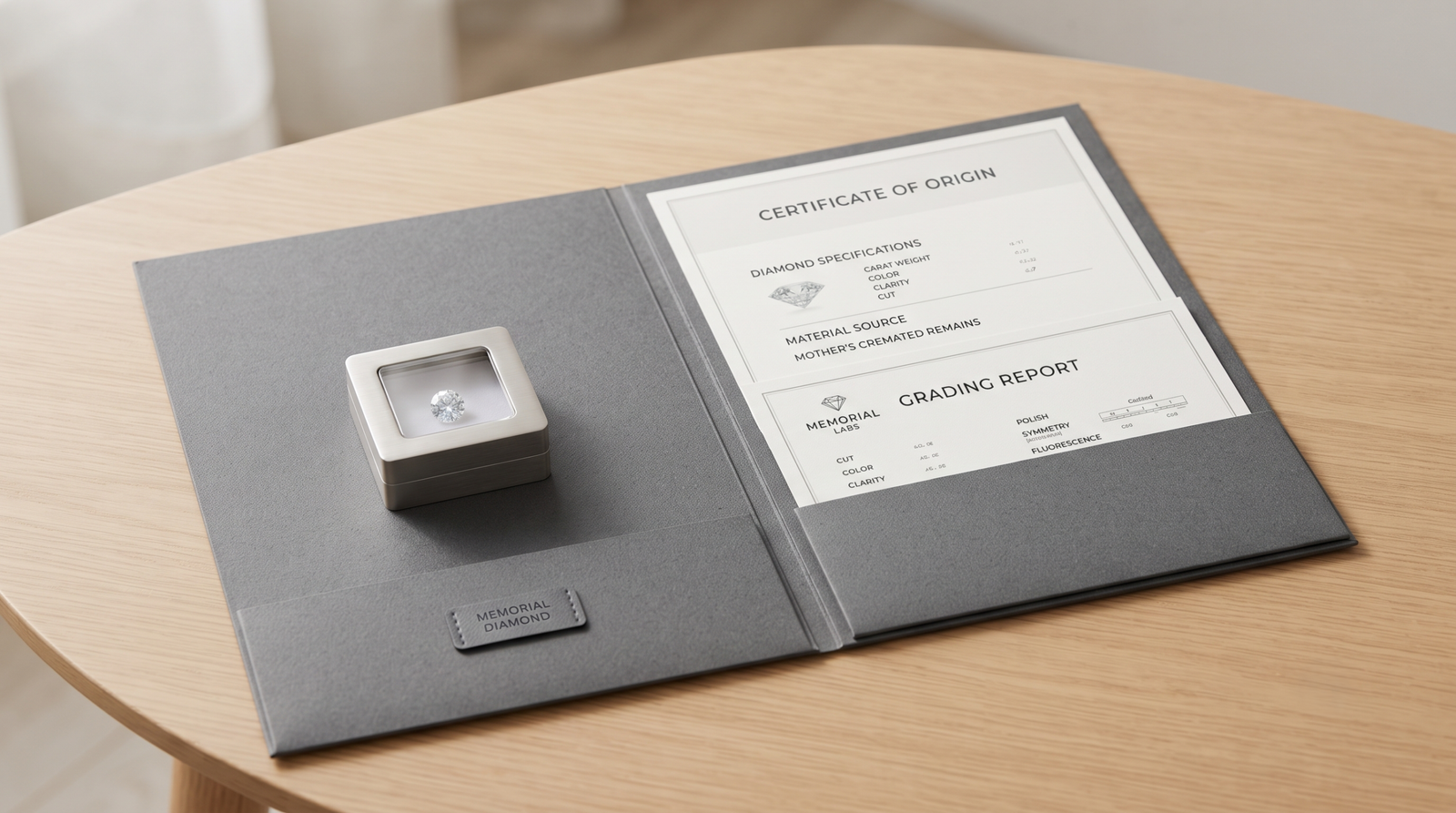
A diamond passes into the ordinary category of inherited jewellery, where the rules are already understood. It can be worn, kept, or passed on without anyone having to decide about remains, and its provenance travels with its paperwork, as explored under memorial diamonds as a family heirloom.
Both need someone to know what they are. A stone with no documentation is just a stone in fifty years, which is an argument for keeping the origin certificate and grading report with it.
Religious and Cultural Considerations
Worth naming honestly rather than skipping: no religious tradition has an official position on memorial diamonds specifically. What traditions address is cremation, and in some cases the dividing of ashes. Two of them bear directly on this particular comparison.
Catholic: Current guidance from the Vatican’s Dicastery for the Doctrine of the Faith permits cremation but directs that ashes be kept intact in a sacred, church approved place rather than divided among family or kept privately at home, with a narrow allowance for a “minimal part” under specific conditions. Whether that allowance extends to a memorial diamond is a question for your own parish.
Islamic: Cremation itself is considered impermissible across all major schools of Islamic thought in ordinary circumstances. That is why a hair based diamond, which requires no cremation at all, sits outside the objection entirely rather than needing to be reconciled with it.
Elsewhere the picture varies by movement, community, and individual clergy rather than by fixed rule. Orthodox and Conservative Judaism generally prohibit cremation while Reform Judaism does not. Hindu practice centres on cremation followed by immersion of ashes, with keeping a small portion described as an increasingly common practice rather than a doctrinal controversy. Buddhist traditions predominantly cremate and hold their own relic tradition, and teachers differ on how a memorial diamond sits with teaching on non attachment. Protestant and Evangelical traditions are generally neutral on method, with most mainline clergy raising no objection.
Where this matters to your family, the person to ask is your own clergy, not a jewellery company.
Frequently Asked Questions
Do I have to choose between keeping her ashes and having a diamond?
Almost never. A memorial diamond uses a small fraction of a cremation, so the remainder can still be kept in an urn, interred, or scattered exactly as planned. Families who assume it is all or nothing are usually deciding against something that was never required.
Is a diamond a more permanent memorial than an urn?
The stone is more durable. Diamond is the hardest known material, lab grown or mined. Whether that makes it a better memorial is a family’s judgment rather than a fact, and an urn kept carefully can last generations too.
Can we start with an urn and decide about a diamond later?
Yes. Cremated remains do not deteriorate, so a decision made in five years is exactly as available as one made now, provided the ashes have not been fully scattered or interred in the meantime.
Is it disrespectful to divide her ashes?
Views differ genuinely by faith, family, and person, and this is not a question a company should answer for you. What can be said factually is that dividing remains is common practice in many families and prohibited or discouraged in some traditions.
What if the ashes are already interred?
Then a hair based memorial diamond is the remaining route, if any hair was kept. It requires no cremated remains and no exhumation, which is also why it works for families where there was never a cremation at all.
Does a memorial diamond replace a grave or a place to visit?
Only if a family wants it to. Many keep both, and some deliberately keep the visiting place precisely because a wearable stone does a different job: it is with you rather than somewhere you go.
It Is Rarely One or the Other
The honest framing is not which one, but whether to add a portion to what you have already decided. If your family has settled on an urn, a niche, or a scattering, none of that has to change for a memorial diamond to be possible. The number that settles it is the quantity required for the size you have in mind. Get the details from us at memorialdiamond.us, then weigh it against what you actually hold.