
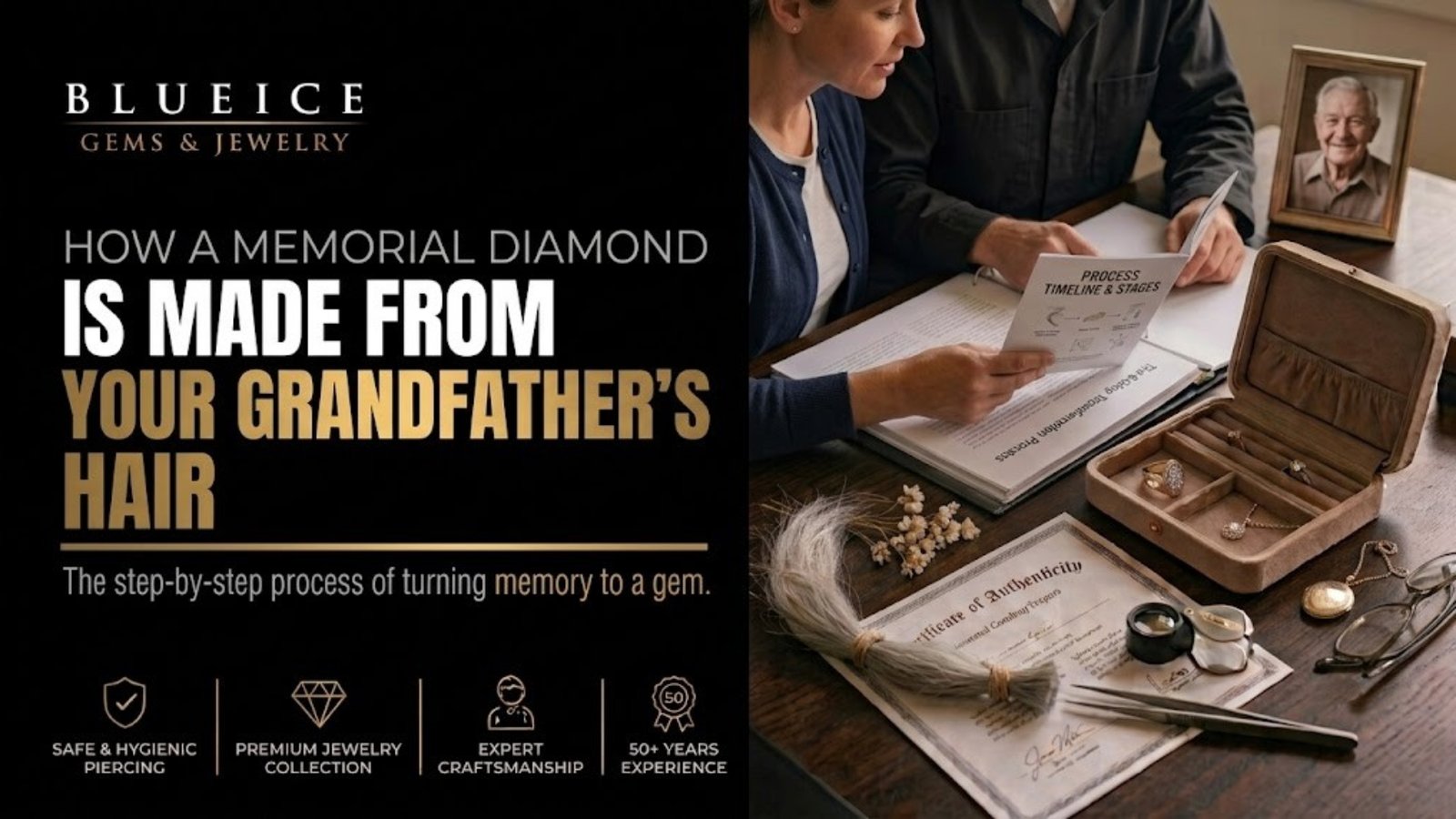
Perhaps a lock of his hair was set aside, and before you let it go you want to understand what a lab would actually do with it. A memorial diamond made from grandfather hair begins as keratin, which is roughly half carbon; that carbon is extracted, purified, turned into graphite, typically blended with supplemental lab carbon, and grown under intense heat and pressure into a real diamond that is then cut, polished and documented.
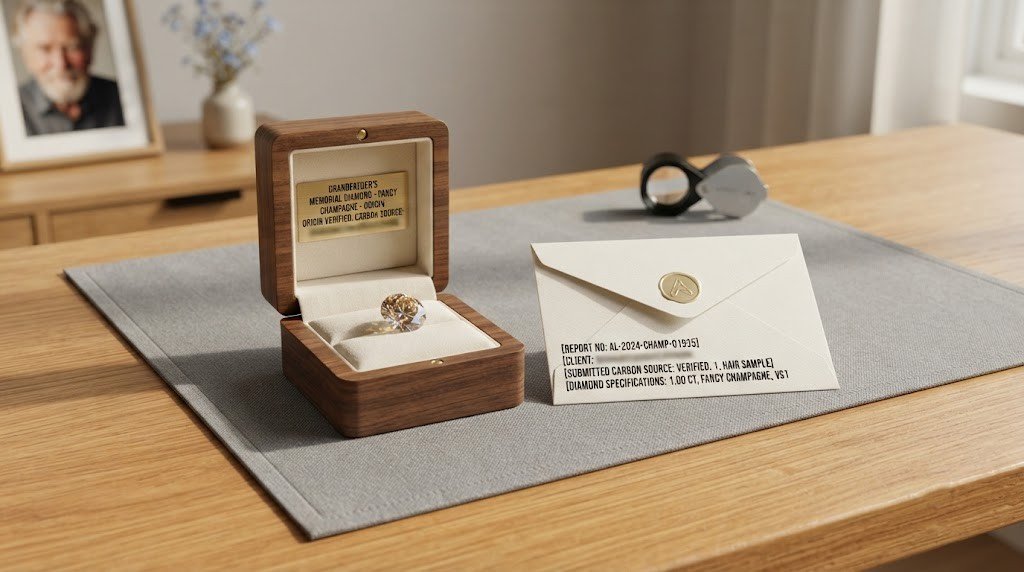
Table of Contents
Why Does Hair Hold So Much Carbon?
Hair is built almost entirely from keratin, a structural protein, and keratin is roughly 50% carbon by weight. That one fact explains why a memorial diamond made from grandfather hair needs only a small amount of starting material.
Keratin also carries hydrogen, oxygen, nitrogen and sulfur, bound together in long protein chains. None of those other elements belong in a diamond lattice, so before anything can be made from grandfather hair, the lab has to separate the carbon from everything around it.
Ashes sit at the other end of the scale. They consist largely of calcium phosphate from bone, with only around 0.5–4% of their weight left as usable carbon. Hair starts from a far richer carbon position, which is why a diamond made from grandfather hair and one grown from his ashes look so different on paper. If you hold both his ashes and his hair, the complete guide to grandfather ashes and hair diamonds sets out how the combined route compares.
Hair also needs no cremation. If your grandfather was buried, a lock saved before the funeral or kept from an earlier haircut can still be a workable source, so a stone made from grandfather hair is open to families who never held ashes at all. For the wider picture beyond the lab, the grandfather hair diamond complete guide covers cost, settings and choices in one place.
What Are the Lab Stages for a Diamond Made From Grandfather Hair?
Seven broad stages lie between the lock you send and a finished stone made from grandfather hair. Each lab names and groups them a little differently, so read the table as a map of the science rather than a description of one provider’s workflow.
| Stage | What happens | What the lab is aiming for |
|---|---|---|
| 1. Receipt and logging | The hair is checked in, weighed and given an identifier that follows it through the lab | An unbroken record from the first moment |
| 2. Carbon extraction | Controlled heating without oxygen breaks the keratin down and drives off non-carbon elements | Carbon separated from hydrogen, oxygen, nitrogen and sulfur |
| 3. Purification | Further refining removes what traces remain | Carbon at roughly 99.9% purity or higher |
| 4. Graphitization | The purified carbon is heated to roughly 2,500–2,700°C | Graphite, the feedstock a growth press uses |
| 5. Growth | Graphite, typically blended with supplemental lab carbon, grows around a seed under HPHT, or is converted to gas for CVD | A rough diamond crystal |
| 6. Cutting and polishing | A cutter shapes the rough into the chosen cut | A finished gemstone |
| 7. Grading and documentation | Optional independent grading, plus an in-house authenticity certificate | Proof of quality and proof of origin |
From receipt to finished stone, a memorial diamond made from grandfather hair typically takes 6–10 months, and up to about 12 for larger stones near 2 carats and above or for specialty colors. Labs do not publish a dependable breakdown by stage, and growth on its own spans weeks to months, so any stage-by-stage schedule is something to ask the provider about rather than assume.
Why Is So Little Hair Needed Compared With Ashes?
Because roughly half of hair’s weight is carbon, a small lock or a few grams is the typical starting amount, while ash routes usually ask for anything from a few tablespoons up to roughly 4 oz (about 100 g). Exact minimums vary by provider, and no figure you read online should be taken as a rule for your order.
The amount you send does not set the size of the finished stone. Carat depends on how long the crystal grows in the press, not on the weight of hair that arrives. A thicker lock will not on its own produce a larger diamond made from grandfather hair, and a modest one does not cap the stone at a tiny size.
Since only a portion is used, you may be able to keep part of the lock rather than sending all of it, and several stones made from grandfather hair can often come from one source. If a sibling or cousin also wants a piece, raise that before anything is posted. To see how the low-carbon ash route handles the same science, read how a memorial diamond is made from your grandfather’s ashes.
What Does Carbon Extraction Strip Away?
Extraction removes everything in the keratin that is not carbon. For a diamond made from grandfather hair, the strands are heated in a controlled, oxygen-free environment, so it does not burn the way it would in open air; the non-carbon elements are driven off and a carbon-rich residue remains.
Residues that arrived with the hair, such as natural oils or traces of product, are also among the things this stage and the purification after it are meant to leave behind. The aim is a material that is carbon and nothing else, because stray elements carried into growth can affect the stone’s color.
This is also where questions about treated hair belong. Whether dyed, permed or chemically treated strands need extra handling before anything is made from grandfather hair is something only a provider can answer for its own process, and this guide makes no claim either way. If the hair you saved was colored or treated, say so when you first ask, and request the reply in writing.
How Do Purification and Graphitization Work?
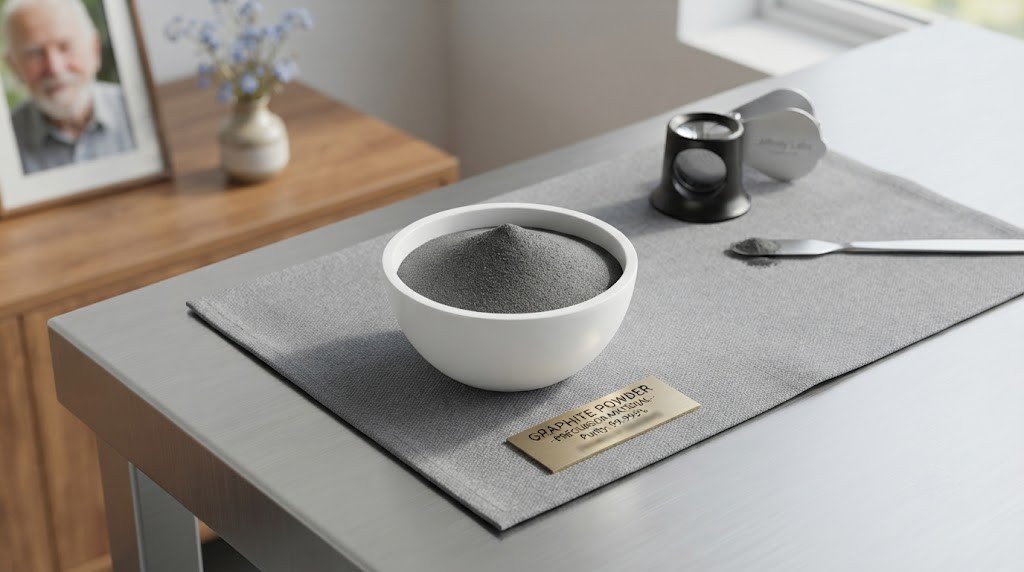
Purification refines the extracted carbon until it reaches roughly 99.9% purity or higher, and graphitization then converts it into graphite at around 2,500–2,700°C. Both exist because a growth press needs clean, consistent feedstock.
Purification is generally a multi-stage process, with repeated controlled heating that pushes out the last traces of other elements. In a stone made from grandfather hair, trace elements left behind at this point can influence color. Graphitization reorganizes the carbon atoms into flat, stacked sheets, the crystalline form that HPHT growth begins from.
By this point, carbon destined for a stone made from grandfather hair looks like any other graphite. Nothing visible marks where it came from, which is why the records kept from stage one onward carry so much weight. From here on, the lab’s tracking is what connects that graphite to him.
How Does Graphite Become a Diamond?
Graphite becomes diamond under extreme pressure and heat. In HPHT growth, the industry standard for memorial stones, a press holds the carbon at roughly 6–8 GPa and about 1,400–2,500°C around a tiny diamond seed, and carbon atoms build onto that seed in a diamond lattice.
A minority of providers use CVD instead, converting carbon to a gas and depositing it layer by layer onto a seed plate in a vacuum chamber. The synthetic diamond overview on Wikipedia gives a fuller technical account of both methods.
Growth takes weeks to months, and the length of that run decides carat weight. Sizes on offer across the industry generally run from roughly 0.10 ct up past 5 ct, and a larger diamond made from grandfather hair simply needs a longer, more tightly controlled growth period.
A diamond made from grandfather hair is a real diamond, chemically and physically the same as one mined from the ground. It rates 10 on the Mohs scale of mineral hardness, the highest rating any natural mineral reaches. Hardness is not toughness, however: a sharp blow can still chip a diamond, and a setting that guards the edges helps if the piece will be worn daily.
Is Supplemental Carbon Added, and How Much of the Stone Is His?
Supplemental lab carbon is typically blended in during growth, and no finished-stone percentage is published for how much of a hair-based diamond is personal carbon. Anyone telling you a gem made from grandfather hair contains nothing but his hair is overstating what the process does.
Why blend at all when hair is so carbon-rich? A growth run needs a set volume of consistent feedstock, and labs balance personal carbon against lab carbon to reach it. The ratio in a stone made from grandfather hair is a process decision that can differ between labs and between stone sizes.
You may see a personal-carbon share quoted for ash-based stones. That figure belongs to ash alone, because it reflects ash’s low carbon yield, and it should never be read across to hair. For a stone made from grandfather hair, the honest position is that the share is unpublished, so the only reliable number is the one a provider puts in writing for your specific order.
What stays true either way: a real, documented portion of his own carbon becomes part of the crystal lattice of any diamond made from grandfather hair. The stone is not a symbol standing in for him; it is physically grown in part from him. If you are weighing whether to add ashes to the hair, how a memorial diamond is made from your grandfather’s ashes and hair walks through the two-material science.
Where Does the Color of a Diamond Made From Grandfather Hair Come From?
Trace elements caught up in the growing crystal set its color. Nitrogen tints a stone yellow and boron tints it blue, while a colorless result depends on keeping both almost entirely out. Memorial diamonds, including those made from grandfather hair, commonly trend toward yellow, blue and champagne or brown tones, and colorless usually costs more because it demands tighter control.
Some providers also offer optional post-growth irradiation, which can move a stone toward red, pink, green or black. It is an elective step, separate from growth, and it is priced and described by each provider on its own terms.
No source makes the color of a diamond made from grandfather hair predictable from the hair itself. There is no published basis for expecting gray, white, dark or dyed hair to give a lighter or darker stone, so color is something you choose and discuss with the lab rather than something his hair decides.
What Happens at Cutting, Grading and Certification?
After growth, the rough crystal of a diamond made from grandfather hair is cut and polished into a finished shape, then documented in two separate ways: an optional independent grading report covers its quality, and an in-house authenticity certificate covers its origin.
Cut choices such as round, oval, cushion or princess affect how much of the rough is kept and how the finished stone handles light. Fancy cuts are often priced as an extra, as are engraving and settings.
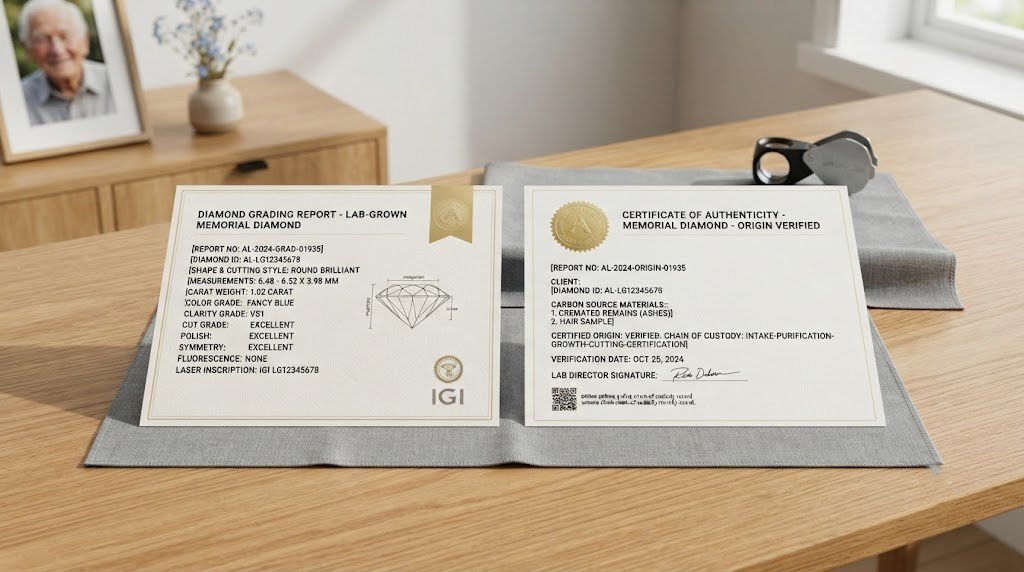
A grading report, commonly referencing the GIA 4Cs of diamond quality and sometimes issued by IGI, describes cut, color, clarity and carat exactly as it would for any diamond. Memorial stones typically land in the SI2 to VVS clarity range. An authenticity certificate does a different job: it states that the stone was grown from the material you sent, and it is the last link in the chain of custody.
When the documents for a stone made from grandfather hair arrive, check that they include:
- the identifier assigned to his hair at receipt
- the measured carat, cut, color and clarity
- whether grading was independent or in-house
- a statement of origin naming hair as the source material
- who issued each document, and how to verify it
How Can You Know a Stone Was Made From Grandfather Hair?
Confidence rests on chain of custody: a documented trail showing who handled the hair, when, and under which identifier, from arrival to finished stone. A grading report describes quality rather than origin, so that trail is the evidence you will rely on; if you want to know whether any testing could add to it, ask the provider.
Ask how a lab keeps a lock sent for a diamond made from grandfather hair apart from other customers’ material, whether each stage is logged against a unique code, and whether you may see that log. Ask, too, whether progress updates or photographs are offered and how often; that is set by each provider, so get the answer in writing.
The same doubt comes up for ash, and whether a memorial diamond is really made from your grandfather’s ashes answers it for that material. For hair, a lab that explains its tracking clearly and without hesitation gives you a better signal than any promise printed on a website about a diamond made from grandfather hair.
Does Gray, White, Short or Beard Hair Change Anything?
There is no published evidence either way on whether gray, white, short, sparse, facial or treated hair behaves differently when a diamond is made from grandfather hair, so each is a question for the provider rather than a reason to hesitate or to assume.
What was saved might be short clippings, a few strands from a brush, a lock from the crown, or beard hair kept after a trim. Ask the lab directly:
- Do you accept short or loose clippings, or do you need longer lengths?
- Is beard or other facial hair accepted in the same way as scalp hair?
- How much do you need if the hair is fine or sparse?
- Should dyed or chemically treated hair be flagged before sending?
- Should hair be taken out of a brush, locket or frame, or sent as it is?
Keep every reply in writing. If one lab cannot work with what you have, that says nothing about whether another can, and nothing at all about the worth of what you kept.
What Should You Settle Before the Hair Leaves Your Hands?
Before anything is made from grandfather hair, settle who in the family should be part of the decision and what you want done with any hair you hold back.
Regulations around human remains mostly target the remains, which means hair you already hold tends to be the simpler material in practice. Belongings can still form part of an estate, though, and rules vary by state. If his hair is held by another relative, using it is a conversation with them, not a decision to make alone.
Hair can also matter for faith. No tradition has an official position on memorial diamonds as such; the positions that exist concern cremation and the handling of ashes. For Muslim families, and for Orthodox and Conservative Jewish families, where the concern is cremation itself, a stone made from grandfather hair involves no cremation, though your own imam, rabbi or clergy member is the right person to ask. When you are ready for the ordering side, how to turn your grandfather’s hair into a diamond covers the practical steps.
Frequently Asked Questions
Can hair saved many years ago still be used?
Possibly, but that is for the provider to say. Whether older hair is accepted for a diamond made from grandfather hair, whether its age or storage matters, and whether hair kept in a locket or frame can be used are all questions to confirm in writing.
Is the hair used up during the process?
Any hair the lab processes is transformed: extraction drives off everything that is not carbon, and that carbon becomes graphite and then diamond. Send only the amount requested, keep the rest if you wish, and ask whether unprocessed hair is returned.
Can more than one stone come from the same lock?
Often, yes. Because hair is carbon-rich and only a portion is typically used, several stones can sometimes be grown from one source. Ask the provider how much each additional stone needs and whether the carbon is split before or after purification.
Will the finished stone look different from a mined diamond?
Not in its physical makeup. A diamond made from grandfather hair has the same crystal structure, hardness and optical behavior as a mined diamond. Differences you notice will come from its color, cut and clarity, which a grading report describes in the same terms used for any diamond.
Does a hair-based stone cost less than one grown from ashes?
Not necessarily: published industry prices are set out by carat, color, cut and grading, not by whether a stone is made from grandfather hair or from ashes. Ranges in 2026 start around 1,500–3,500 for about 0.10–0.25 ct. Ask each provider whether hair and ash orders are priced differently.
Can the stone be set into any kind of jewelry?
Yes, a finished memorial diamond can go into a ring, pendant, earring, bracelet or any setting a jeweler can make. There is no rule that a grandfather’s stone belongs in a particular style; choose whatever suits the person who will wear or keep it.
Final Thoughts on a Diamond Made From Grandfather Hair
The science is precise, but the decision is personal. Knowing what extraction removes, why lab carbon is typically added, and where the paperwork matters lets you ask sharper questions and judge the answers. Whatever you decide, there is no deadline, and the hair can stay safely where it is while you gather answers.
Learn More About Grandfather Memorial Diamonds
- Grandfather Hair Diamond: The Complete Guide the full picture for hair-based stones
- How to Turn Your Grandfather’s Hair Into a Diamond practical steps from first question to delivery
- How a Memorial Diamond Is Made From Your Grandfather’s Ashes the same science for cremated remains
- How a Memorial Diamond Is Made From Your Grandfather’s Ashes and Hair when both materials are sent together
Talk With Memorial Diamond
If you would like to talk through what you have saved and what a lab would need, we are here to answer questions at whatever pace suits you. Visit memorialdiamond.us to start a conversation, with no obligation and no rush.