
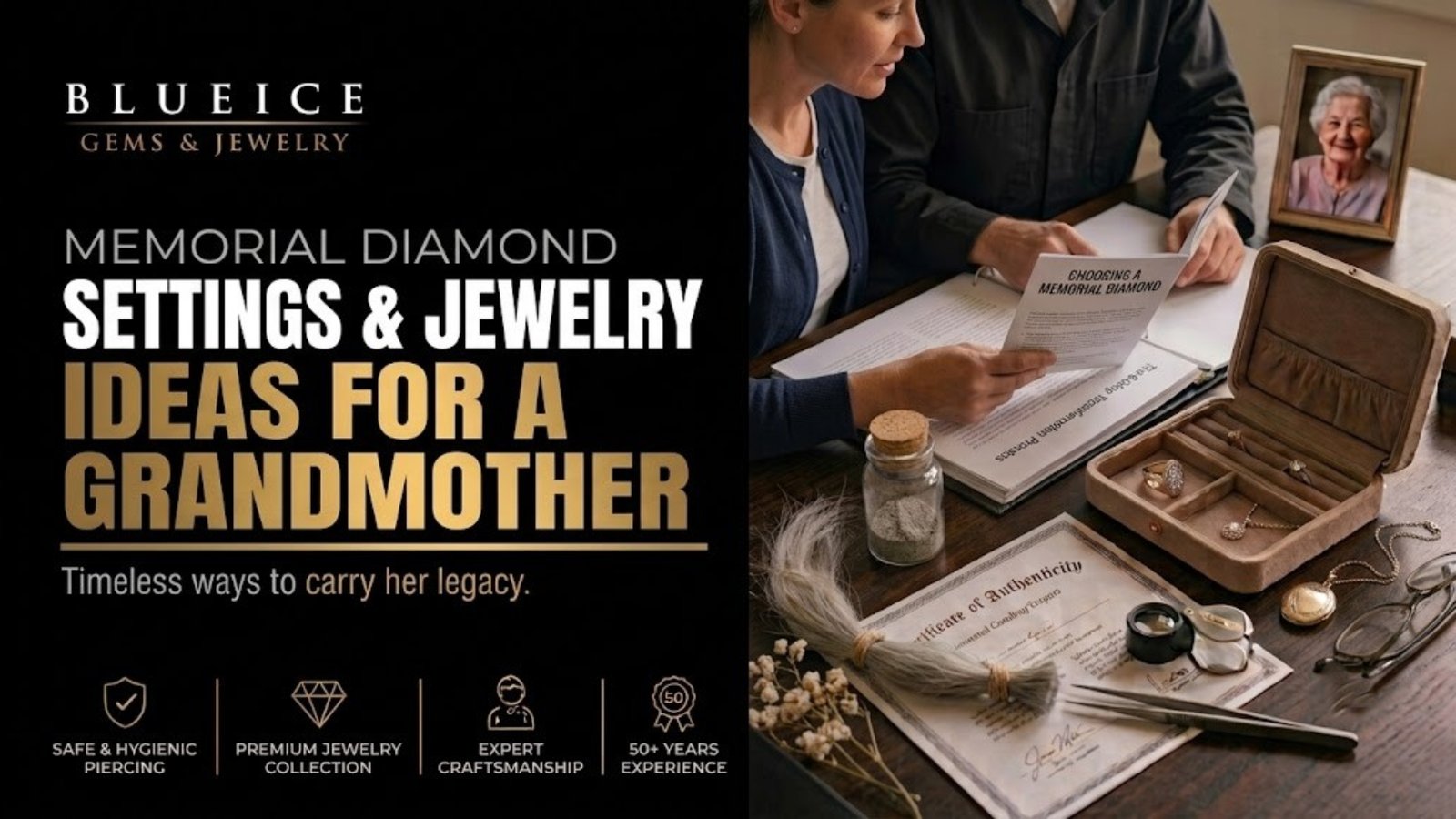
A small diamond grown in part from her carbon still has to live somewhere, on a hand, a chain or in a drawer. Grandmother memorial diamond settings decide how that stone is held, how well it copes with daily wear, and how it looks. Five setting types cover most choices: prong, bezel, halo, flush and tension. Bezel and flush settings tend to protect the stone best, while prongs show the most light.
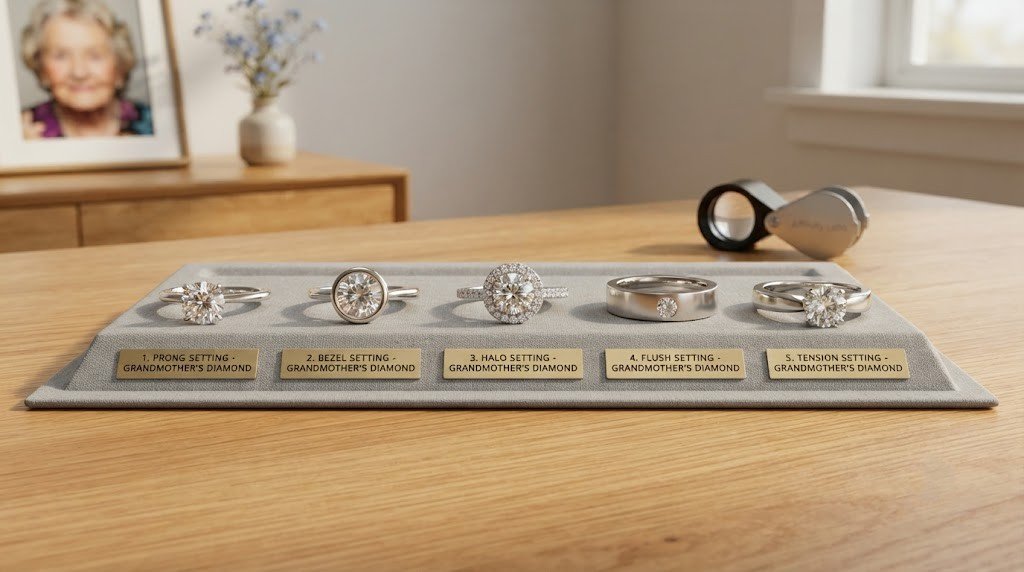
Table of Contents
Why Do Grandmother Memorial Diamond Settings Matter So Much?
In grandmother memorial diamond settings, the metal is the part of the piece that protects the diamond, and it shapes how often the stone can be worn without worry. A memorial diamond is a real lab-grown diamond that is not easily replaced, so the metal around it does real work.
On the Mohs scale of mineral hardness, diamond sits at 10, harder than any other natural mineral. Hardness resists scratching, though, not every kind of impact. A sharp knock at the wrong angle can still chip a diamond, especially at a thin edge or a pointed corner. Good grandmother memorial diamond settings reduce that risk by covering the most exposed parts of the stone.
The setting also decides how the piece feels to wear. A high setting can catch on sweaters and gloves. A low one sits close to the skin and is easier to forget you are wearing. When you compare grandmother memorial diamond settings, think about the wearer’s real day: work with their hands, children, travel, sports or none of these.
It is worth knowing what the stone itself is before choosing grandmother memorial diamond settings around it. Her carbon is extracted, purified and typically blended with supplemental lab carbon before growth.
In a stone made from ashes, her share of the finished mass is usually around 10–15% for ash, with some providers quoting lower or higher. For hair, or a stone grown from ashes and hair together, no finished-stone share is published, so ask the provider for their figure in writing. The complete guide to a grandmother ashes diamond explains the full process from start to finish.
Which Setting Types Hold Up Best for Everyday Wear?
Among grandmother memorial diamond settings, bezel and flush designs usually hold up best for daily wear, because metal surrounds or recesses the stone. Prong, halo and tension settings can all be worn every day too, but they leave more of the stone exposed and benefit from more frequent checks.
The table below compares the five common grandmother memorial diamond settings on protection, light and maintenance. These are general jewelry patterns, so ask a jeweler to confirm how a specific design performs.
| Setting type | How it holds the stone | Protection for daily wear | Light and look | Maintenance note |
|---|---|---|---|---|
| Prong | Small metal claws grip the edge | Moderate; prongs can bend or catch | Most light reaches the stone | Ask the jeweler how often to check prongs |
| Bezel | A thin metal rim wraps the edge | High; the girdle is shielded | Slightly less sparkle, clean modern line | Low; the rim can dent but rarely snags |
| Halo | A ring of smaller stones surrounds the center | Moderate; many small stones to monitor | Makes a small center look larger | Check the small stones as well as the center |
| Flush (gypsy) | Stone sits recessed into the metal surface | Very high; almost nothing exposed | Subtle, low-profile look | Low; mostly cleaning |
| Tension | Pressure from the band holds the stone in a gap | Varies with design and metal | Stone appears to float | Ask whether resizing is possible later |
A short way to think about these five grandmother memorial diamond settings:
- Prong suits someone who wants maximum sparkle and is happy to have the piece checked from time to time.
- Bezel suits an active wearer who wants the stone protected without losing presence.
- Halo suits a small stone that should read larger, if the wearer accepts more parts to care for.
- Flush or gypsy suits a ring or band worn every day where snag-free comfort matters most.
- Tension suits a striking, modern look, with careful questions to the jeweler about durability and resizing.
These styles are not limited to rings. A bezel works well on a pendant or a pair of stud earrings, where it keeps a small stone from catching on hair or scarves. Prongs suit a solitaire pendant that hangs freely and rarely takes a knock.
A flush setting can sit in a cuff, a bar necklace or a signet-style ring worn by anyone. Halos can frame a stone on a brooch or a lapel pin, and tension designs appear in rings and some pendants. Bracelets take more knocks than necklaces, so protective styles tend to suit them better.
The piece itself should follow the wearer, not a rule about who wears what. A pendant may suit someone who works with their hands. A ring may suit someone who wants to see the stone often. Earrings can split two smaller stones between ears or between two relatives.
None of these grandmother memorial diamond settings is the correct one for a grandmother. The right choice depends on who wears it, how and how often. Two cousins could choose completely different grandmother memorial diamond settings for stones grown from the same source, and both would be right.
Which Metals Work for a Memorial Setting?
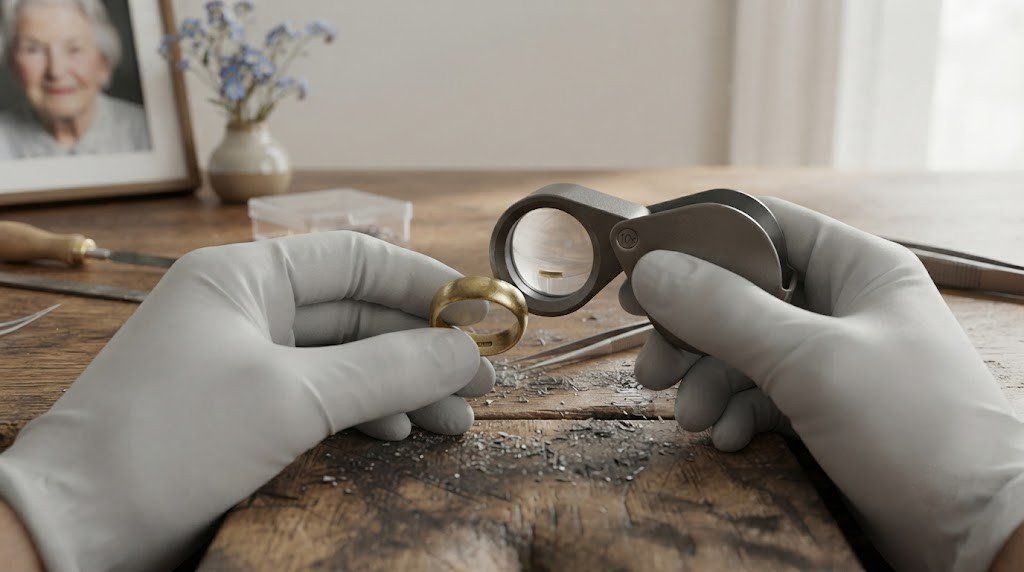
Most fine-jewelry metals work for grandmother memorial diamond settings, and the choice usually comes down to color, durability and budget. Yellow gold, white gold, rose gold and platinum are the common options, and each can hold any of the grandmother memorial diamond settings described here.
At a general level, platinum is dense and wears slowly, which some people like for prongs. Gold is mixed with other metals to make it durable, and its karat affects softness and color. White gold is often plated, and plating can wear over time. Rose gold has a warm tone that some people find flattering with champagne stones. Ask your jeweler to explain these tradeoffs for your exact design rather than relying on general rules, since the same metal can behave differently across grandmother memorial diamond settings of different shapes.
Allergies and skin sensitivity matter too. If the wearer reacts to certain metals, say so before anything is made. A jeweler can suggest alloys or finishes, and that conversation belongs at the start, before any grandmother memorial diamond settings are made, rather than after the piece arrives.
How Should the Setting Match the Stone’s Size and Color?
Good grandmother memorial diamond settings match the scale of the stone and use a metal that flatters its tone. Finished memorial stones usually fall somewhere from roughly a tenth of a carat (0.10 ct) up past 5 ct, and a setting built for one end of that range can look awkward at the other.
Small stones, around 0.10–0.25 carats, can disappear in heavy grandmother memorial diamond settings. A halo, a slim bezel or a delicate pendant bail can give them presence. Larger stones have more surface exposed, so protective grandmother memorial diamond settings such as a bezel may be worth the slight loss of light.
Color matters as much as size. Memorial stones commonly come out yellow, blue or champagne, with colorless available at higher cost and red, pink, green or black possible through optional post-growth treatment. Warmer tones often look rich in yellow or rose gold, and blue or colorless stones can look crisp in white metals, though personal taste should lead. The page on memorial diamond colors for a grandmother explains where each tone comes from and why none can be promised in advance.
A useful habit is to choose grandmother memorial diamond settings after you see the finished stone, or at least to keep the design flexible until then. The same mounting can look very different with a pale yellow stone and a deep blue one.
Can Her Own Ring or Piece Be Reset With the New Stone?
Sometimes, and it is a question for a jeweler who can examine the piece in person. Reworking a ring, pendant or brooch she owned into one of the grandmother memorial diamond settings in this guide can be a meaningful way to bring her jewelry and her memorial stone together, but what is possible varies a great deal.
A jeweler will usually look at the condition of the metal, whether the existing mounting fits the new stone’s size and shape, and whether the change would damage original details. Some older pieces adapt easily to a new stone. Others need a new head or bezel soldered in, and some are too fragile to alter without risk.
If you are considering this route, bring these questions to the jeweler:
- Can this mounting hold a stone of my intended size and shape safely?
- Will the work change or remove any original detail, marks or engraving?
- Can the original stone, if there is one, be kept or set elsewhere?
- What does the work cost, and how long will the piece be with you?
- If the piece cannot be adapted, can a new setting echo its design?
Also think about who holds her jewelry now. A ring that passed to someone else is a family conversation first. If her belongings are still being settled as part of an estate, it can help to wait until that is clear. The guide on talking to family about a grandmother memorial diamond has gentle ways to raise it.
How Can Several Relatives Have Matching or Different Settings?
Several stones can often be grown from one source of her ashes or hair, because only a portion is used for each. That opens the door to grandmother memorial diamond settings chosen for several people at once, either as a matched set or as individual pieces.
Matching grandmother memorial diamond settings can create a quiet connection between cousins, siblings or a parent and child who live far apart. Different settings let each person choose what suits their own life, whether that is a ring, a pendant, a pair of studs or a stone kept in a box. Both approaches honor her equally.
A few practical points help when several relatives are involved:
- Agree on carat size and budget before anyone commits, since larger stones cost more and can take longer.
- Decide whether matching means the same setting, the same metal, or simply the same engraving.
- Ask the provider how multiple stones are tracked and documented, in writing.
- Accept that untreated stones from one source can still differ in tone.
Before anyone chooses grandmother memorial diamond settings, the question of who decides about her remains comes first. Who holds that say depends on the state, since no one nationwide rule settles it. A surviving spouse or partner, if she had one, and her grown children are commonly ahead of grandchildren in that order, and any written wishes she left can shift it.
A grandchild who would like a stone can ask whoever holds that authority for a small portion, or consider hair as another route. A lock you already hold is usually the simpler case, because laws about remains are written with the remains in mind. Even so, her belongings may be counted in her estate, each state sets its own rules, and hair a relative is holding calls for a conversation with them first. The article on sharing a grandmother memorial diamond among family covers this in more depth.
What Can Be Engraved on the Setting?
Most grandmother memorial diamond settings in metal can carry a short engraving, usually inside a ring band or on the back of a pendant. Engraving is typically priced separately, and space limits what fits.
Options might include her name or initials, a date that matters to the family, a short phrase she used, or coordinates of a place connected to her. Some people engrave the same words across grandmother memorial diamond settings made for several relatives, so the pieces are linked even if their designs differ.
Before engraving grandmother memorial diamond settings, ask the jeweler how many characters will fit, which fonts are possible, and whether hand or machine engraving is used. Ask too whether engraving affects resizing later, since cutting a band can interrupt the text. Inscribing the diamond’s own girdle is a separate service from engraving the metal, so ask the provider whether they offer it at all.
How Do You Care for and Inspect a Memorial Setting?
Gentle cleaning at home and periodic checks by a jeweler keep grandmother memorial diamond settings secure. The stone is hard, but the metal holding it wears, and a loose prong or thin bezel is easier to fix before the stone is lost.
At home, warm water, a drop of mild dish soap and a soft brush usually clean grandmother memorial diamond settings well. Avoid harsh chemicals, chlorine and abrasive cleaners, which can affect some metals and finishes. Take rings off for heavy lifting, gardening, cleaning or anything that might strike the stone.
For inspection, ask your jeweler how often they recommend checking the specific grandmother memorial diamond settings you choose. A prong or tension design may warrant more frequent checks than a flush band. Signs to watch between visits include a stone that moves, a prong that catches on fabric, or a change in how the piece sits.
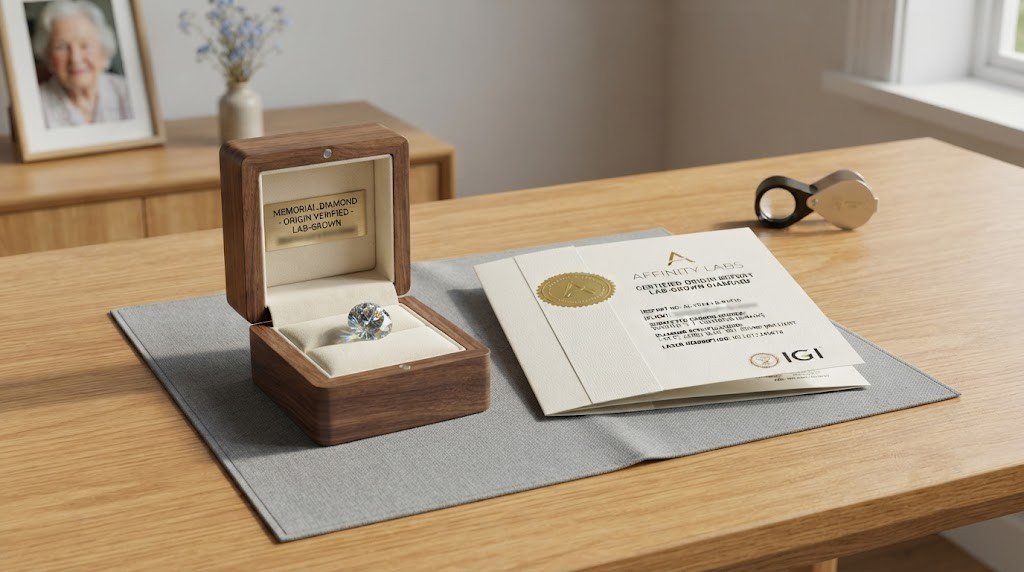
Insurance is a question for an insurance agent, not for a jeweler or provider. Ask an agent whether and how grandmother memorial diamond settings and the stone in them can be covered, what documentation they need, and whether an appraisal or grading report would help. Independent grading, commonly to GIA’s 4Cs standards, describes the stone’s cut, color, clarity and carat, and is different from the in-house origin certificate that records the stone’s link to her material.
Is It Fine to Keep the Stone Loose for Now?
Yes. A loose diamond can usually be set later, even years on, and there is no obligation to choose any of the grandmother memorial diamond settings right away. Keeping the stone loose gives you time to decide what feels right, or to wait for someone who will wear it.
Until you settle on grandmother memorial diamond settings, store the loose stone in a small padded box or pouch on its own, away from other jewelry that could scratch or be scratched. Keep its certificate and any grading report with it, and note where it is kept so others in the family know. A loose stone is small and easy to misplace, so a safe, consistent place matters.
Some people decide they do not need grandmother memorial diamond settings at all and that the loose stone is the memorial in itself, held in the hand rather than worn. Others set it later for a milestone in the family’s life. The ideas collection on grandmother memorial diamond rings, pendants and keepsakes shows wider possibilities, and the questions to ask before turning her hair into a diamond help with the provider side.
Frequently Asked Questions
What is the most protective way to set a memorial diamond in a ring?
A flush or bezel design usually offers the most protection, because metal covers the stone’s edge. Prongs show more light but leave more exposed. Ask a jeweler which design suits the wearer’s daily routine, then follow their advice on inspection.
Can a memorial diamond chip even though it is so hard?
Yes. Diamond rates 10 on the Mohs scale and resists scratching well, but a hard knock at the wrong angle can still chip it. A protective setting and removing the piece for heavy tasks lower that risk.
Does a memorial stone need a special kind of setting?
No. A memorial diamond is a real lab-grown diamond, so any setting designed for diamonds can hold it. Choose based on size, color, wear and taste, and tell the jeweler what the stone means so they handle it with care.
Can I wear a memorial diamond pendant every day?
Often, yes, as pendants take fewer knocks than rings. Check the chain and clasp as well as the setting, and remove it for swimming, sleeping or rough activity if the jeweler advises. Periodic inspection is still worth asking about.
Should every grandchild’s piece use the same metal?
Not necessarily. Some relatives choose one metal to link the pieces, while others pick what suits their own skin tone or wardrobe. An engraving or matching style can connect the set even when metals differ. Agree on the approach before ordering.
Are grandmother memorial diamond settings included in the price of the stone?
Usually not. Across the industry, settings, engraving, fancy cuts and independent grading are typically priced separately from the loose stone. Ask each provider or jeweler for an itemized written quote so you can compare the full cost.
Final Thoughts on Grandmother Memorial Diamond Settings
Grandmother memorial diamond settings are a practical decision that carries a lot of feeling. It is fine to take your time, to try designs on, to keep the stone loose until something feels right, or to change your mind. What matters is that the person who wears it, or keeps it, feels at ease with how her stone is held.
Learn More About Grandmother Memorial Diamonds
- Everything families ask about a grandmother memorial diamond a hub of common questions in one place
- Cost of a grandmother memorial diamond typical industry price ranges and add-ons
- Choosing a memorial diamond for your grandmother where to begin the whole decision
- Grandmother hair diamond: the complete guide the hair-based route from start to finish
Talk With Memorial Diamond
If you are weighing grandmother memorial diamond settings, metals or whether to keep a stone loose for now, the team at Memorial Diamond is happy to talk it through with you. Ask as many questions as you need; there is no deadline for deciding.