
Between the day a small portion of her ashes leaves your hands and the day a finished stone comes back, a great deal happens that most families never get to see. A diamond made from daughter ashes moves through eight laboratory stages, one of them optional: intake and logging, carbon extraction, purification, graphitization, crystal growth, cutting, optional color treatment, and certification before it is returned. Most of that sequence is chemistry and patience, and across the industry it typically fills six to ten months.
This page walks through each stage of a diamond made from daughter ashes in plain language, at whatever pace suits you. Nothing here has to be understood before you begin.
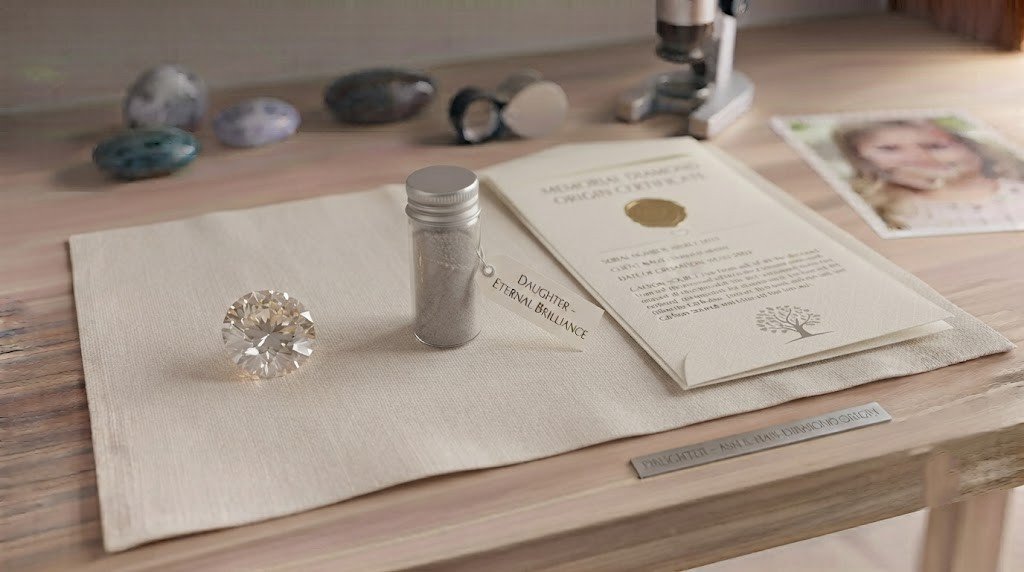
Table of Contents
How Is a Diamond Made From Daughter Ashes, Stage by Stage?
In eight stages, nearly all of them invisible from the outside. Laboratories name the work differently, but the sequence is shared across the industry: from a mineral heavy powder toward a single, ordered crystal.
| Stage | What happens to the material | What it produces | Does it involve you? |
|---|---|---|---|
| 1. Intake and logging | The sealed container is checked against its paperwork and given a unique reference | A tracked submission | Only to confirm it arrived |
| 2. Carbon extraction | Controlled heating without oxygen drives off what is not carbon | A small amount of raw carbon | No |
| 3. Purification | Further processing removes remaining trace minerals | Carbon at roughly 99.9% purity or better | No |
| 4. Graphitization | Heat at roughly 2,500 to 2,700°C reorders the carbon | Graphite feedstock | No |
| 5. Growth | An HPHT press, or less often CVD, builds a crystal on a seed | A rough diamond | No |
| 6. Cutting and polishing | A gemologist studies, cuts and polishes the rough | A finished loose stone | Confirming the shape |
| 7. Optional irradiation | Post growth treatment shifts color, only if chosen | A treated color | Only if you ask for it |
| 8. Certification and return | Origin paperwork is issued; independent grading if requested | The stone and its documents | Deciding on grading |
The combined span for a diamond made from daughter ashes is usually six to ten months from receipt, occasionally twelve for larger stones or specialty colors. For the authorization, collection kit and shipping, the family’s side of turning her ashes into a diamond sets that out separately.
What Are Cremated Remains Actually Made Of?
Mostly bone mineral. By the end of cremation the soft tissue is gone, and what remains is largely calcium phosphate, the hard, pale mineral that gave her skeleton its strength. Grainy and light gray, it is closer to coarse sand than to fireplace ash.
Carbon rides along as a minor part of that mineral. Industry figures place usable carbon around 0.5% to 4% of the ash by weight, shifting from person to person and between crematories. That small proportion is why any stone made from daughter ashes starts from a measured portion rather than a pinch.
The portion requested is itself a small share of what you hold. Across providers it typically runs from a few tablespoons up to around 4 oz, roughly 100 grams, leaving most of her remains for burial, scattering, an urn or whatever else the family has planned. How much ash a daughter memorial diamond needs goes through those quantities in detail.
None of this depends on her age. At whatever age she died, in childhood or well into adult life, the chemistry is the same, and so is the laboratory method.
How Is Her Carbon Separated and Purified?
With heat, in the absence of oxygen, over more than one pass. Without oxygen the carbon cannot burn away as gas, so the laboratory keeps it while calcium phosphate and the other minerals are driven off or separated.
A first pass recovers raw carbon from the mineral bulk, and later passes strip out the remaining traces until the carbon reaches roughly 99.9% purity or better. The precise chemistry differs between laboratories and is often kept proprietary.
What emerges is modest in quantity, and that small amount shapes every stage that follows. For anyone wondering how a diamond made from daughter ashes can contain any of her at all, extraction is the answer: the carbon carried forward is carbon that came from her.
Purity matters because anything carried into the growth of a diamond made from daughter ashes can affect the crystal. It does not, however, make the final color predictable; even very clean carbon can surprise a laboratory.
Why Does the Carbon Become Graphite Before It Becomes Diamond?
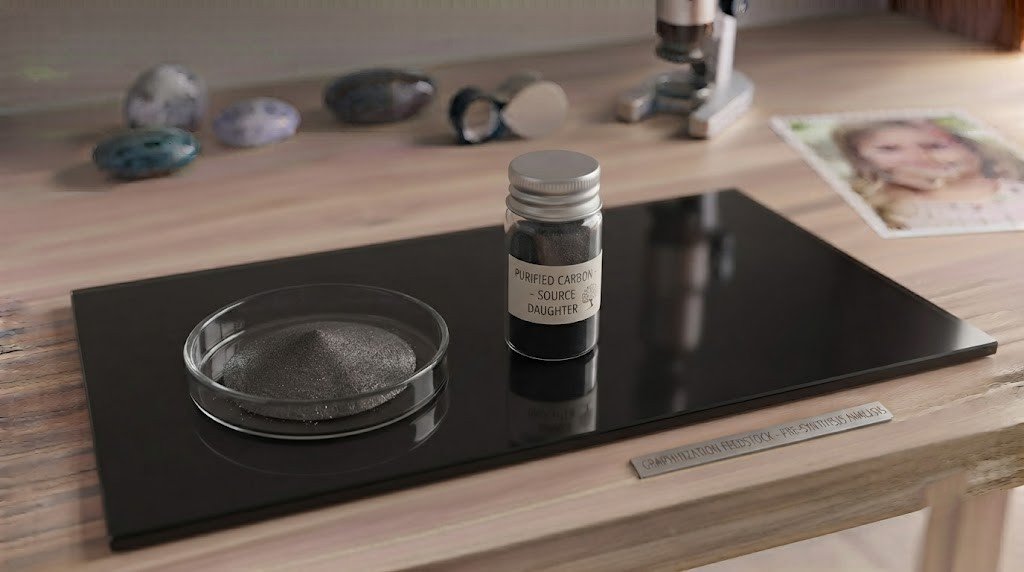
Because a growth press works best with carbon in an ordered, stable form. Purified carbon destined for a stone made from daughter ashes is still a loose, irregular material. Heating it further, to roughly 2,500 to 2,700°C, rearranges its atoms into graphite, the soft, layered form of carbon familiar from pencil lead.
Graphite and diamond are one element arranged two different ways. In graphite the atoms lie in flat sheets that slide easily over each other; in diamond every atom is locked to four neighbors in a rigid three dimensional lattice.
For a family, graphitization is mainly a milestone: her carbon has been recovered, cleaned and prepared, but no crystal has begun to form. If a provider offers progress updates, this is a natural stage to ask about.
How Does the Crystal Actually Grow?
Under immense pressure and heat, around a tiny diamond seed. Most laboratories growing a diamond made from daughter ashes use HPHT, short for high pressure, high temperature: the graphite is sealed into a growth cell with a seed crystal and held at roughly 6 to 8 GPa and 1,400 to 2,500°C, recreating conditions far below the surface where natural diamonds took shape.
Over weeks to months, carbon dissolves and settles onto the seed, and the crystal slowly thickens. A minority of providers use CVD, chemical vapor deposition, in which a carbon bearing gas such as methane deposits crystal onto a seed plate inside a vacuum chamber. Both are established methods of growing synthetic diamond, and either can yield a genuine diamond made from daughter ashes rather than a lookalike.
The most misunderstood fact here is what controls size. Carat weight is set by how long the crystal stays in growth, not by how much ash was sent; a full urn would not produce a bigger stone or a faster one. Carat is a choice the family makes near the beginning, and it largely decides how long the press runs.
Stones made from daughter ashes are generally offered from about a tenth of a carat to more than five, and the upper end is where timelines stretch toward a year. Clarity is shaped here too, usually landing between SI2 and VVS.
How Much of a Stone Made From Daughter Ashes Is Really Hers?
A real portion, though not the whole. On the ash route, the carbon recovered from her remains usually accounts for about 10 to 15% of what the finished diamond weighs, with a few providers citing as little as 3%. The share moves with stone size and with how much ash was submitted.
The balance is supplemental carbon, prepared in the laboratory and blended with hers before growth. The reason is arithmetic: with usable carbon at a few percent of the ash by weight, a few tablespoons cannot supply enough to grow a stone of meaningful size alone.
That can be hard to read, but the honest version still means something. Her carbon is not set beside the diamond or sealed inside a cavity; it becomes part of the crystal lattice itself, her atoms bonded among the others. A stone made from daughter ashes this way is not a symbol standing in for her. It is, in part, physically made from her.
Any claim that a diamond made from daughter ashes is 100% pure ash describes something the physics does not support. Whether a memorial diamond is really made from her ashes takes up that question from the skeptic’s side, including what records can evidence it.
Questions worth putting to any provider in writing:
- What share of the finished stone is expected to be her carbon, at the size you want
- Whether that share is an estimate or is measured for each stone
- What happens to leftover ash or unused extracted carbon
- Whether a second stone can be grown from the same submission
What Happens After the Rough Crystal Leaves the Press?
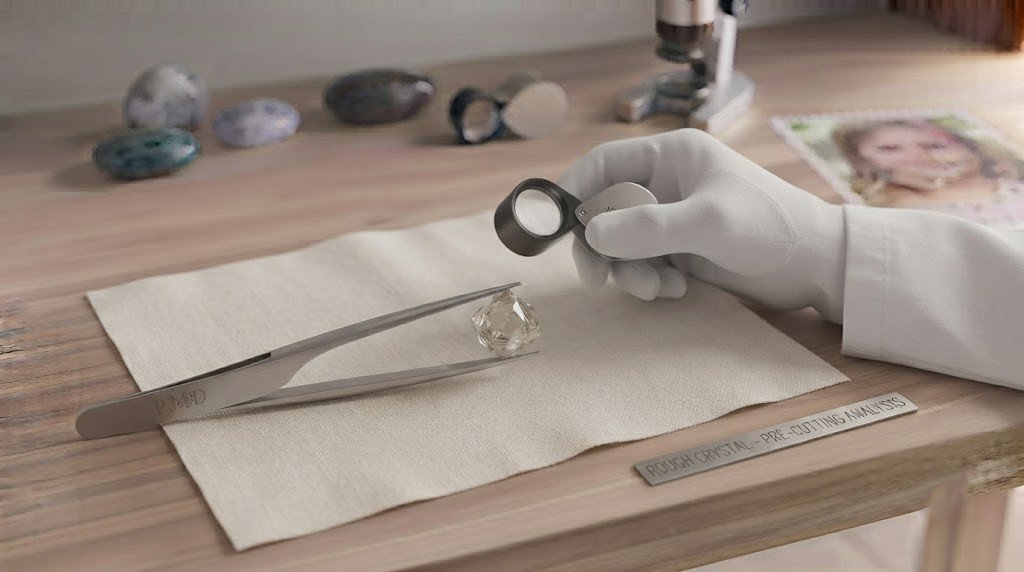
Cutting comes first, then an optional color treatment, then the paperwork. A rough crystal made from daughter ashes looks nothing like jewelry when it leaves growth; a gemologist has to study it before deciding how best to cut it.
Cutting and polishing turn that rough into a recognizable shape: round, princess, cushion, oval, emerald or any other diamond shape. Some weight is always lost, and the rough occasionally suits a different shape than the one requested. A careful provider will tell you rather than proceeding quietly.
Color, meanwhile, was mostly settled during growth. Trace nitrogen draws a diamond toward yellow, trace boron toward blue, and a colorless result depends on keeping both out, which tends to add processing and cost. Because this carbon began as organic material rather than a controlled feedstock, warm yellow, champagne and blue tones are common in stones made from daughter ashes. What color a diamond grown from her ashes might be explores why.
Irradiation is the optional part. After growth, some providers offer a treatment that shifts or deepens color toward red, pink, green or black. It is an add on rather than a stage every stone passes through, and many families keep whatever color their diamond made from daughter ashes grew on its own. If a color matters, let it be one that meant something to her or to you.
Grading Report or Origin Certificate: What Is the Difference?
They answer two separate questions. An origin or authenticity certificate, usually issued in house by the provider, states that this particular stone was grown from the carbon in your submission. It is, in effect, the closing page of the chain of custody.
A grading report describes the stone’s quality: its cut, color, clarity and carat weight, measured against the same quality factors used for any diamond. Independent grading of a stone made from daughter ashes by a third party gemological laboratory is optional across this industry and normally priced as an extra. Some families value that outside view; others feel the origin document is the only paper that matters.
For a diamond made from daughter ashes, the two documents do complementary jobs. The certificate speaks to where the stone came from; the grading report, if you choose one, speaks to what the stone is.
How Is Her Carbon Tracked From One Stage to the Next?
Through paperwork and reference numbers that stay with the material at every handoff. Chain of custody is the record of which container arrived, when, who handled it, and which batch of carbon entered which growth cell. Without it, nothing links the finished stone to your submission, and any claim that the stone was made from daughter ashes at all rests on trust alone.
For a diamond made from daughter ashes, a sound tracking process tends to include:
- Logging the submission on arrival and confirming receipt to the family
- Keeping each family’s material physically separate throughout
- Assigning a reference that follows the carbon through extraction, graphitization and growth
- Tying the final origin certificate back to that same reference
Ask how a provider handles each, and expect specific answers in writing.
This is also the moment to ask what is not used. Extraction rarely consumes every grain of a submission, and policies differ: some providers return remaining ash, others handle it another way. Knowing before you ship is kinder than wondering afterward. Each step of turning her ashes into a diamond places this in the full sequence.
How Long Does a Diamond Made From Daughter Ashes Take, and What Drives Cost?
Six to ten months is typical across the industry, counted from the day material is received; larger stones and specialty colors can run to twelve. Nearly all of that is growth time, with the chemical stages and the finishing work brief beside it.
Cost follows the stone you choose, not the ash you send. As general 2026 industry ranges rather than any one company’s prices:
- About 0.10 to 0.25 carat: roughly $1,500 to $3,500
- Half a carat to a full carat: roughly $5,000 to $15,000
- Two carats and above: roughly $20,000 to $75,000 or more
- Colorless: usually costs more than yellow, champagne or blue at the same size
- Extras: such as independent grading, engraving, fancy cuts, settings and, where offered, irradiation are typically priced apart from the stone
For a diamond made from daughter ashes, the decisions that move price and timeline alike are carat, color and cut. The quantity of ash moves neither one.
What Has to Happen Before Anything Reaches a Laboratory?
Two things no laboratory can do for you: confirming who may authorize release of her remains, and preparing the portion that is sent.
Authority is the one to settle first. Each state sets its own order of priority, with no national standard. A spouse or partner she leaves behind, or grown children of hers, may come before her parents in that order, and written wishes of hers, such as a directive, a clause in a will or a funeral pre arrangement, can override the default. A parent arranging a diamond made from daughter ashes is not automatically the person who signs. The funeral home or an attorney can confirm the local rule.
Families arrive at this differently, too. Parents do not always agree, and one parent handling everything alone is common. None of that changes the laboratory side once the right authorization is in place. The complete guide to a daughter ashes diamond covers those decisions alongside cost, color and settings.
Frequently Asked Questions
Can the laboratory tell her carbon apart from the added carbon?
Not once they are blended and grown into one crystal, because carbon atoms are chemically identical wherever they came from. What shows her carbon is present is the chain of custody record, which follows her material from arrival through extraction, graphitization and growth. That is why it is reasonable to ask exactly how a provider keeps each submission separate.
Does it matter how long ago she was cremated?
Generally not. Cremated remains are a stable mineral material, so ashes kept for years can usually still yield carbon for a diamond made from daughter ashes. How they were stored can matter more than when, so describe the container and storage conditions when you first contact a provider and let the laboratory judge whether anything affects extraction.
Is a diamond made from daughter ashes a real diamond?
Yes. HPHT and CVD both produce genuine diamond with the same crystal structure, hardness and optical properties as a mined stone. It can be graded on the same cut, color, clarity and carat scales and rates 10 on the Mohs hardness scale. What makes it a memorial stone is the origin of part of its carbon, not any difference in the material.
Can more than one stone come from the same ashes?
Often, yes. Because only a portion of her remains is used, parents, siblings or her own children may each be able to receive a stone. Each diamond made from daughter ashes goes through growth separately, with its own timeline and its own price. Ask whether a single submission can supply several stones or whether each one needs its own measured portion.
Why does the laboratory side take so many months?
For a stone made from daughter ashes, almost all of the time is crystal growth. Extraction, purification and graphitization are comparatively short, but building a diamond layer by layer under high pressure is slow, and larger carats need longer in the press. Across the industry, six to ten months from receipt is typical, and larger or specialty color stones can take up to twelve.
Will I see the stone at any point before it is finished?
That depends on the provider. Some share photographs of a rough crystal made from daughter ashes before cutting or send updates at milestones such as graphitization, while others communicate mainly at the end. If following the progress matters to you, raise it before sending anything, and ask for the update schedule in writing.
Final Thoughts on How Her Ashes Become a Diamond
Laid out stage by stage, the way a diamond is made from daughter ashes is less mysterious than it first appears. Her ashes are mostly bone mineral; a small share of carbon is drawn out, cleaned, reshaped into graphite, grown into a crystal, then cut and documented.
Knowing why each stage exists will not shorten the wait, but it can sharpen the questions. Ask what share of a stone made from daughter ashes will be hers, how her material is tracked, what happens to whatever is not used, and which optional steps really are optional. The answers tell you a good deal about who you are trusting with her.
Learn More About Daughter Memorial Diamonds
- Everything about a daughter ashes diamond, in one guide
- The family’s side of turning her ashes into a diamond
- Whether a memorial diamond is really made from her ashes
- Each step of turning her ashes into a diamond
- What color a diamond grown from her ashes might be
Talk With Memorial Diamond
If you would rather talk any of these stages through with a person, Memorial Diamond can be reached at memorialdiamond.us. Ask whatever you need to about how a diamond made from daughter ashes is handled, documented and returned. There is no obligation in asking.
Leave A Comment