
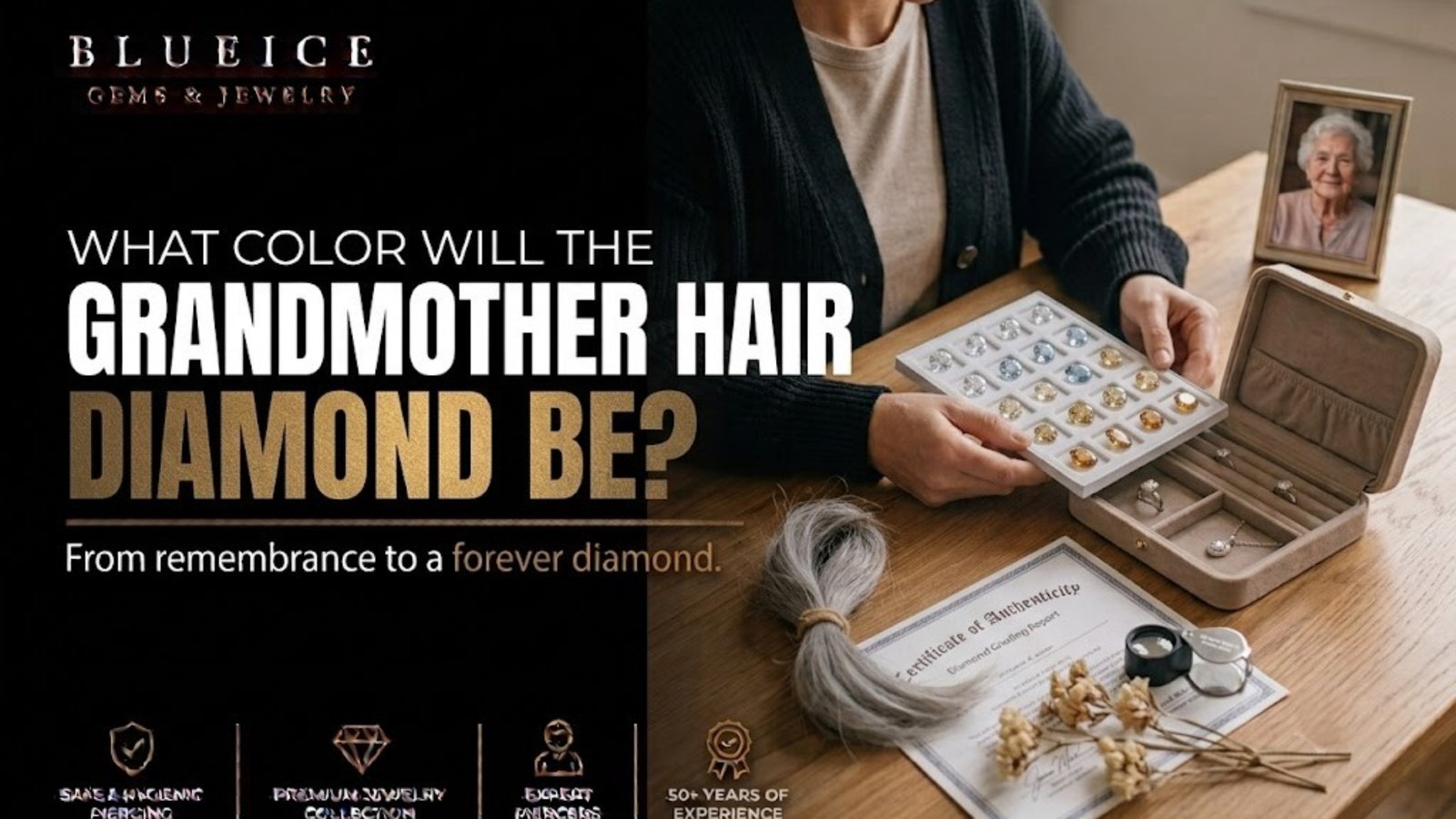
Maybe it is a lock tucked into an envelope, or strands someone thought to save from her brush, and now you are wondering what it could become. The grandmother hair diamond color you are most likely to see is a yellow, blue, or champagne-to-brown tone, and the exact shade is not known until the stone is grown. Hair is rich in carbon, but trace elements still steer the hue, so hair does not give a lighter or more predictable stone than ashes. Colorless and treated shades are available from some providers.
Nothing here requires a decision today. The sections that follow each answer one part of the grandmother hair diamond color question, from chemistry to cost to who should be consulted about using her hair.
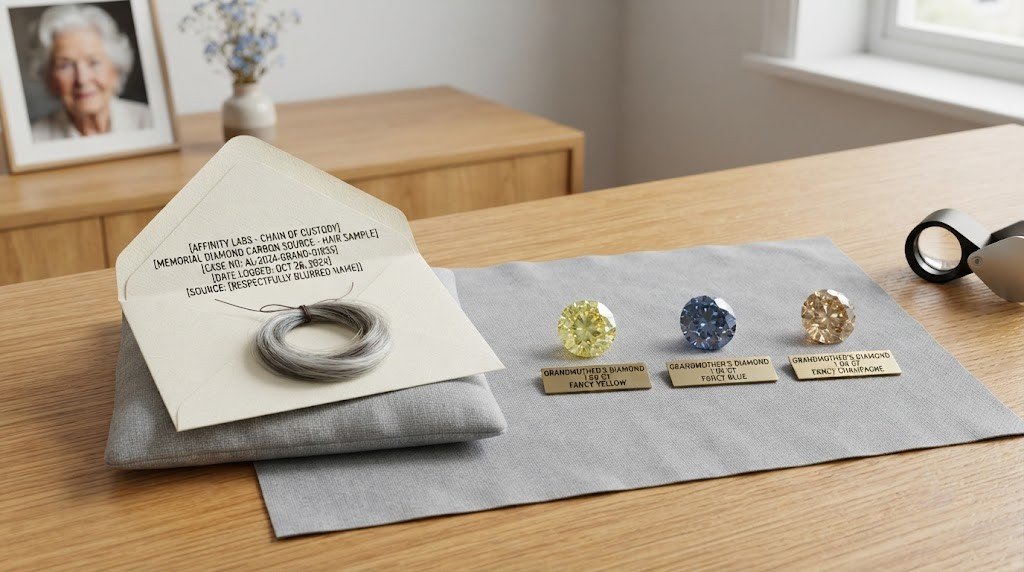
Table of Contents
Does hair make grandmother hair diamond color lighter or more predictable?
No. Hair is built mostly from keratin, a protein that is about 50% carbon by weight, which is why only a small lock or a few grams is usually needed and why no cremation is involved. That high carbon share is a practical advantage; it gives grandmother hair diamond color no head start.
Grandmother hair diamond color still depends on which trace elements end up inside the crystal as it grows. Nitrogen gives yellow tones and boron gives blue tones; a stone free of both shows no body color. Recovered carbon is purified to roughly 99.9% or higher, yet a personal, organic source still tends to produce tinted stones, so yellow, blue, and champagne results are typical.
How much of the finished stone is her carbon?
For hair, no industry-wide figure for the share of personal carbon in the finished stone has been published. Providers typically blend recovered carbon with supplemental lab carbon to grow a stone of useful size, and the blend varies. Ask each provider to state in writing roughly what share of your stone will come from her hair and how they arrive at that figure. The post on whether a memorial diamond is really made from her hair looks at that question closely.
The explanation of how a memorial diamond is made from her hair covers extraction, graphitization, and growth in more detail, which helps show where grandmother hair diamond color is actually set.
What if her hair was gray, dyed, permed, or chemically treated?
Hair that had gone gray or turned white, hair she colored for years, or hair that was permed or relaxed: families ask about all of it. No claim can fairly be made here that any of these changes grandmother hair diamond color, and you should be wary of anyone who says otherwise without explaining why.
Whether dyed or chemically treated hair is accepted at all is a separate question from grandmother hair diamond color, and each provider answers it for itself. Some may have preferences about how recent the hair is or how it was stored. Ask before you send anything.
A practical approach if you have several samples
If the family kept more than one lock, perhaps one from years back and one more recent, describe both to the provider and ask which they would prefer to work with and why. Ask, too, whether they expect the choice to affect grandmother hair diamond color in any way, and listen for a reasoned answer rather than a promise. Their answer will tell you a fair amount about how carefully they handle the material.
Which shades does grandmother hair diamond color usually fall into?
Five broad outcomes cover nearly every grandmother hair diamond color you will see quoted. Three of them are natural results of growth, one comes from controlled processing, and one comes from treatment after the crystal is finished.
| Shade | Source of the tint | Natural or treated | Question to put to the provider |
|---|---|---|---|
| Yellow | Nitrogen in the crystal lattice | Natural | How often do your hair-grown stones come out yellow? |
| Blue | Boron in the crystal lattice | Natural | Can you show finished blue examples grown from hair? |
| Champagne to brown | A warm tone common with organic sources | Natural | How do you describe this tone on paperwork? |
| Colorless | Nitrogen and boron excluded during growth | Natural, extra processing | What does colorless add to price and time? |
| Red, pink, green, or black | Post-growth irradiation | Treated | Which treated shades do you offer, and how are they disclosed? |
Whichever of the three natural shades appears, that grandmother hair diamond color is an ordinary result, not a defect. None of them can be selected in advance with certainty, since the source material is organic and every growth run is separate.
How will a report describe grandmother hair diamond color?
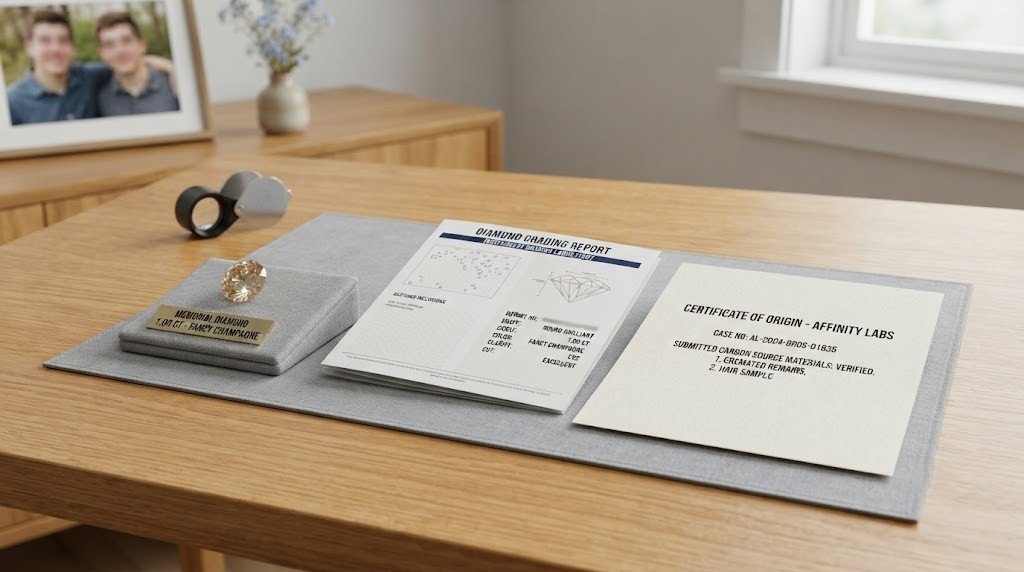
A stone grown from her hair may come with two kinds of paperwork, and only one of them records grandmother hair diamond color. An authenticity or origin certificate, usually issued by the provider itself, records chain of custody and ties the finished stone to the hair your family sent. A grading report is different: it assesses cut, color, clarity, and carat, the same four Cs used for any diamond.
The most trusted grading reports come from an independent third-party lab, typically one working to GIA standards, with IGI used by some. Independent grading is usually an optional purchase rather than part of the base price. For a primer on what each grade means, the GIA guide to how diamond quality is judged is a reliable place to start.
Reading the color entry
As a general gemology convention, white and near-white stones receive a letter grade, while tinted stones are described by hue and depth with terms along the lines of “fancy yellow” or “fancy light blue.” A treated grandmother hair diamond color is usually flagged as treated by independent labs. Ask the provider for a sample report so the wording does not surprise you later.
Clarity for memorial diamonds usually falls somewhere between SI2 and VVS, and it appears on the same document as grandmother hair diamond color. If independent grading matters to your family, raise it when you request a quote, not after the stone is finished.
Does grandmother hair diamond color change what you pay?
It does, though carat weight moves the price far more than grandmother hair diamond color does. The figures below are broad 2026 ranges seen across the industry; they are not Memorial Diamond’s prices, which have not been published.
- About 0.10 to 0.25 carat: roughly $1,500 to $3,500, with natural tones generally toward the lower side.
- 0.5 to 1 carat: roughly $5,000 to $15,000; at this size a colorless stone costs meaningfully more than a yellow, blue, or champagne one.
- 2 to 5 carats and above: roughly $20,000 to $75,000 or more, with longer growth and further cost for colorless or treated shades.
Several items tend to sit outside those numbers: a separate grading report, engraving, a fancy cut, and the ring, pendant, or earrings that hold the stone. When grandmother hair diamond color is tied to your budget, request one quote for a natural tone and one for colorless at the same carat weight and compare them line by line.
What does a colorless stone from her hair involve?
Colorless is an achievable grandmother hair diamond color. The provider has to keep both nitrogen and boron out of the lattice during growth, which calls for added processing and tighter control. That extra effort is the main reason colorless typically costs more at the same size.
People settle on colorless as the grandmother hair diamond color they want for many reasons. It might sit beside a wedding band already worn every day, or the wearer may simply like a bright white stone. Others prefer to let the natural tint stand. Both are reasonable, and neither honors her more than the other.
Before committing to colorless, ask whether the provider offers it for hair-grown stones, how they handle a run that ends up with a visible tint, and whether that outcome changes the price. Those answers are set by each company, so get them in writing.
Which irradiated colors do some providers offer?
Irradiation is a treatment some providers apply after growth to shift or intensify grandmother hair diamond color. Red, pink, green, and black are the usual results. The stone remains a real diamond, with the same hardness of 10 on the Mohs scale of mineral hardness, because the treatment changes how the crystal absorbs light rather than covering it.
Availability varies widely. One provider may offer all four treated shades, another only one or two, and some none at all. A specialty grandmother hair diamond color, such as black, can also stretch the timeline toward the upper end of the range.
If a treated shade appeals, ask how it is described on any grading report, what it adds to the cost, and whether the provider considers the color stable in everyday wear.
How should the wearer’s taste shape grandmother hair diamond color?
The stone will be worn by someone in particular: you, a parent, an aunt, a sibling, a cousin. Their everyday style matters as much as anything about her. A person who wears mostly silver might lean toward colorless or blue; someone who favors warm gold might like how champagne looks against it.
Meaning can come from her side as well, as long as it comes from who she really was. If she spent her working life outdoors, a natural tone might feel right. If she had a favorite color she wore without fail, that may tip a family toward a particular treated shade. These links belong to your memories, not to any idea of what grandmothers are supposed to like.
Some families decide to accept whatever grandmother hair diamond color the growth produces and find the meaning afterward. Others choose a controlled option from the start. A stone handed down a generation later carries its story either way, and that story does not depend on the shade.
Do carat weight and shape change how the tint looks?
Generally, yes, although carat and shape change how grandmother hair diamond color looks rather than what it is. In a larger stone, light travels farther through the crystal, so a tint of the same chemistry can appear more saturated. Memorial diamonds are commonly offered from about 0.10 carat up past 5 carats, a span wide enough that the same tone can look quite different at each end.
Shape matters too. Round brilliants and other brilliant-style cuts break light into sparkle that can mute a faint tint, while step cuts such as emerald or asscher can display body color more openly. The metal around the stone adds its own cast, cooler with platinum or white gold and warmer with yellow or rose gold.
When grandmother hair diamond color is a priority, ask the provider for photos of finished stones in a few shapes and metals. Seeing the options side by side is easier than imagining them.
How long does it take, and how much of her hair is needed?

Industry-wide, the full process usually runs about 6 to 10 months after the provider receives the hair. Stones larger than about 2 carats, and specialty-color stones, can take up to roughly 12 months. Carat size is set mainly by growth time in the press rather than by how much material is supplied.
Because hair is so carbon-rich, the usual request is a small lock or a few grams. Sending more will not deepen or lighten grandmother hair diamond color, and it will not make the stone larger or faster. It can sometimes allow more than one stone, which matters when several relatives each hope for one; confirm that with the provider.
The guide to how much hair a grandmother memorial diamond needs goes further into quantities, storage, and what to do if only a small amount survives. What happens to any hair that is not used is a provider decision, so ask how it is tracked and whether it is returned.
Who should be asked before her hair is used?
Hair kept at home is usually a simpler practical matter than ashes, since nothing has to be released by a crematory. Still, personal possessions may count toward what she left behind, and each state handles estates its own way. If someone is acting as executor or settling her affairs, a short conversation with them first is sensible.
Family feelings matter as much as the grandmother hair diamond color itself. An aunt or uncle may have kept her hairbrush, a cousin may already have a lock, and her surviving spouse or partner, if there is one, may have views of their own. Talking openly before choosing a grandmother hair diamond color keeps the stone from becoming a point of friction later.
When faith is part of the picture
No religious tradition has issued a position on memorial diamonds as such; teaching addresses cremation and the handling of remains. A hair-grown stone involves no cremation, which matters where the concern is cremation itself: major schools of Islamic thought consider cremation impermissible, for instance, and a stone from hair never touches that question. Her clergy or community is still the right place to ask.
For the full family and practical picture, the complete guide to a grandmother hair diamond brings these threads together.
What should you ask a provider about grandmother hair diamond color?
A short written list makes conversations about grandmother hair diamond color easier to compare across providers. These questions cover the points that are decided company by company:
- Which natural tones do your hair-grown stones most often come out in?
- Do you accept dyed, permed, or chemically treated hair, and does that affect your process?
- Do you offer colorless for stones grown from hair, and at what price difference?
- Which irradiated shades do you offer, and how are they disclosed?
- Roughly what share of the finished stone will be carbon from her hair?
- Is independent grading included, or is it a separate add-on?
- What happens if the result differs from the color we hoped for?
Keep every answer in writing alongside the quote. If you want to see how the whole journey unfolds, the overview of how to turn your grandmother’s hair into a diamond sets the questions in order. Families weighing the other route can compare with what color a stone from her ashes tends to be, which follows the same chemistry.
Frequently Asked Questions
Will her gray hair produce a white diamond?
Not necessarily. No published evidence links the color of someone’s hair to the color of the diamond grown from it. Grandmother hair diamond color depends on trace elements such as nitrogen and boron and on the provider’s process. A white stone requires the colorless option.
Can a lock of her hair from decades ago still be used?
That depends on the company and on how the hair was kept. Describe its age and storage honestly, ask in writing whether it is suitable, and ask whether its age could affect yield, timing, or the finished stone.
Would hair from her and hair from a grandchild give different colors?
There is no basis for predicting that. Each stone’s color comes from what enters the lattice during its own growth run and from processing choices. Two stones from the same person’s hair can differ too, so treat any prediction like that cautiously.
Is it possible to have two stones in different colors from one lock?
Sometimes. If the lock holds enough carbon for two stones, a provider may grow one as a natural tone and one colorless, or treat one after growth. Whether that is offered, and at what cost, varies, so ask directly.
If grandmother hair diamond color comes out blue, is the stone lower quality?
No. Blue comes from boron in the lattice, and a blue stone is graded on cut, color, clarity, and carat like any other diamond. Color is a description of the stone, not a measure of its worth or of how it was made.
Can grandmother hair diamond color be changed after the stone arrives?
Some providers offer post-growth irradiation, which shifts color, but whether a finished stone can be sent back for treatment is a provider decision. Ask about it before ordering, since changing course afterward may add cost and time.
Final Thoughts on the Color of Her Hair Diamond
Grandmother hair diamond color will most likely be a soft yellow, blue, or champagne tone, and the exact hue will be a discovery rather than a choice. Hair makes the process practical with very little material, but it does not make the color any more certain.
What you can control is the conversation: what to ask, what to put in writing, and who to include. The color can be left to the crystal.
Learn More About Color and Her Hair
- Grandmother Hair Diamond: The Complete Guide — everything from family conversations to the finished stone
- Is a Memorial Diamond Really Made From Your Grandmother’s Hair? — how much of the stone is her carbon
- What Color Will a Diamond Made From Your Grandmother’s Ashes and Hair Be? — color when both sources are combined
- How Much Hair Do You Need for a Grandmother Memorial Diamond? — quantities and storage
Talk With Memorial Diamond
Whenever you are ready to talk about her hair, the colors that might come from it, or how to raise the idea with family, Memorial Diamond is here to listen and answer what we can. Take your time; there is nothing to decide in one conversation.
Reach out through memorialdiamond.us at whatever pace suits you.
Leave A Comment