
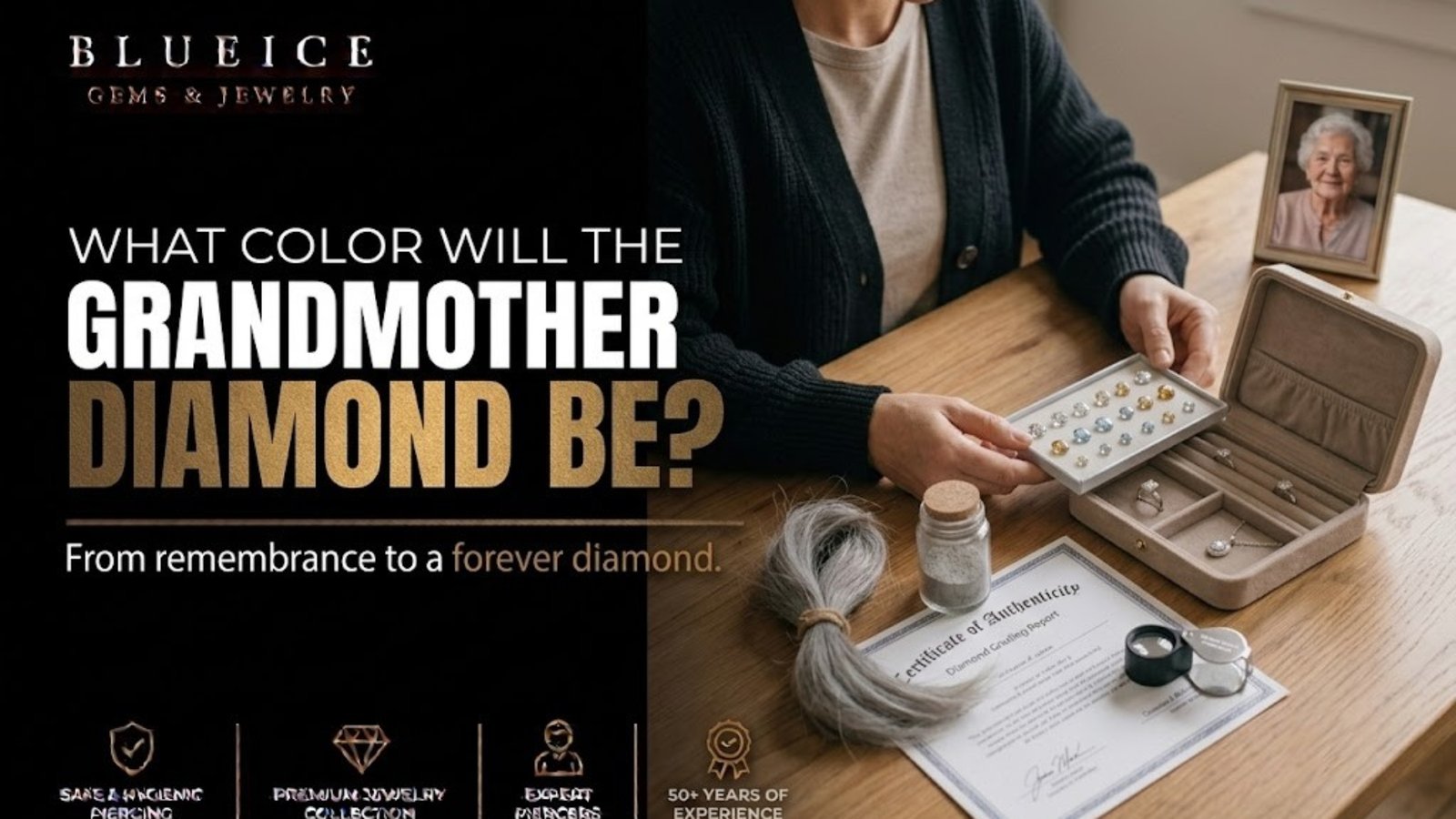
Maybe a small envelope of her hair has been tucked beside her urn for a while, and now you are picturing what a stone grown from both might look like. If you are wondering about grandmother ashes hair diamond color, the plain answer is that the stone will most likely settle into a yellow, blue or champagne-brown tone, and no provider can predict the exact shade ahead of time. Combining her ashes with her hair does not make the stone lighter or more predictable, and a colorless result is possible only with extra processing that typically costs more.
What follows explains where grandmother ashes hair diamond color comes from, what you can ask for, and how color moves the price. Where the answer depends on a particular company, it is framed as a question to put to that company in writing.
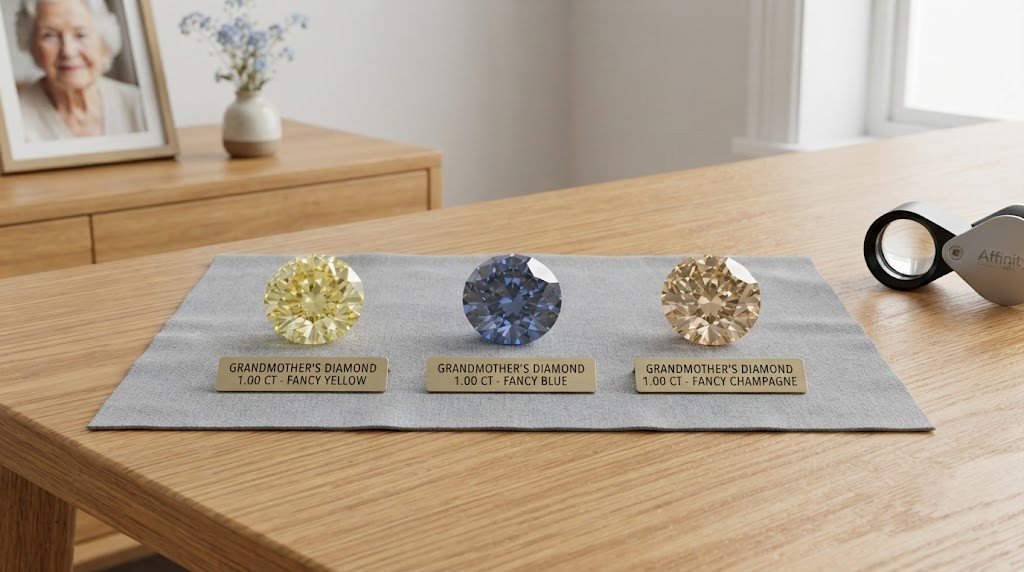
Table of Contents
What Grandmother Ashes Hair Diamond Color Should You Expect?
Memorial diamonds as a group lean toward three families of tone: yellow, blue, and champagne or brown. A stone that draws on both her ashes and her hair follows the same pattern, because grandmother ashes hair diamond color is shaped by the same chemistry as every other lab-grown memorial stone.
Inside each family the shade can run from faint to deep, from pale straw to a fuller gold, or from barely tinted to clearly sky-blue. Where yours lands cannot be promised, and a provider worth trusting will say so plainly instead of showing a single sample photo as though it were a forecast of your grandmother ashes hair diamond color.
| Color outcome | What usually causes it | How it is reached | Cost compared with other colors at the same size |
|---|---|---|---|
| Yellow | Nitrogen present during growth | Arises on its own during growth | Typically below colorless |
| Blue | Boron present during growth | Arises on its own during growth | Typically below colorless |
| Champagne or brown | Trace elements common in an organic carbon source | Arises on its own during growth | Typically below colorless |
| Colorless (white) | Nitrogen and boron both kept out | Extra processing to exclude trace elements | Typically meaningfully higher |
| Red, pink, green or black | Post-growth treatment | Irradiation, offered by some providers only | Set by each provider; may lengthen the timeline |
Read the table as a map of possibilities rather than a menu. The first three rows happen without intervention; the last two are outcomes a provider works toward on purpose. Talking through grandmother ashes hair diamond color with relatives or a provider goes more smoothly when everyone starts from that distinction.
Why Do Trace Elements Decide the Color, Not the Material?
Diamond is carbon locked into a tight crystal lattice, and carbon with nothing else in it grows colorless. Color appears when other atoms slip into that lattice while the crystal forms. Nitrogen gives yellow tones, boron gives blue, and a colorless stone needs both kept out of the growth environment.
Before any of that happens, the carbon recovered from her ashes and her hair goes through an oxygen-free, multi-stage purification that brings it to roughly 99.9% carbon or higher. It is then converted to graphite at about 2,500–2,700°C. So the stone is not tinted by ash minerals or by hair pigment in any direct way. Trace elements are common when carbon comes from an organic, personal source, which is why memorial diamonds lean toward these tones. Beyond that, grandmother ashes hair diamond color depends on which trace elements end up in the growth cell and how the press is run, and those conditions sit with the provider’s process.
Where her carbon fits in the finished stone
The purified carbon is typically blended with supplemental lab carbon so there is enough volume to grow a stone of useful size. Industry figures for ash-only stones put her personal carbon at roughly 10–15% of the finished stone’s mass; a few providers cite 3%, and some cite more. For hair, and for stones that combine ashes and hair, no comparable finished-stone figure has been published, so ask each provider to state its own number in writing. If that question weighs on you, read about whether the stone genuinely holds carbon from her ashes and hair.
The growth science is the same across the industry, and the general background on how lab-grown diamonds form under heat and pressure is a useful primer. HPHT presses, the method most memorial providers use, run at about 6–8 GPa and 1,400–2,500°C and need weeks to months to grow a crystal, while a minority of providers use CVD. Neither method changes what to expect for grandmother ashes hair diamond color: yellow, blue and champagne remain the common outcomes.
Does Combining Her Ashes and Hair Change the Color?
No. Some families hope that adding hair will “clean up” the color, and others worry that ash will darken it. Neither idea holds. Putting the two materials together does not make the stone lighter, and it does not make grandmother ashes hair diamond color any easier to predict. No published evidence shows one material steering the result more than the other, so treat a claim in either direction with caution and ask the person making it where it comes from.
The reason is the purification step. By the time carbon from either source reaches the press, it has been stripped down to carbon. Put simply, grandmother ashes hair diamond color is settled during growth, not by which envelope the carbon came out of.
Is the shade of her hair a preview of the stone?
It is not. Whatever shade her hair was near the end, and whether it had been colored, permed or cut short, it does not work as a preview of the finished stone. Predicting grandmother ashes hair diamond color from a lock of hair simply does not work.
A separate, practical question is whether a provider will accept hair that was dyed or chemically treated at all. Policies differ, so ask before you send anything, and keep a small reserve of hair back in case a second sample is requested.
Will a Provider Combine Both Materials or Grow Two Stones?
That depends entirely on the company. Some may merge carbon from her ashes and her hair into a single growth run. Others may prefer to keep the two sources apart and grow one stone from each. There is no single industry practice to point to, so this is the first thing to ask about grandmother ashes hair diamond color when both materials are on the table.
If two stones are grown, each growth run is its own event, so grandmother ashes hair diamond color may differ between them even when both are yellow or both are blue. That matters if you picture a matching pair, such as two earrings, or a ring for one cousin and a pendant for another. Ask whether a provider can aim for similar tones and what it does if the results differ noticeably.
Useful questions to send by email, so the answers come back in writing:
- Do you combine carbon from ashes and hair into one stone, or keep the two separate?
- If combined, how do you document that both materials were used, and what share of the finished stone comes from her?
- If kept separate, can the two stones be grown toward a similar tone, and what happens if they differ?
- How do you write down a family’s wishes on grandmother ashes hair diamond color, and what happens if the result falls outside them?
- Do you accept hair that was dyed, permed or otherwise treated?
- What happens to any ashes or hair you do not use?
Each stage of a combined order is laid out in the explainer on how a stone is grown from both her ashes and her hair. Quantities are a separate topic, set out in how much ash and hair a combined stone usually needs, and the amount you send has no bearing on grandmother ashes hair diamond color.
Can You Request a Colorless Stone or a Particular Shade?
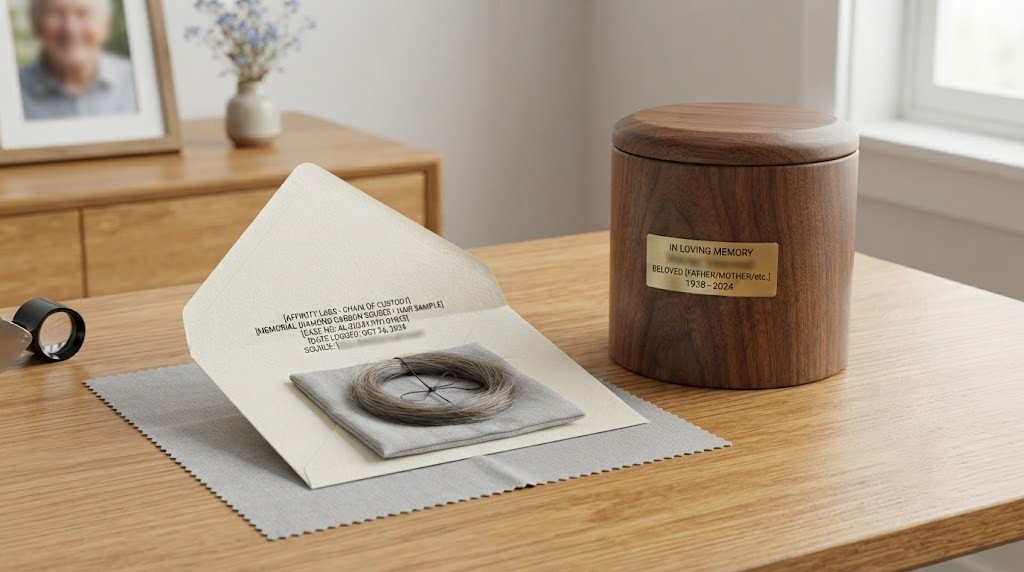
You can usually state a preference. What you cannot do is choose or match an exact shade, because the growth environment, not an order form, settles the final tone. Seeing grandmother ashes hair diamond color as a direction you can lean toward, rather than a swatch you can pick, keeps expectations steady before you commit.
Colorless takes extra work
A colorless memorial diamond is achievable, but it requires additional processing to keep nitrogen and boron out of the growth cell. That extra work is why colorless stones typically cost more than yellow, blue or champagne stones of the same size. If your hope for grandmother ashes hair diamond color is a colorless stone, ask what the provider does when a colorless attempt comes out with a faint tint.
Irradiated colors
Some providers offer post-growth irradiation to produce red, pink, green or black stones. Not every company does this, and those that do set their own prices and timelines. When irradiation is part of your plan for grandmother ashes hair diamond color, ask whether the treated tone is permanent under normal wear and whether the treatment is noted on the stone’s paperwork.
A preference is not a promise
Families sometimes hope to match her eye color, a gem she wore, or a shade from a favorite photograph. A provider can note the wish, but no one can match a natural shade on demand. When the stone arrives, the tone it carries is the result of her carbon in that particular growth run, and that individuality is something a family may come to value.
How Is Grandmother Ashes Hair Diamond Color Graded?
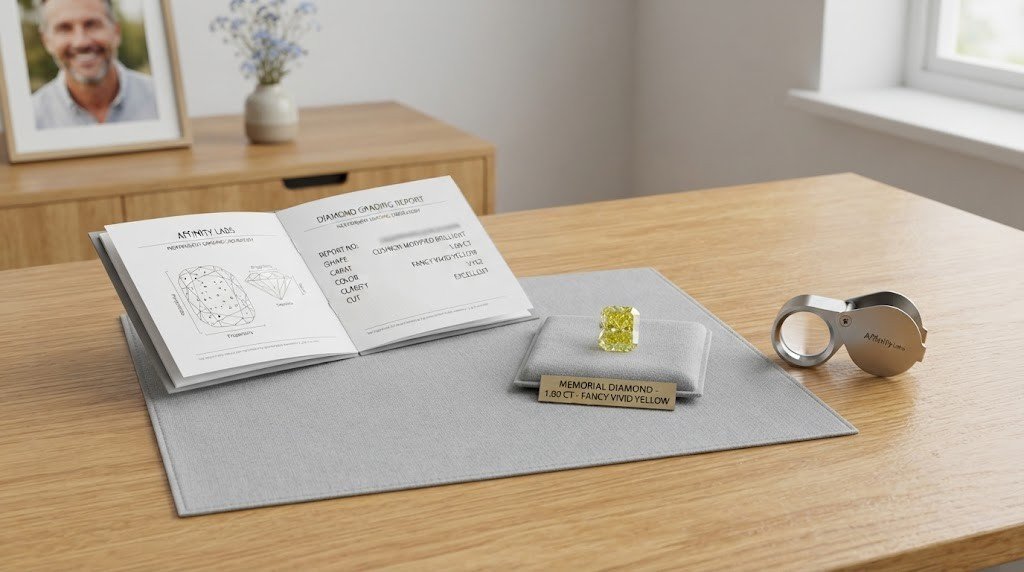
Two different documents can come with a memorial diamond, and they answer different questions. An authenticity or origin certificate, which the provider normally issues itself, ties the stone to the carbon your family supplied. It is a chain-of-custody record. A grading report describes the stone itself: cut, color, clarity and carat.
Grading is ideally done by an independent third-party lab working to GIA standards, and sometimes by IGI. Independent grading is typically an optional add-on with its own fee. If you want to understand what the color line on such a report means, GIA’s overview of how diamond color and the other quality factors are assessed is a clear starting point.
For a colored stone, a report generally records grandmother ashes hair diamond color as hue and intensity instead of a letter grade from the scale used for near-colorless diamonds. Memorial diamonds typically grade in the SI2 to VVS clarity range. Ask whether a report is included or extra, and which lab issues it, since that document is where grandmother ashes hair diamond color gets recorded in independent terms.
How Does Grandmother Ashes Hair Diamond Color Affect the Cost?
Size drives most of the price, and grandmother ashes hair diamond color adjusts it. These are broad 2026 figures for the industry as a whole; Memorial Diamond has not yet published prices of its own.
| Carat band | Broad 2026 industry range | Where color pushes the price |
|---|---|---|
| About 0.10–0.25 ct | Roughly 1,500–3,500 | Ask each provider how colorless or treated colors are priced at this size |
| 0.5–1 ct | Roughly 5,000–15,000 | Expect colorless to sit well above yellow, blue or champagne of equal size |
| 2–5+ ct | Roughly 20,000–75,000+ | Larger and specialty-color stones may also take longer to grow |
A grading report, engraving, a fancy cut and a jewelry setting are usually priced on top of the loose stone. When you compare quotes, ask each provider to separate those items so the effect of grandmother ashes hair diamond color on the total is visible.
Does Grandmother Ashes Hair Diamond Color Change the Timeline?
Industry-wide, most memorial diamonds are finished 6 to 10 months after a provider receives the material. Larger stones, above roughly 2 carats, and specialty colors such as black can take up to about 12 months.
Time in the press, rather than the quantity of ash or hair supplied, is what determines carat size. Colorless or an irradiated shade may add time, so when you raise grandmother ashes hair diamond color with a provider, ask for a written estimate that reflects the specific color and size you have in mind.
How Can a Family Agree on a Color Together?
Before color comes up at all, it helps to know who is entitled to decide about her ashes. That turns on state law and on any written wishes she left, and the order of priority differs from one state to the next. A surviving spouse or partner often comes first, with her adult children next and grandchildren after them, but treat that as a common pattern to confirm rather than a rule. Whoever signed the cremation authorization is usually on record with the funeral home or crematory, and staff there can often tell you.
Hair kept at home tends to be the simpler practical matter. Even so, her belongings can count as part of her estate, and the rules vary by state, so a short conversation with the executor or whoever is settling her affairs makes sense before any hair is sent.
Letting the color follow who she was
Once the right people are involved, grandmother ashes hair diamond color becomes a more personal conversation. Some families lean toward a tone that echoes something about her, such as a color she wore often. Others let the person who will wear the stone decide. If cousins are each considering a stone, agreeing on whether every stone should share a color family avoids surprises later.
If the stone may pass down a generation, the next wearer’s taste can be part of the discussion. For the wider picture, the complete guide to an ashes-and-hair diamond for your grandmother brings every topic together, while color expectations for a stone from her ashes alone and what a stone from her hair alone tends to look like help when the family is weighing a single material.
Which Color Myths Are Worth Setting Aside?
A few ideas about grandmother ashes hair diamond color come up again and again in family conversations.
- “More hair will make it lighter.” Hair is roughly 50% carbon, far richer than ash, which is why so little is needed. That carbon content says nothing about color.
- “A full urn gives a deeper or bigger stone.” Growth time sets carat size. Sending more material changes neither size nor shade.
- “Yellow or brown means lower quality.” Tone is a description, not a verdict. A yellow memorial diamond is a real diamond, 10 on the Mohs scale, graded on the same 4Cs as any other.
- “Colorless proves more of her is in it.” A colorless stone reflects extra processing to exclude trace elements, not a larger personal carbon share.
- “Two stones from the same material will match.” Separate growth runs can produce different tones, so ask before assuming a pair will look alike.
Setting these aside makes it easier to compare providers on what actually matters about grandmother ashes hair diamond color: documentation, written answers and honest estimates.
Frequently Asked Questions
Will adding her hair make the diamond lighter than her ashes alone would?
No. Combining hair with ashes does not lighten the stone or make grandmother ashes hair diamond color easier to predict. Carbon from both sources is purified before growth, and color depends on trace elements such as nitrogen and boron in the growth environment.
Can the stone be made to match her eye color or a gem she wore?
A provider can note the wish, but nobody can match an exact natural shade. You can usually state a preferred direction, such as colorless or a blue tone, and some providers offer irradiation for red, pink, green or black, each priced and timed separately.
If her ashes and hair become two separate stones, will they match?
Not necessarily. Each growth run is a separate event, so two stones can come out in different tones. If you want a matched pair, ask the provider in writing whether it aims for similar tones and what it does when the results differ noticeably.
Is a yellow or champagne memorial diamond lower in quality?
No. When it comes to grandmother ashes hair diamond color, yellow, blue and champagne are the most common outcomes and say nothing negative about the stone. It is still a real diamond, graded on cut, color, clarity and carat, with hardness of 10 on the Mohs scale.
Does a colorless stone from her ashes and hair cost more?
Typically, yes. A colorless result needs extra processing to keep nitrogen and boron out during growth. In the 0.5 to 1 carat range, where industry prices run roughly $5,000 to $15,000, colorless usually costs meaningfully more than yellow, blue or champagne.
Where does grandmother ashes hair diamond color appear on the paperwork?
It appears on a grading report, which describes cut, color, clarity and carat. An in-house authenticity certificate records origin and chain of custody instead. Independent grading is typically an optional add-on, so ask which lab issues the report and whether it is included.
Final Thoughts on the Color of Her Ashes-and-Hair Diamond
The color of a stone grown from her ashes and hair will be its own, settled in the press rather than chosen from a chart. Yellow, blue and champagne are the usual results for grandmother ashes hair diamond color, colorless and treated shades take extra steps, and combining the two materials does not tip the outcome either way.
What you can shape is the quality of the answers you gather. Ask each provider how it handles both materials, what it records, and what happens if the tone surprises you, then keep those answers in writing alongside her paperwork.
Learn More About Ashes-and-Hair Stones for Your Grandmother
- How to turn your grandmother’s ashes and hair into a diamond the practical steps from first inquiry to finished stone
- Grandmother ashes diamond guide everything about stones grown from her ashes alone
- Grandmother hair diamond guide the hair-only route, with no cremation involved
- How much ash a grandmother memorial diamond needs typical quantities and what happens to the rest
Talk With Memorial Diamond
If you are still turning over what color her stone might be, or whether to use her ashes, her hair or both, you are welcome to talk it through with us. We can explain grandmother ashes hair diamond color in plain terms and help you sort out which questions matter for your family.
Visit memorialdiamond.us whenever you are ready. There is no deadline, and asking questions commits you to nothing.
Leave A Comment