
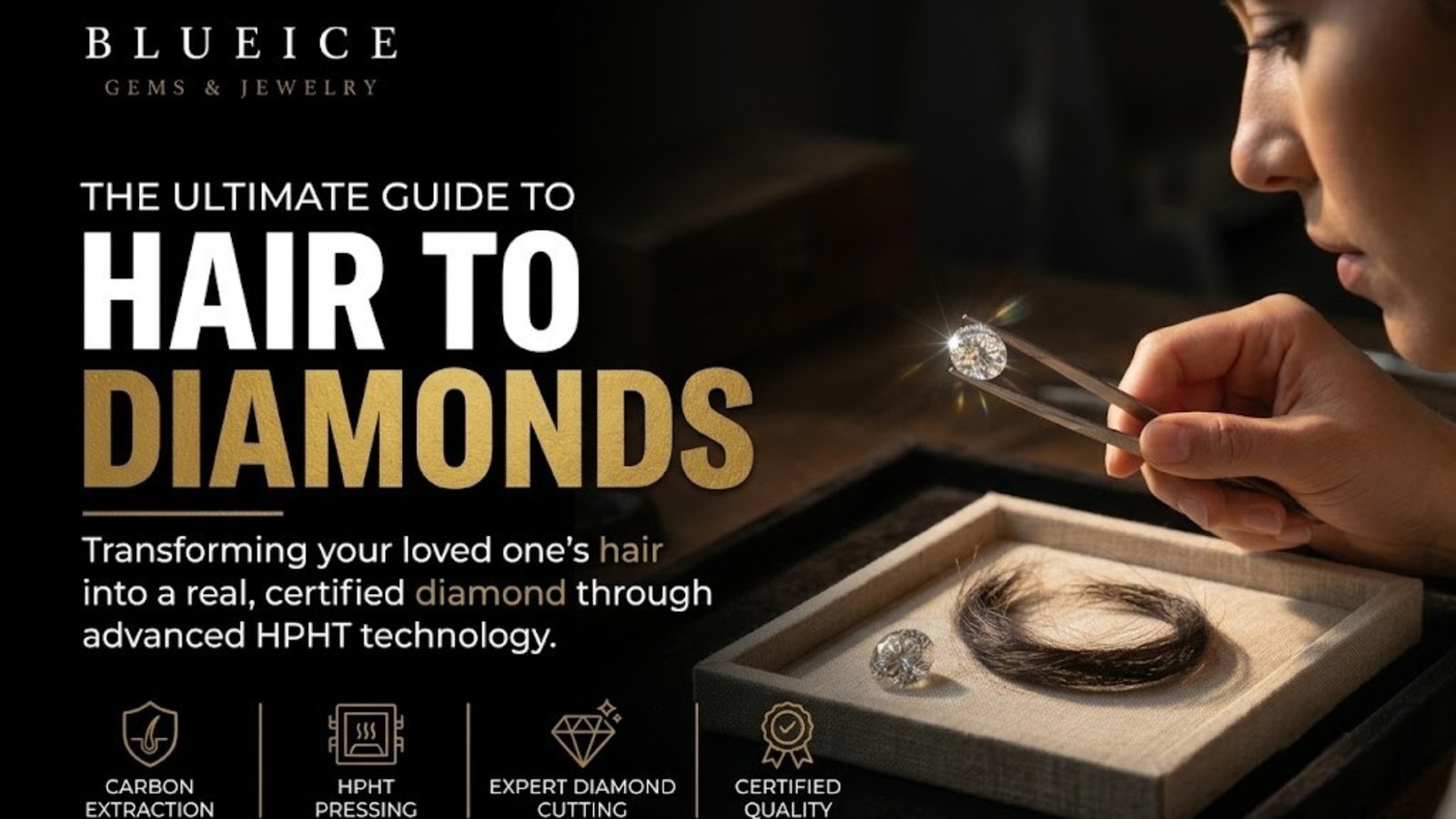
A lock of his hair might already be tucked in an envelope somewhere, or you may only now be realizing that hair is an option at all. You can turn brother hair into a diamond without any cremation: find a small lock (saved earlier, trimmed by the funeral home, or kept among his things), confirm who has the right to release it, send a few grams to a provider, choose carat and color, and receive a real lab-grown diamond in roughly 6–10 months.
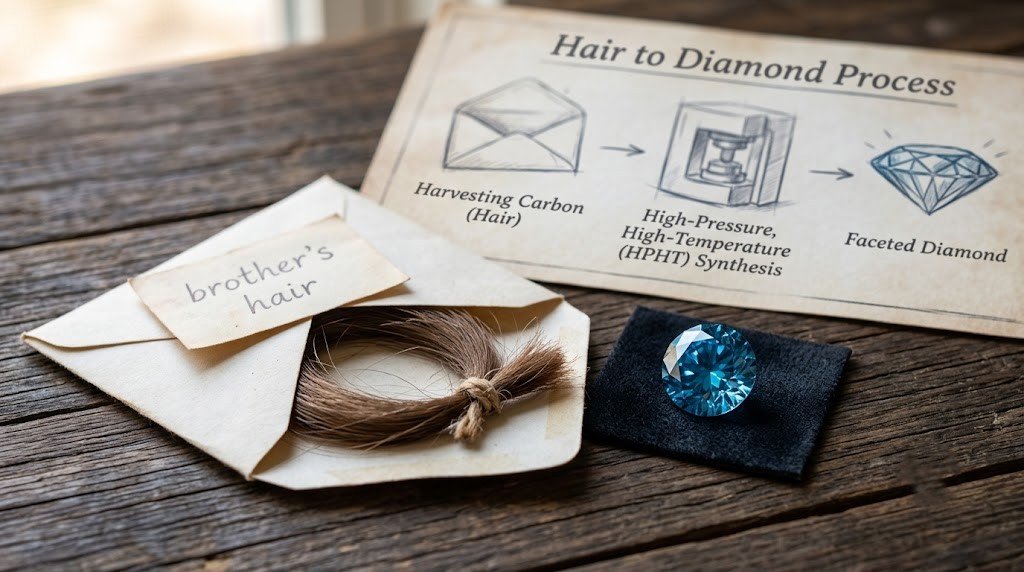
Table of Contents
How Do You Turn Brother Hair Into a Diamond, Step by Step?
Hair makes for a shorter, simpler route than ashes in one important way: there is no urn to divide and no cremation to wait on. The steps still matter, though, because a little care at the start protects the hair and avoids misunderstandings within the family later.
This is the sequence a sibling generally follows to turn brother hair into a diamond. Providers may label the stages differently, but the order holds.
| Step | Your action | Things to have ready |
|---|---|---|
| 1. Locate the hair | Find a saved lock, ask about funeral-home trimming, or identify hair among his belongings | A clean envelope or small container |
| 2. Confirm who can release it | Check who holds authority over his remains or his estate, and ask them | Names and contact details of close relatives, the funeral home |
| 3. Choose a provider | Compare honesty about carbon, grading, and policies | A short list of questions |
| 4. Pack and send | Follow the provider’s kit instructions and use tracked shipping | The labeled hair, signed forms |
| 5. Make your selections | Decide carat, color, cut, and any setting | A budget range and an idea of how it will be worn |
| 6. Wait, then receive and check | Follow updates, then match the stone to its paperwork | Your order details and both certificates |
Each step can happen at its own pace. There is no need to rush from one step to the next. If the hair has been stored for a long time, describe its age and condition to the provider and ask whether older samples are accepted.
For a broader orientation before you begin, the complete guide to a brother hair diamond covers the background in more depth. What follows here is the hands-on version: what you actually do when you decide to turn brother hair into a stone.
Where Can the Hair Come From When You Turn Brother Hair Into a Diamond?
Before you can turn brother hair into a diamond, you need the hair itself, and it often comes from one of three places.
- A lock saved earlier. A childhood curl in a baby book, or a clipping someone kept after a haircut. If it exists, a relative may already know where it is.
- A trimming taken by the funeral home. If his funeral has not yet happened, or his body is still in the funeral home’s care, staff can often cut a small lock discreetly before burial or cremation. That hair is generally released through whoever holds authority over his remains, so the request usually goes through that person.
- Hair at home. Strands caught in a hairbrush, a comb, or a cap may be usable. Ask the provider whether loose strands like these are accepted and what condition they need to be in.
Hair found at home or among his belongings deserves a moment of thought. Personal possessions may form part of his estate, and how that applies to something like a hairbrush depends on the state. If someone else is handling his estate, it is worth mentioning your plan to them before you take anything.
Whatever the source, keep the hair dry, in a clean envelope or small container, labeled with his full name. Ask your chosen provider whether it prefers a particular kind of packaging, so you can turn brother hair into a diamond without the sample being turned away.
Whose Permission Do You Need Before You Turn Brother Hair Into a Diamond?
Hair can feel more personal and less formal than ashes, but permission still matters. A provider will typically ask who authorized the request, and the answer depends on where the hair came from.
If the funeral home is taking a trimming, staff generally act on the instructions of the person who holds authority over his remains. That person is not always a sibling. A common pattern in state rules gives priority to a surviving spouse or registered partner, then adult children, then parents, with siblings later in the line, though the exact order differs by state. If he put his own instructions in writing, for instance by naming a particular person to make these calls or by arranging his funeral ahead of time, that document can hand the decision to someone else entirely.
If the hair was saved years ago, or is among his things at home, it may count as part of his estate, and estate rules vary by state. Whoever is administering the estate, or the relatives closest to the decision, deserve a conversation before you send anything.
The respectful route is usually simple: tell the people involved what you hope to do, explain that only a small lock is needed, and invite them in. If you want to turn brother hair into a diamond as a shared tribute, offering updates or a stone of their own can make agreement easier. If you are unsure whose consent applies, the funeral home or a local estate attorney can help clarify it.
Why Doesn’t a Hair Diamond Need Cremation?
Ashes contain very little carbon, which is why ash-based diamonds need cremation and a measured portion of the remains. Hair is different. It is built from keratin, a carbon-rich protein, and is roughly 50% carbon by weight, so a small lock supplies the material a provider needs to work from.
That means you can turn brother hair into a diamond whether he was buried, cremated, or his family has not yet decided. Burial plans stay exactly as they are. Nothing about the funeral has to change.
This can matter for faith reasons. No religious tradition has an official position on memorial diamonds specifically; the guidance that exists concerns cremation and the handling of ashes. Some traditions object to cremation itself, and a hair-based diamond sits outside that particular concern. Practices vary widely within every faith, so if this question applies to your family, confirm with your own faith leader.
If his ashes are also available and the family agrees, you are not limited to one material. Our guide on how to turn brother ashes into a diamond explains the ash-only path, and siblings who want both can read about how to turn brother ashes and hair into a diamond together.
How Much Is Enough to Turn Brother Hair Into a Diamond?
Industry guidance typically calls for a small lock or a few grams of hair, sometimes described as palm-sized or a few wisps. Because hair carries so much more carbon than ash, the quantity needed is small. Exact minimums vary by provider, so confirm the figure before you send anything.
The amount of hair does not decide the carat. A diamond’s size comes from how long it grows in the press, so sending more hair will not make the stone larger. If you hope to turn brother hair into more than one diamond, for yourself and another relative perhaps, ask whether one lock can supply several stones or whether each needs a separate sample.
Questions to ask about the sample itself:
- Do you accept loose strands from a brush, or only cut locks?
- Does hair that was dyed, treated, or stored for many years work?
- How should the hair be packed, and does it need to be sealed?
- Will any unused hair be returned to me?
The detailed breakdown of how much hair a brother memorial diamond needs goes further into quantities and edge cases.
How Do You Pick a Provider and Send the Hair?
A provider worth trusting to turn brother hair into a diamond explains plainly where the carbon in your stone comes from, including the supplemental lab carbon that is typically blended in. Read how each company you consider describes this. One that sidesteps the question entirely, or implies the stone is made from nothing but your brother, is telling you something about how it treats facts.
Before you turn brother hair into a diamond with any company, ask how it tracks each sample from arrival to finished stone, whether it offers an independent grading report alongside its own certificate, and what happens if a growth attempt does not succeed. Our list of questions to ask before turning your brother’s hair into a diamond gathers these in one place.
For shipping, follow the provider’s instructions exactly, and ask whether it supplies a sample kit, what packaging it expects, and whether any carrier rules apply to mailing hair. Use tracking and signature confirmation where offered, photograph the package before sending it, and keep every receipt. A small sample of hair is easy to post, but it is also irreplaceable, so treat the handoff with the same care you would give anything you could not get back.
What Happens to His Hair Inside the Lab?
Once a provider agrees to turn brother hair into a diamond for you, the sample goes through a controlled, oxygen-free heating process in several stages. This strips away the non-carbon parts of the keratin and leaves carbon at roughly 99.9% purity or higher.
Next comes graphitization: a second, hotter firing in the region of 2,500–2,700°C turns the purified carbon into graphite, the form a growth press can work with. Blended with supplemental lab carbon as is typical, the graphite is placed around a small diamond seed. HPHT, the method most memorial providers rely on, presses the cell at roughly 6–8 GPa while holding it between 1,400 and 2,500°C; fewer providers use CVD instead. Growth lasts weeks to months depending on the carat you chose.
The rough crystal is then cut and polished by a gemologist, optionally irradiated to adjust color, and graded. The page on how a memorial diamond is made from brother hair describes each stage in more detail. Understanding these stages helps when you turn brother hair into a diamond, because the updates you receive will make sense as they arrive.
How Much of a Hair Diamond Comes From Him?
Here is the honest picture for anyone who wants to turn brother hair into a diamond. Hair is about 50% carbon by weight, far richer than ash. But there is no published industry figure for what share of a finished hair diamond’s mass comes from the hair itself. Providers typically add supplemental lab carbon to reach the volume a stone needs, and how much depends on the provider, the sample, and the size of the diamond.
So when you turn brother hair into a diamond, the stone is not made of him alone, and a company that claims it is has stepped past what the chemistry supports. Ask your provider directly how it describes the personal share of the carbon in its stones, and whether it documents that share.
What is certain is still meaningful. Carbon from his own hair is extracted, purified, and built into the crystal lattice of a diamond that exists because of him. It is physically, verifiably connected to him, not a representation chosen to look like him.
What Size, Color, and Setting Can You Choose?
When you turn brother hair into a diamond, sizes generally range from about 0.10 carats up to 5 carats or more. Smaller stones suit everyday wear and a lower budget; larger ones take longer to grow and cost considerably more.
Color comes from trace elements during growth. Nitrogen produces yellow tones, boron produces blue, and colorless requires both to be excluded, which takes extra processing and typically costs more. Memorial stones commonly land in yellow, blue, or champagne shades; a post-growth irradiation step, where offered, can push a stone toward red, pink, green, or black. Nobody can tell you the exact shade in advance just by looking at his hair. The guide to what color a diamond from your brother’s hair might be explains why.
For settings, think about how the piece will live with you. A pendant, ring, earrings, a bracelet, cufflinks, a lapel pin, or a loose stone in a keepsake box are all common choices, and none is more fitting than another. When siblings turn brother hair into several stones, each person can choose a different shape and setting.
What Does It Cost to Turn Brother Hair Into a Diamond, and How Long Does It Take?
Across the industry, the decision to turn brother hair into a diamond typically means a wait of 6 to 10 months from the time the provider receives the material, and up to about 12 months for stones larger than roughly 2 carats or for specialty colors. The wait comes mostly from growth time, so a larger stone means a longer timeline.
| Size (approx.) | Typical 2026 industry price range |
|---|---|
| 0.10–0.25 carat | 1,500–3,500 |
| 0.5–1 carat | 5,000–15,000 (colorless toward the upper end) |
| 2–5+ carats | 20,000–75,000+ |
These are industry-wide ranges for the loose stone, not a quote. Independent grading reports, engraving, fancy cuts, and settings are usually added separately. If several relatives turn brother hair into stones from one sample, each diamond is typically priced individually. The fuller explanation of what a brother memorial diamond costs walks through the add-ons.
How Do You Check the Finished Diamond?
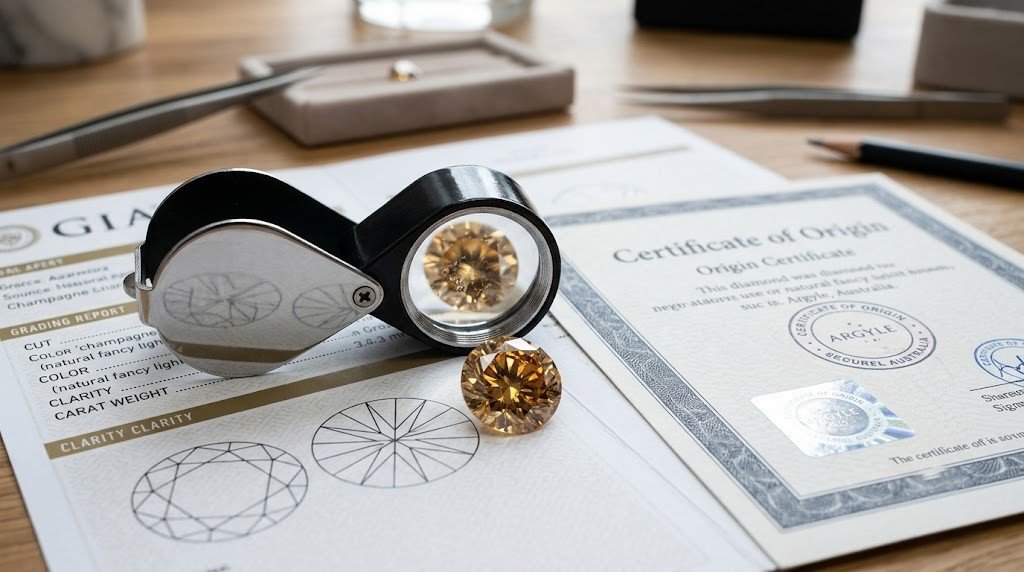
When the diamond arrives, give yourself whatever time you need before opening it. Once you are ready, two documents and a quick inspection confirm everything is right.
The first document is usually an origin or authenticity certificate, issued by the provider, recording that the stone was grown from the hair you sent. The second, ideally from an independent lab, is a grading report describing the stone’s cut, color, clarity, and carat, using standards like those explained in the GIA’s guide to diamond quality factors. Check that the details on both match each other and your order.
Then look at the stone itself. Memorial diamond clarity usually lands somewhere from SI2 to VVS, meaning a loupe may reveal small inclusions. Diamond sits at 10 on the Mohs scale of mineral hardness, yet a sharp knock can still chip an edge, so ask about care and insurance if you plan to wear it daily. If you turn brother hair into a diamond, keep the certificates, the report, and shipping receipts together, so the full record stays with the stone.
Frequently Asked Questions
Can you turn brother hair into a diamond if he was buried?
Yes. Hair does not depend on cremation, so a lock saved beforehand, or one trimmed by the funeral home before burial, can be used. Burial plans do not need to change. Whoever holds authority over his remains or estate should still agree.
Can the funeral home cut a lock of his hair for me?
Often, yes, if his body is still in their care, and that is one practical way to turn brother hair into a diamond. Funeral homes generally act on instructions from the person holding authority over his remains, so that person usually needs to make or approve the request.
Does hair from a hairbrush work?
Sometimes. Providers differ on whether you can turn brother hair into a diamond using loose strands from a brush or comb, and how much is needed. Ask before sending. Hair kept at home may form part of his estate, and rules vary by state, so check with relatives.
How old can the hair be?
There is no single industry cutoff. Whether a lock saved years or decades ago will let you turn brother hair into a diamond depends on each provider’s acceptance standards, so describe the sample’s age and how it was stored, and ask what they recommend.
Will a diamond made from hair look different from one made from ashes?
Not in any predictable way. Color comes from trace elements such as nitrogen and boron during growth, and the exact shade cannot be forecast from either source. Both produce real lab-grown diamonds graded on the same cut, color, clarity, and carat scale.
Can more than one sibling get a diamond from the same lock?
Often, yes, because each stone typically uses only part of the recovered carbon. Relatives who turn brother hair into several diamonds may share one sample. Ask the provider how many stones it can grow from the amount of hair you have available.
Final Thoughts on Turning Your Brother’s Hair Into a Diamond
Hair asks very little of a family. A small lock, gathered with permission and handled carefully, can become a stone grown in part from him, without any change to how he was laid to rest. If you choose to turn brother hair into a diamond, take each step when you are ready, ask every question that occurs to you, and keep the people closest to him in the conversation.
Learn More About Turning His Hair Into a Diamond
- Brother hair diamond: the complete guide the full overview for hair-based stones
- Step-by-step: turning your brother’s hair into a diamond a closer look at each stage
- Is a memorial diamond really made from your brother’s hair? the carbon question in depth
- Brother memorial diamond ideas rings, pendants, and keepsakes
Talk With Memorial Diamond
If you have a lock of his hair, or think you might be able to find one, Memorial Diamond is glad to talk through what is possible. We can help you understand how much is needed, what to ask about permission, and what each step looks like, with no pressure on timing. Begin whenever you are ready at memorialdiamond.us.
Word count: 3,102 words · Reading time: about 16 minutes
Leave A Comment