
Hope and suspicion often arrive together when you first hear that part of your brother could become a diamond, and wanting proof is not disloyal to him. The honest answer is yes: a memorial diamond really made from brother ashes is a genuine lab-grown diamond holding a real portion of carbon recovered from his cremated remains. That carbon is typically blended with supplemental lab carbon, and industry figures put the ash-derived share at roughly 10–15% of the finished stone.
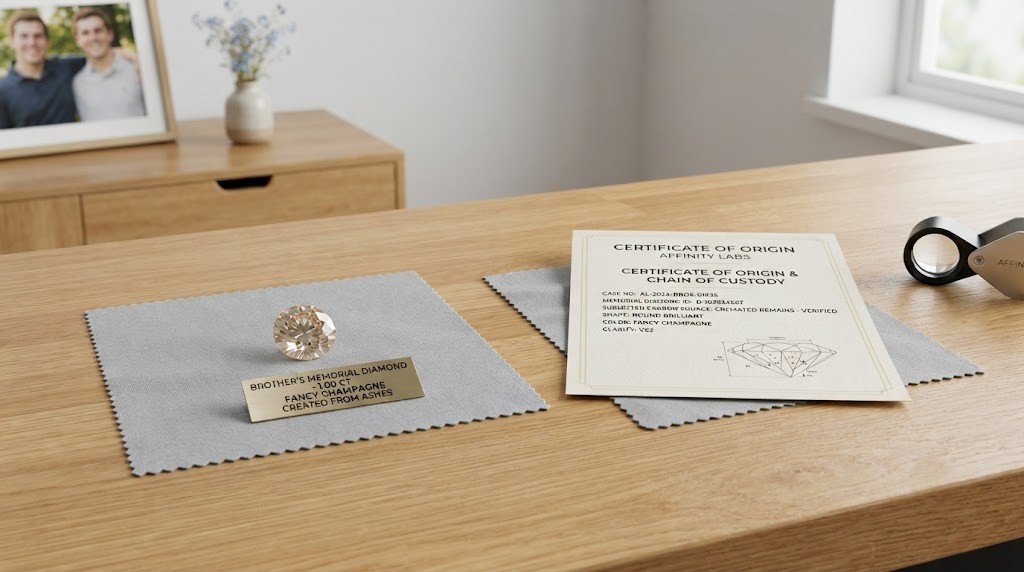
Table of Contents
What Is Physically True When a Diamond Is Really Made From Brother Ashes?
Hearing that a stone is really made from brother ashes can sound like marketing, so it helps to pin down what is physically true. A memorial diamond is a chemically real diamond, with the same crystal structure, hardness, and optical behavior as any other diamond, grown in a laboratory rather than mined. It is not glass, resin, or a cubic zirconia with ashes sealed behind it.
What makes it a memorial stone is where part of its carbon came from. Cremated remains are mostly calcium phosphate, the mineral framework of bone, but a small fraction is carbon. A provider recovers that carbon, purifies it, and uses it as part of the feedstock that grows the crystal. So a stone really made from brother ashes is not a symbol placed beside his remains; atoms that were once part of him sit inside its lattice.
That is the yes. The qualifier is that his carbon is usually one ingredient among others rather than the only one. For a neutral outside reference on how the category developed, the Wikipedia overview of memorial diamonds is a reasonable starting point, and our complete guide to a brother ashes diamond covers every stage beyond this single question.
How Much of a Diamond Really Made From Brother Ashes Is Actually Him?
This is the number a careful reader wants, and it deserves a straight answer. Industry figures suggest usable carbon makes up only about 0.5% to 4% of cremated remains by weight, depending on the person and the cremation itself. After extraction and purification, the ash-derived portion typically ends up around 10–15% of the finished diamond’s mass. Some providers cite ash figures as low as 3%, and others cite higher, depending on stone size and how much ash was submitted.
Put simply, when you hold a diamond really made from brother ashes, a minority share of its carbon came from him and the rest came from a controlled lab source. That share is real and recorded at the extraction stage, but it is not the whole stone.
| Measure | Typical industry figure | What it tells you |
|---|---|---|
| Carbon in cremated remains | About 0.5%–4% by weight | Ash is mostly mineral, not carbon |
| Purity after extraction | Roughly 99.9%+ carbon | His carbon is cleaned before use |
| Ash-derived share of finished stone | Around 10–15% (some cite \~3%) | His carbon is a real minority of the crystal |
| Ashes typically requested | A few tablespoons to about 4 oz (\~100 g) | The rest of his ashes can stay as planned |
Two practical points follow. Ask any provider for their own percentage, in writing, for the carat size you are considering, since it depends on their process. And treat a company that will not discuss the share at all with more caution than one that gives you a modest, specific figure for a stone really made from brother ashes.
Why Is Lab Carbon Blended Into a Stone Really Made From Brother Ashes?
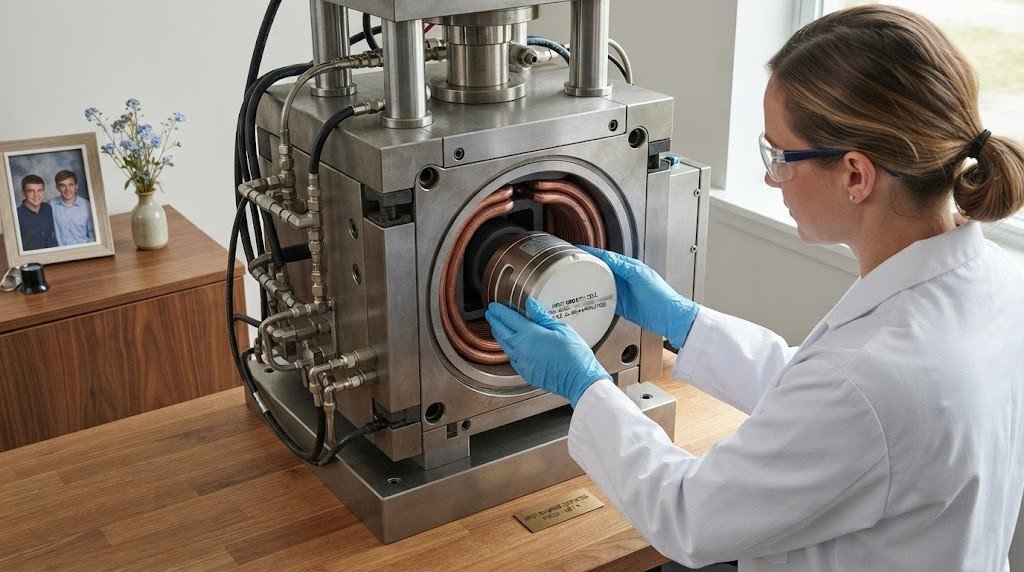
Growing a wearable diamond takes a dependable volume of very pure carbon, and the amount recovered from a portion of ashes is small. Supplemental lab carbon is typically added so the growth cell has enough feedstock to form a stable crystal. It does not replace his carbon; it is the scaffold that lets his carbon become part of a stone you can set and wear.
This also explains why sending more ashes does not automatically produce a bigger diamond. The weight of the finished gem tracks the length of the growth run, while the volume of ash in the box plays no real part in it. A family who sends a full urn does not receive a faster or larger stone than one who sends a few tablespoons. The carat is a choice made at the start, and the timeline follows from it.
Providers may describe their blend in their own terms, and the proportion can shift with the carat you choose. Asking how theirs works is fair, as long as the answer arrives with specifics rather than slogans. A diamond really made from brother ashes is still genuinely his when lab carbon is part of the recipe; the blend is simply how the physics of crystal growth works.
How Does Carbon Travel From His Ashes Into a Diamond?
Knowing the route makes a diamond really made from brother ashes easier to trust, because each stage is a point where a record should exist. The broad sequence is consistent across the industry, even though each provider runs it with its own equipment.
| Stage | What happens | Record to expect |
|---|---|---|
| 1. Receipt | His ashes arrive and are logged under a unique identifier | Intake record with his name and your order number |
| 2. Extraction and purification | An oxygen-free, multi-stage heating process removes non-carbon minerals, reaching roughly 99.9%+ carbon | Lab record linking the purified carbon to his file |
| 3. Graphitization | The cleaned carbon goes back into a furnace at roughly 2,500–2,700°C and reorganizes into graphite | Batch log tied to the same identifier |
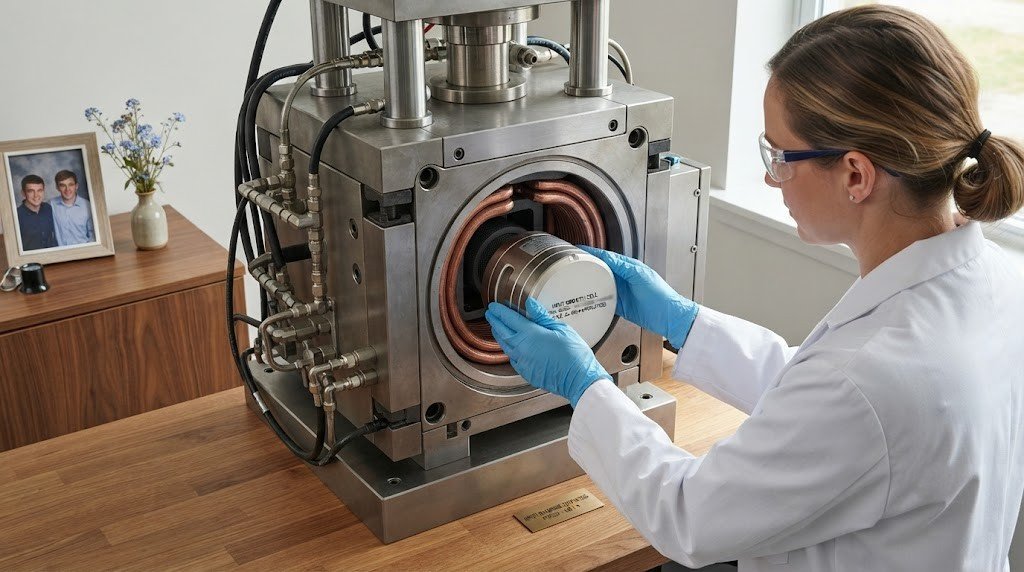
| 4. Growth | Graphite, typically blended with lab carbon, grows on a tiny diamond seed under HPHT conditions of about 6–8 GPa and 1,400–2,500°C, over weeks to months | Growth record, with photos where offered |
| 5. Cutting and polishing | A gemologist shapes the rough crystal into your chosen cut | Workshop record |
| 6. Optional color treatment | Some providers offer irradiation to shift color | Written disclosure of any treatment |
| 7. Grading | The finished stone’s qualities are assessed, ideally by an independent lab | Grading report plus an origin certificate stating the stone is really made from brother ashes |
A minority of providers grow memorial stones by chemical vapor deposition instead, turning the carbon into a gas that deposits layer by layer on a seed plate. Both growth methods are described in the Wikipedia article on synthetic diamond. If you would like the same journey told as a narrative, read how a memorial diamond is made from brother ashes.
How Can You Verify a Diamond Is Really Made From Brother Ashes?
Here is the fact that matters most for a skeptic: once carbon is purified to a near-pure state, nothing left in the finished crystal identifies whose carbon it was. A gemologist can confirm a stone is a lab-grown diamond and grade its color and clarity, but no grading test reads his identity out of it. Proof that a gem is really made from brother ashes therefore lives in the paperwork trail rather than in the stone.
That trail rests on two different documents, and it pays to know which is which.
- Origin certificate. Usually issued in-house by the provider, it states that the diamond was grown from carbon recovered from the remains submitted under your order. It is a chain-of-custody document, and its worth depends on the provider’s record-keeping.
- Independent grading report. Issued by a third-party lab, it describes the stone itself: cut, color, clarity, and carat, measured against standards such as those GIA sets out for the four quality factors. It says nothing about whose carbon is inside.
Ask for both whenever you order a stone really made from brother ashes, then put these questions to any provider and notice whether the answers come easily:
- How is his material labeled from intake to finished stone, and can I see a sample record?
- Are different families’ materials ever processed in the same batch, and how are they kept apart?
- What share of the finished stone do you expect to come from his ashes at my chosen carat?
- Will an independent lab grade the stone, and is that report included in the price?
- What happens to any of his ashes you do not use, and how are they returned?
- If a growth attempt fails, what is your written policy?
A company comfortable with every one of those questions is offering the kind of transparency that makes a stone really made from brother ashes something you can verify rather than simply believe. Our list of questions to ask before turning your brother’s ashes into a diamond goes further if you are comparing providers side by side.
Which Sales Claims Should Make You Pause?
Grief makes reassurance attractive, and a few marketing lines about stones really made from brother ashes lean on that. None of the claims below proves bad faith by itself, but each one deserves a follow-up question before you hand over anything of his.
- “100% him” or “pure ashes, nothing added.” Ash yields too little carbon for that to be how the process typically works; supplemental lab carbon is usually part of the blend.
- A precise percentage with no explanation. A credible figure comes with its basis: carat size, ash quantity, and method.
- “Certified” with no named lab. An in-house certificate speaks to origin, while a quality claim should point to an independent grading report.
- A promise that more ashes mean a bigger stone. Size depends mainly on growth time, not on the quantity submitted.
- A promised exact color. The precise shade cannot be predicted from the source material.
- Pressure to decide quickly. A decision about his remains deserves whatever time you need to compare providers calmly.
When a provider answers those follow-ups patiently and backs each answer with a document, you are seeing what a diamond really made from brother ashes should come with: evidence, not adjectives.
Who Decides Whether His Ashes Can Be Used?
Before anyone orders a diamond really made from brother ashes, there is a quieter question about permission. As a sibling, you may not be the person who holds authority over your brother’s remains. Those who usually rank first include a spouse or registered partner, adult children, and parents, yet each state writes its own sequence, and anything he put in writing, whether naming an agent, arranging a pre-need plan, or leaving a will, may reorder it.
When the decision rests with someone else, a conversation tends to be the kindest approach: asking whether a small portion of his ashes could be set aside, since only a few tablespoons to about 4 oz is typically requested. Ask the provider what authorization paperwork they need, and bring the authority holder in early so nobody feels bypassed.
Hair can be another path. Funeral-home staff who trim a lock generally hand it over through the person with authority. Hair you kept yourself, or that turns up among his things, can count as part of his estate, with rules that differ between states. If ashes are not available to you, reading about what a brother hair diamond involves may help. And if several relatives each hope for a stone really made from brother ashes, our piece on sharing a brother memorial diamond explains how one portion can often supply more than one.
What Does It Cost, and How Long Does It Take?
Price and timing belong in the honesty conversation, because a diamond really made from brother ashes involves months of specialized lab work. The ranges below are general 2026 industry figures, not memorialdiamond.us’s published pricing.
| Carat range | Typical industry price | Notes |
|---|---|---|
| About 0.10–0.25 ct | Roughly 1,500–3,500 | Smallest common tier; suits a pendant, ring, or any other setting |
| 0.5–1 ct | Roughly 5,000–15,000 | A colorless stone of this size costs noticeably more than yellow, blue, or champagne |
| 2–5+ ct | Roughly 20,000–75,000+ | Longer growth and closer process control |
Independent grading, engraving, fancy cuts, and settings are typically priced separately from the loose stone. Across the industry, the process typically runs 6 to 10 months from receipt of his ashes, while specialty colors, or stones larger than roughly 2 carats, may need closer to 12 months. A price far below these ranges for a stone really made from brother ashes is worth a pointed question about what is actually being made. For more detail, see what a brother memorial diamond costs and the typical brother memorial diamond timeline.
Will a Stone Really Made From Brother Ashes Look Different?
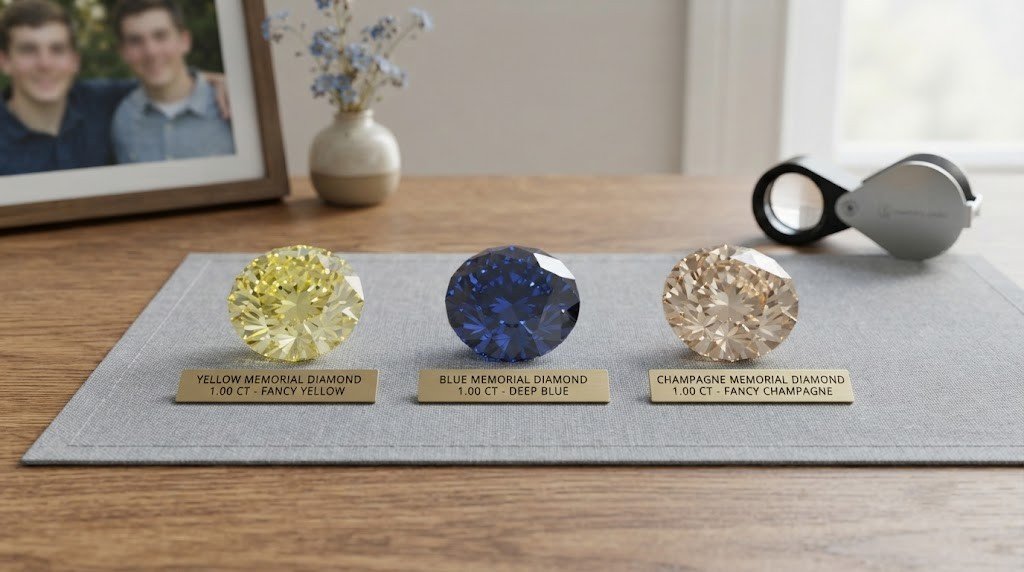
To the eye, no. A stone really made from brother ashes looks like a diamond because it is one. It rates 10 on the Mohs hardness scale like every diamond, which means it resists scratches well but can still chip if struck hard against something, and clarity for memorial stones typically falls between SI2 and VVS.
Color is where the source can show. Trace nitrogen during growth tends to produce yellow, boron produces blue, and a colorless stone requires excluding both, which takes extra processing and usually costs more. That is why memorial diamonds trend toward yellow, blue, or champagne tones; where a provider offers post-growth irradiation, red, pink, green, or black become possible too.
The exact shade a diamond really made from brother ashes will take cannot be predicted from his ashes in advance, so be wary of anyone who promises one. Our guide to brother ashes diamond color explains the choices in more depth.
What Do People Commonly Get Wrong About Ash Diamonds?
A handful of misunderstandings come up again and again, and each one changes how you judge whether a gem is really made from brother ashes.
“The ashes are squeezed into a diamond.” They are not. Carbon is extracted and purified first, and the calcium phosphate that makes up the bulk of the ashes is removed.
“His ashes are sealed inside the gem.” That describes ash-infused glass or resin keepsakes, which are a different product. A stone really made from brother ashes contains his carbon as part of the crystal itself.
“A lab test can confirm it is him.” Purified carbon carries no personal marker, so origin is established through chain-of-custody records, not testing.
“Lab-grown means fake.” A lab-grown diamond is a real diamond; only its birthplace differs from a mined one.
“Choosing a diamond means giving up the rest of his ashes.” Typically only a small portion is used, so the remainder can still be kept, scattered, or interred as the family planned.
What If You Would Rather Not Use His Ashes?
A diamond is one meaningful choice among several, and none of them is the wrong one. Keeping his ashes in an urn, scattering them somewhere he loved, or interring them all honor him fully, and a diamond really made from brother ashes can sit alongside any of those because it uses so little.
If questions about authority or verification feel unresolved, hair offers a different route with a very different carbon profile: roughly half of hair’s weight is carbon, against a few percent at most for ash. Some families combine the two. Neither choice makes the result more or less genuine than a diamond really made from brother ashes; each produces a real diamond, and each depends on the same documentation for proof.
If faith matters in your family, it helps to know that no religious tradition has an official position on memorial diamonds specifically. Practices around cremation and dividing ashes vary, so your own faith leader is the right person to ask.
Frequently Asked Questions
Is a diamond really made from brother ashes a real diamond?
Yes. Grown in a lab, it shares the crystal structure, hardness, and optical properties of a mined diamond. Part of its carbon was recovered from his cremated remains, purified, and grown into the crystal, typically alongside supplemental lab carbon.
What percentage of a diamond really made from brother ashes comes from him?
Across the industry, carbon from ash typically accounts for roughly 10–15% of a finished stone’s mass; some providers cite about 3%, others more. The exact share depends on stone size, process, and how much ash was submitted, so ask for a written figure.
Can a gemologist test a stone really made from brother ashes to prove it is his?
No. Purification leaves near-pure carbon, so the finished crystal carries no marker of whose carbon it was. A gemologist can confirm it is a lab-grown diamond and grade it, but proof of origin rests on chain-of-custody records and the origin certificate.
What is the difference between an origin certificate and a grading report?
An origin certificate, usually issued by the provider, documents that the stone was grown from the remains you submitted. A grading report, ideally from an independent lab, describes cut, color, clarity, and carat. They answer different questions, so ask for both before you commit.
Do I need permission to use my brother’s ashes?
Often, yes. A spouse or registered partner, adult children, or parents commonly hold authority before siblings, though each state sets its own order and his written wishes can change it. Asking that person for a small portion is the respectful route.
Will I get a bigger diamond if I send more of his ashes?
Not usually. The stone’s size comes from how many weeks it is left to grow, and a heavier package of ash does not change that. Providers typically request a few tablespoons to about 4 oz, so the remainder of his ashes can stay as planned.
Final Thoughts on Whether the Diamond Is Really Him
Asking for proof is a way of looking after him. A diamond really made from brother ashes is not every atom of your brother, and an honest provider will never pretend it is. It is a real diamond holding a real, documented share of his carbon, which means it is something you can check rather than take on faith. Take the time you need, ask for the paperwork, and choose the company whose answers you could repeat to the rest of the family with confidence.
Learn More About Verifying an Ashes Diamond
- Step-by-step: turning your brother’s ashes into a diamond the practical sequence from first call to finished stone
- How much ash a brother memorial diamond needs typical quantities and what happens to the rest
- Is a memorial diamond really made from your brother’s hair? the same honesty check for hair
- Brother memorial diamond ideas: rings, pendants, and keepsakes setting options across every style
Talk With Memorial Diamond
If you are weighing whether a stone really made from brother ashes is right for your family, Memorial Diamond would be glad to hear from you at memorialdiamond.us and explain what could be done with his ashes. Bring every question on this page with you; clear answers should come before any decision.
Word count: 3,257 words · Reading time: about 16 minutes
Leave A Comment