
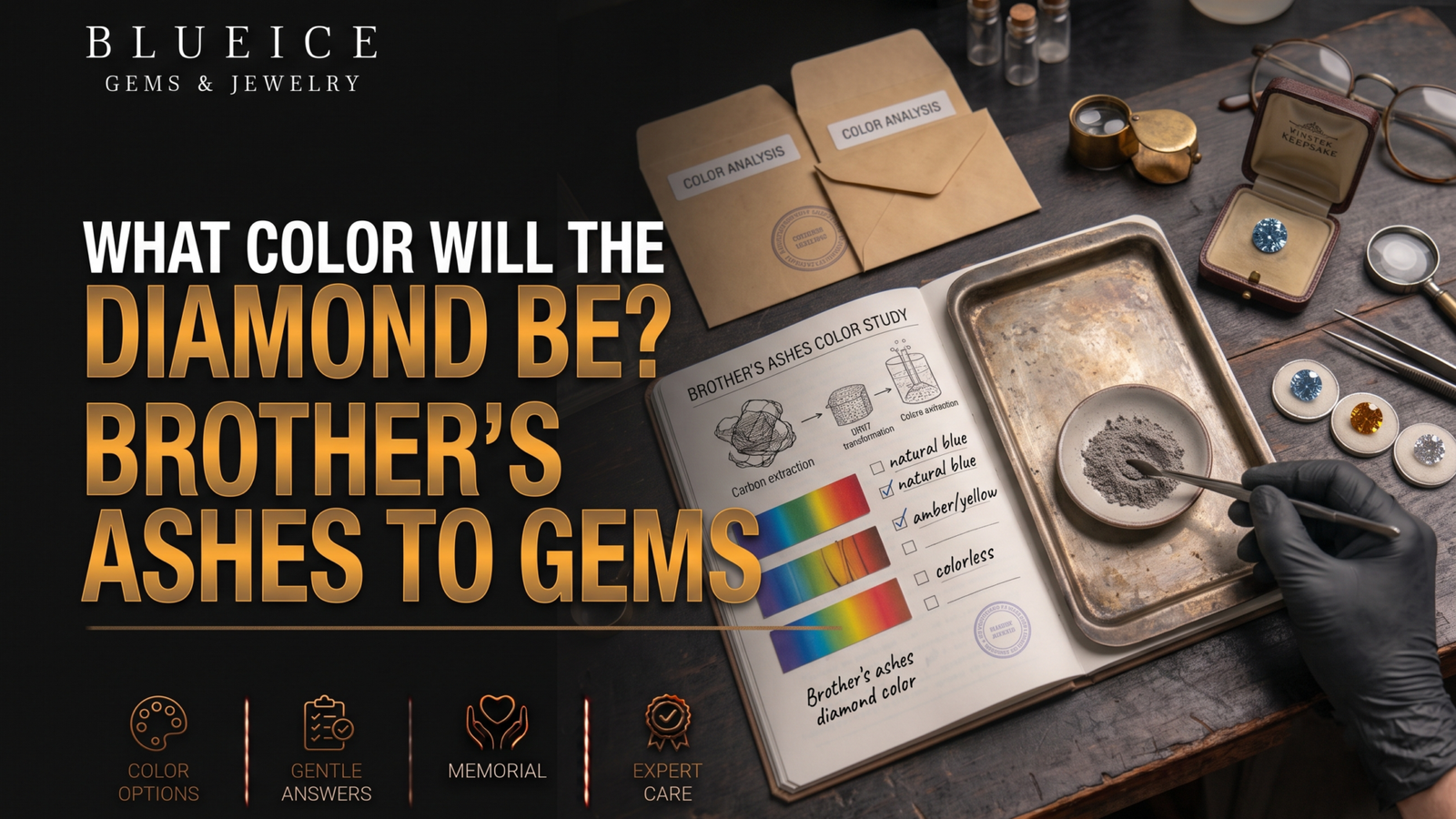
Maybe you have already pictured it: a small stone on a chain or a ring, grown in part from your brother’s ashes, catching the light when you reach for a cup of coffee. Then the practical question arrives. The brother ashes diamond color you end up with cannot be promised in advance. Stones grown from cremated remains typically come out yellow, blue, or champagne because of trace nitrogen and boron, colorless takes extra processing and costs more, and some providers offer irradiated red, pink, green, or black.
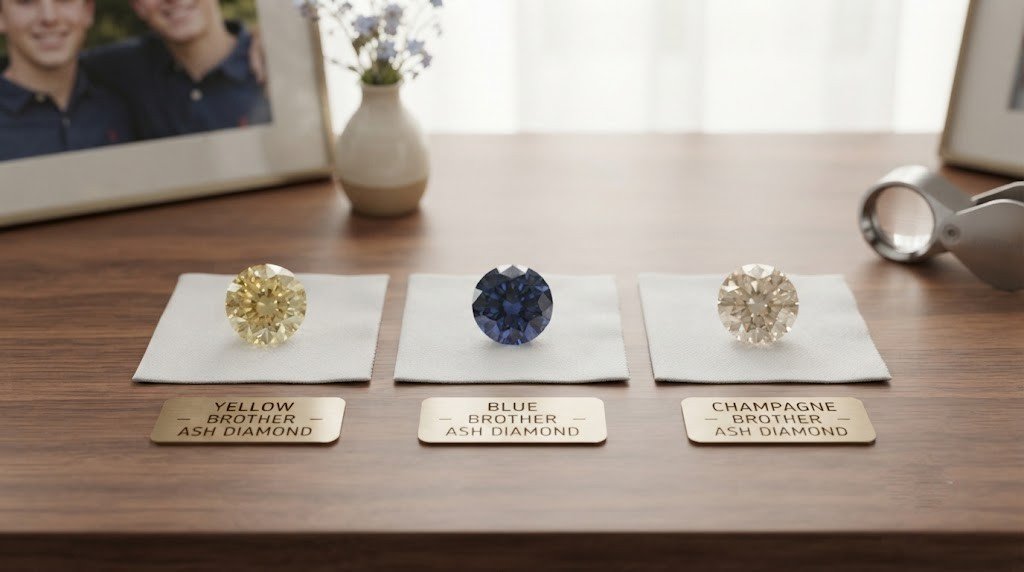
Table of Contents
What Decides a Brother Ashes Diamond Color?
A diamond is a lattice of carbon atoms, and a perfectly clean crystal lets light pass through without adding any tint. Color appears when a few other atoms slip into that lattice while the stone is growing. Two elements do most of the work: nitrogen pulls a diamond toward yellow, and boron pulls it toward blue. A stone needs the near complete absence of both to read as colorless.
That means the brother ashes diamond color you receive is settled in the growth chamber, not in the urn. Before growth begins, the carbon recovered from his ashes is extracted and purified to roughly 99.9% or higher, then converted into graphite at around 2,500 to 2,700°C. That graphite, typically blended with supplemental lab sourced carbon, goes into a press that recreates deep earth conditions of about 6 to 8 GPa and 1,400 to 2,500°C under the HPHT method most providers rely on.
Whatever trace elements are present during those weeks to months of growth leave their mark on the finished tone. The stone is a genuine diamond, with the same hardness and optical behavior as any other, and it also comes from an organic, personal source rather than a sterile industrial feedstock. That second fact explains why a brother ashes diamond color so often carries a tint, and why that tint is better understood as part of the stone’s individuality than as a flaw.
Why Do Stones Grown From Ashes Lean Yellow, Blue, or Champagne?
Cremated remains are mostly calcium phosphate, the mineral framework of bone. Industry figures put the usable carbon at about 0.5% to 4% of the ash by weight, and everything else is stripped away during extraction. What remains is an organic carbon source, and organic sources are rarely as clean as a controlled synthetic feedstock, so trace elements are common, and they are the main reason a brother ashes diamond color rarely comes out icy white.
That is why memorial diamonds across the industry naturally trend toward a handful of color families, each with a simple chemical story:
- Yellow usually points to nitrogen in the crystal, with tones ranging from pale straw to a richer canary.
- Blue points to boron, and depending on the provider and process it can look soft and icy or noticeably deeper.
- Champagne or brown is a warm, muted family that sits between the brighter yellows and the cooler blues.
- Colorless requires keeping both nitrogen and boron out, which takes additional processing.
None of these outcomes means something went wrong. A yellow stone is not a lesser version of a colorless one; it simply records which elements were present while that particular crystal formed. Seen this way, a brother ashes diamond color in the yellow, blue, or champagne family starts to feel less like a gamble and more like a signature written by the chemistry of his own carbon.
Can You Choose Colorless as the Brother Ashes Diamond Color?
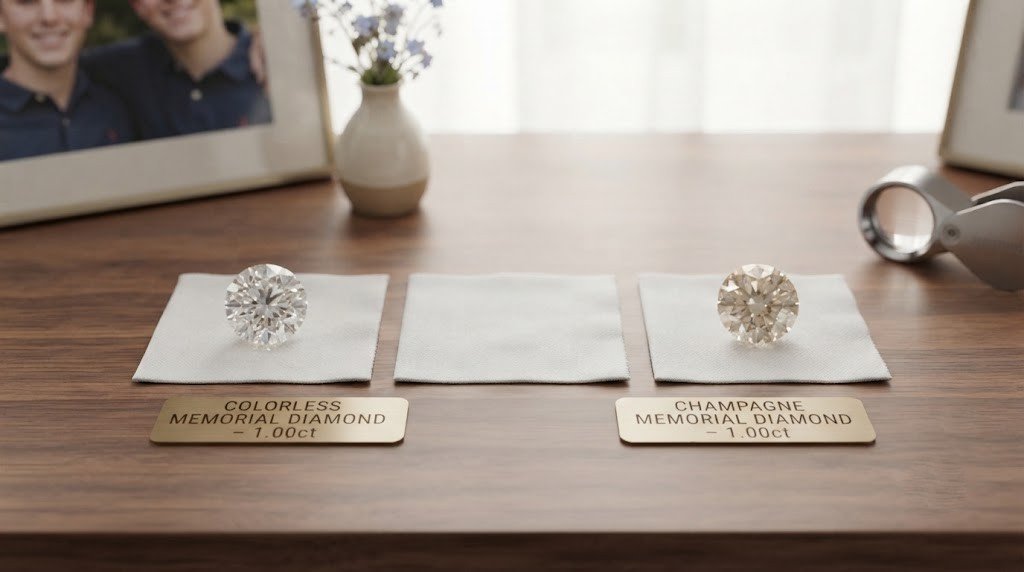
Yes, colorless memorial diamonds are achievable, but they are a deliberate choice rather than a default. To produce one, a provider has to exclude nitrogen and boron during growth, which means additional processing and tighter control over the conditions in the press. That extra work is why colorless stones typically cost more than yellow, blue, or champagne stones of the same size.
The price gap is easiest to see in the middle of the market. Industry wide, a 0.5 to 1 carat memorial diamond typically runs about $5,000 to $15,000, and colorless stones sit toward the top of that span. If a colorless brother ashes diamond color matters deeply to you, ask early how a provider prices it and whether the timeline shifts.
There is also an honest question worth sitting with. Do you want colorless because it feels right for him, or because it is the look you associate with a “real” diamond? A memorial stone with a tinted brother ashes diamond color is every bit as real. Some people find that a warm champagne or a clear blue feels closer to the person than a bright white ever could, while others know straight away that they want the classic look, and either answer is valid when it is chosen on purpose.
What Are Irradiated Colors, and Who Offers Them?
Irradiation is an optional step that happens after the diamond has already been grown. Some providers offer it to shift or intensify color, producing tones such as red, pink, green, or black that do not usually arise from growth alone. Because it is a post growth treatment, it changes the brother ashes diamond color after the fact rather than what the stone is made from.
Not every provider offers irradiation, and those that do may not offer every shade. Specialty colors can also stretch the schedule. Across the industry, the full process typically takes 6 to 10 months, while stones in specialty colors such as black, or stones above roughly 2 carats, can take up to about 12 months.
If you are drawn to a treated brother ashes diamond color, ask directly which shades are available, how the treatment is described on the stone’s paperwork, and whether it changes the price. People come to treated colors for very different reasons. A deep green might echo a landscape that reminds you of him, a black stone might feel understated, and a pink might simply be the color that brings him to mind. No rule links any shade to who he was, and choosing one does not make the stone any less his.
Can Anyone Predict a Brother Ashes Diamond Color in Advance?
No. A provider can tell you which color families are typical and which treatments it offers, but no one can look at a container of his ashes and name the exact shade the stone will be. The trace elements that create tint are present in tiny amounts, they vary from person to person and from one cremation to another, and their final effect depends on how growth unfolds in the press.
The uncertainty is easier to accept once you see where it comes from. The small share of ash that is carbon gets purified, converted, and grown alongside supplemental lab carbon, and by common industry estimates his ash derived carbon ends up as only about 10 to 15% of the gem’s final weight, a share a few providers put closer to 3%. With that many variables between the urn and the finished crystal, a precise forecast of the brother ashes diamond color would be a promise no honest provider could keep.
What you can decide is how much uncertainty around brother ashes diamond color you are comfortable with. If you are happy for the stone to show whatever natural tone emerges, you can lean into that. If you have a firm picture in mind, colorless processing or an irradiated shade narrows the range, though even then the exact depth of tone is something to discuss rather than assume. If you are weighing other sources, the same question is explored for a diamond made from your brother’s hair and for a stone that combines his ashes and hair.
How Does Brother Ashes Diamond Color Affect Price and Carat?
Color and size are separate decisions, but they meet on the invoice. A bigger stone simply has to stay in the press longer, under more careful process control; adding more of his ashes to the shipment does nothing to increase the carat. The brother ashes diamond color you pick then adds its own layer: colorless typically costs meaningfully more than yellow, blue, or champagne at the same size, and irradiated shades may carry separate pricing.
Here is how general 2026 industry ranges line up. Treat them as typical figures across the category rather than any single provider’s price list.
| Carat range | Typical industry price | Where brother ashes diamond color comes in |
|---|---|---|
| About 0.10 to 0.25 ct | Roughly 1,500 to 3,500 | Natural yellow, blue, or champagne tones are the usual starting point |
| 0.5 to 1 ct | Roughly 5,000 to 15,000 | Expect colorless to land near the upper end |
| 2 to 5+ ct | Roughly 20,000 to 75,000+ | Longer growth; specialty colors can push the timeline toward 12 months |
| Add ons | Priced separately | Independent grading, engraving, fancy cuts, and settings |
A practical way to use this table is to decide which matters more to you, the brother ashes diamond color or the carat size, and let the other flex. Someone set on colorless might choose a smaller stone to stay within budget, while someone who loves a natural champagne tone might put the difference toward a larger carat or a setting. The guide to what a brother memorial diamond typically costs walks through the rest of the price picture, and the overview of how long a brother memorial diamond takes to make explains why bigger and specialty color stones need more time.
Who Should Agree Before His Ashes Are Used?
Before any brother ashes diamond color is chosen, there is a quieter question about who gets to say yes. A sibling often does not hold the authority to decide what happens to a brother’s remains. A spouse or registered partner, if he had one, any adult children, and his parents tend to rank first, but there is no single national order; each state writes its own. If he left signed instructions, for example appointing someone to handle these arrangements or setting up his funeral plans ahead of time, those can shift the decision to someone else.
If someone else holds that authority, the respectful route is simply to ask for a small portion. A memorial diamond typically needs a few tablespoons up to roughly 4 ounces (about 100 grams) of ashes, usually a small fraction of the whole, so the rest can still be kept, scattered, or interred as the family planned. Requirements vary by provider, so confirm the amount before you have that conversation.
If ashes are not available to you, a lock of his hair is another path. A lock found at home or among his things may count as part of his estate, and how that works varies by state; any hair a funeral home trimmed is generally handed over via the person with authority over his remains. The complete brother ashes diamond guide covers these conversations in more detail, and the list of questions to ask before turning his ashes into a diamond can help you prepare for them.
Do Settings and Metals Matter for a Tinted Stone?
Settings and metals are mostly a matter of taste. White metals, yellow gold, and rose gold each have their admirers, and the right one is whichever looks like something you would actually wear. A solitaire, a bezel, a halo, a simple pendant, a pair of studs, a band with a small inset stone, or a keepsake piece kept in a box are all reasonable homes for a memorial diamond, whatever the brother ashes diamond color turns out to be.
You may hear that a particular metal changes how a brother ashes diamond color reads. If that question matters to you, put it to a jeweler, and ask to see your stone, or a similar one, against different metals before you decide. Looking with your own eyes is more useful than any general rule.
Durability deserves a thought as well. A diamond sits at 10 on the Mohs scale, but that rating is about scratching, not impact, and a stone can still chip if it strikes something hard. If you plan to wear a ring every day, ask a jeweler which settings shield the stone best. For more on formats, browse these brother memorial diamond ideas for rings, pendants, and keepsakes.
How Do You Choose a Brother Ashes Diamond Color That Suits How You’ll Wear It?
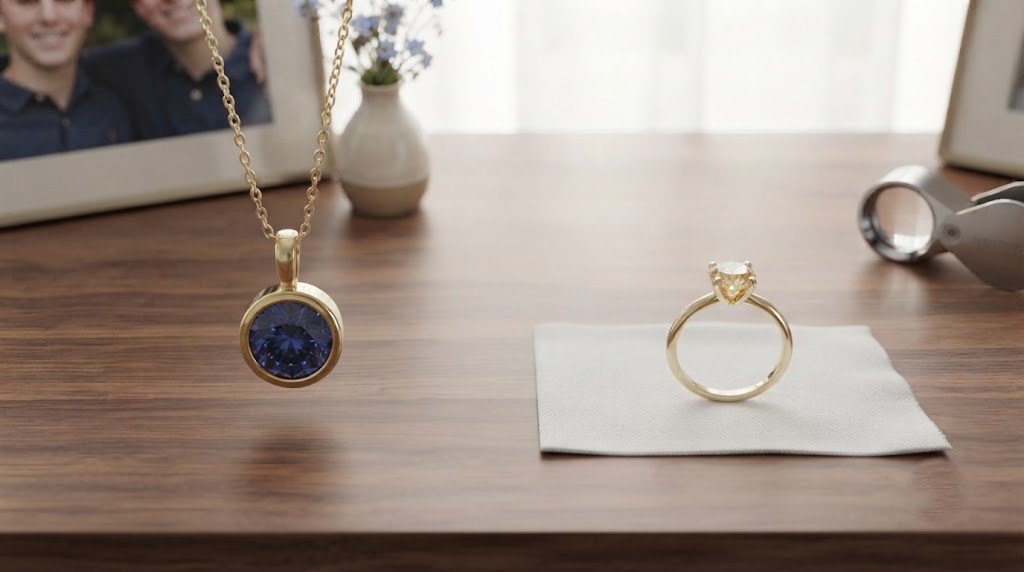
Start with your daily life rather than with any idea of which color “fits” a man. Blue is not more appropriate for him than pink, and yellow is not more appropriate for you than black. The brother ashes diamond color worth choosing is the one that feels like him to you, or the one you will be glad to see on your hand or at your collarbone on an ordinary Tuesday.
A few prompts can help you narrow it down:
- Decide whether you want the stone to be noticed or to stay quiet, since deeper tones tend to draw the eye and softer ones are more discreet.
- Picture the stone with the clothes, watch, or other jewelry you wear most often.
- Consider whether a color tied to a place, a season, or something he cared about brings him to mind.
- Ask yourself whether you would rather let the natural tone of his stone be a surprise.
If several relatives are planning stones from the same ashes, each person can choose a different brother ashes diamond color. One person might want a pendant in whatever natural tone emerges while another relative prefers a colorless ring, and that variety can reflect the different relationships each person had with him. A provider can tell you whether separate stones from one source are possible and how each would be priced.
What Should You Ask a Provider About Brother Ashes Diamond Color?
Clear questions now spare confusion later. These are worth raising before you send any of his ashes:
- Which color families do your memorial stones usually come out in, and can I see examples?
- Do you offer colorless processing, and how does it change price and timeline?
- Which irradiated shades do you offer, and how is the treatment disclosed?
- Will the finished stone come with an independent grading report, and which lab standards does it reference?
- What happens if the brother ashes diamond color differs from what I hoped for?
- Is the authenticity or origin certificate separate from the grading report?
That last point matters, because the grading report is where the brother ashes diamond color is formally recorded. An origin certificate, usually issued in house, documents chain of custody, showing the stone was grown from the carbon you submitted. A grading report, ideally from an independent lab working to standards such as GIA’s diamond quality factors, documents the stone’s cut, color, clarity, and carat, and clarity for memorial diamonds typically lands between SI2 and VVS. For background on the growth methods themselves, this overview of synthetic diamond production explains HPHT and CVD in more depth.
Frequently Asked Questions
Will a diamond from my brother’s ashes be white?
Not by default. Stones grown from ashes typically come out yellow, blue, or champagne because of trace nitrogen and boron. A colorless stone is possible, but it needs extra processing to keep those elements out and typically costs more at the same carat size.
Can a provider promise a specific brother ashes diamond color in advance?
No honest provider can promise an exact shade. Trace elements in his ashes vary, and their effect depends on how the crystal grows. A provider can describe typical color families and offer colorless processing or irradiation to narrow the range of outcomes.
Does a tinted memorial diamond cost less than a colorless one?
Typically, yes. Across the industry, colorless memorial diamonds cost meaningfully more than yellow, blue, or champagne stones of the same size, because excluding nitrogen and boron takes extra processing. Irradiated colors may carry separate pricing, so ask each provider for specifics.
Can a memorial diamond from ashes be pink, red, green, or black?
Some providers offer post growth irradiation that can produce red, pink, green, or black tones. Availability varies, specialty colors such as black can extend the timeline toward about 12 months, and the treatment should be disclosed on the stone’s paperwork.
Does the amount of ashes I send change the color or size?
Neither is set by quantity. Carat size depends mainly on growth time in the press, and color depends on trace elements present during growth. Providers typically ask for a few tablespoons up to about 4 ounces, though requirements vary.
Will the grading report list the brother ashes diamond color?
An independent grading report documents the finished stone’s cut, color, clarity, and carat, the same as for any diamond. That is separate from the origin certificate, which records chain of custody. Ask whether the report comes from an independent lab and is included.
Is blue a better choice for a brother than pink or yellow?
Color carries no rule about gender or relationship. Choose the shade that reminds you of him or suits how you will wear it, whether that is blue, pink, yellow, champagne, colorless, or black. Every one of them is a genuine diamond.
Final Thoughts on Brother Ashes Diamond Color
There is something steadying in learning that the tint of a memorial stone has a reason behind it. A trace of nitrogen or boron, carried through purification and growth, becomes the brother ashes diamond color you see when you look down at your hand. Whether you let his stone show its natural tone or choose colorless or a treated shade, you are deciding how you want to carry him with you, and there is no wrong answer in that.
Learn More About Color in Ashes Diamonds
- Brother Ashes Diamond: The Complete Guide every step, from authority questions to the finished stone
- What Color Will a Diamond Made From Your Brother’s Hair Be? the same color question, answered for hair
- How Much Does a Brother Memorial Diamond Cost? price tiers, color premiums, and add ons
- Brother Memorial Diamond Ideas: Rings, Pendants, and Keepsakes formats and settings to consider
Talk With Memorial Diamond
If you are still turning over which color feels right, you do not have to settle it alone. Reach out to Memorial Diamond at memorialdiamond.us to talk through what is possible for your brother’s ashes, from natural tones to colorless or treated shades, at whatever pace suits you.
Word count: 3,165 words · Reading time: about 16 minutes
Leave A Comment