
A lock cut at his mother’s kitchen table forty years ago and the clippings from a haircut last month go through the same process. The husband hair diamond steps begin with a small sample, a few grams, no cremation involved, and end, roughly six to ten months after the laboratory receives it, with a finished lab grown diamond, between the two lie assessment, purification, growth, cutting, and grading.
There is exactly one place where the age or condition of the sample changes anything, and it comes early: the acceptance step. Everything before it and everything after it is identical. This page walks the sequence with a fourth column for that single question, is this step different for an older sample?, and nearly every cell reads no.
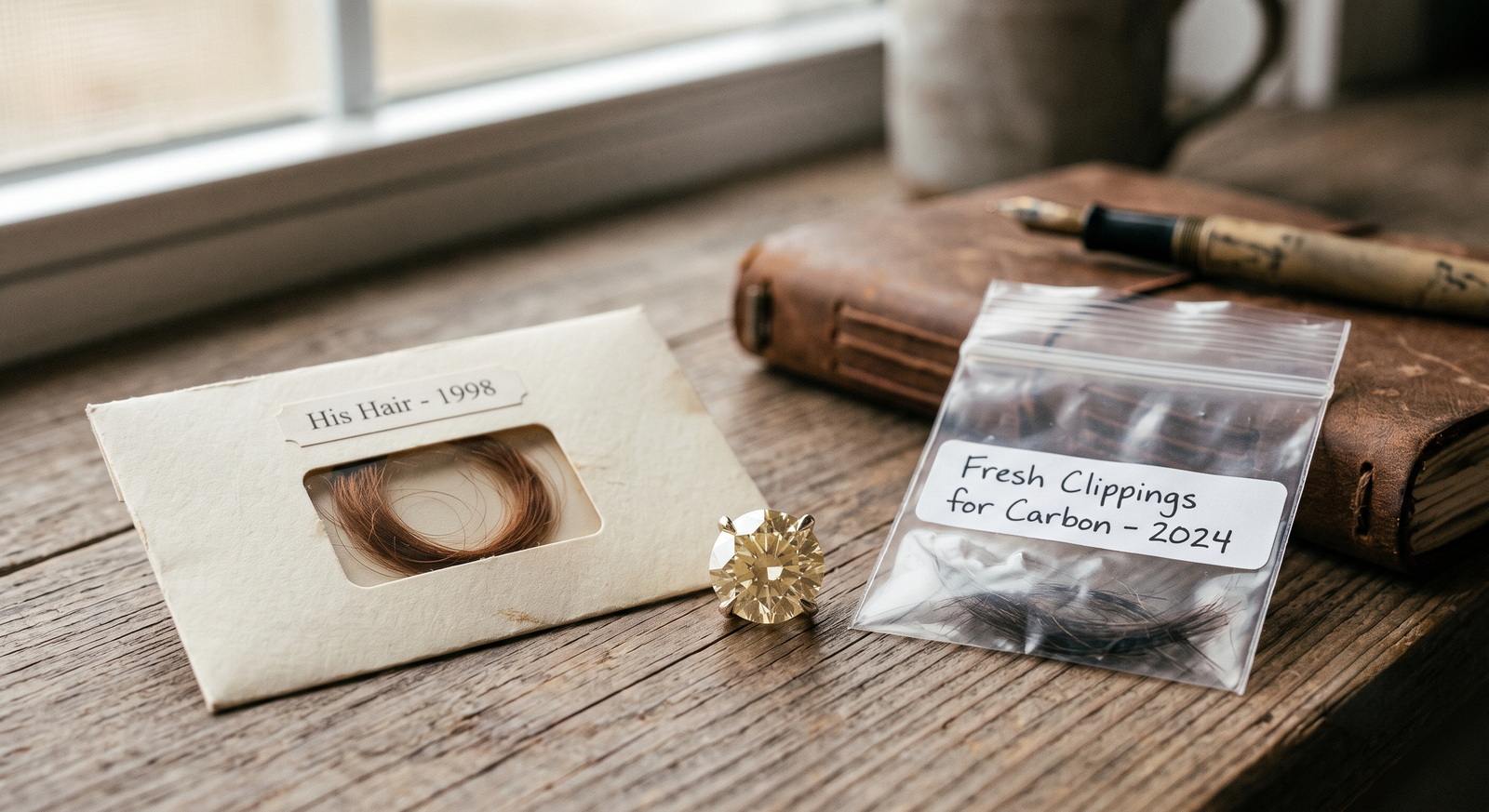
Table of Contents
Does an Old Lock Run a Different Process From New Clippings?
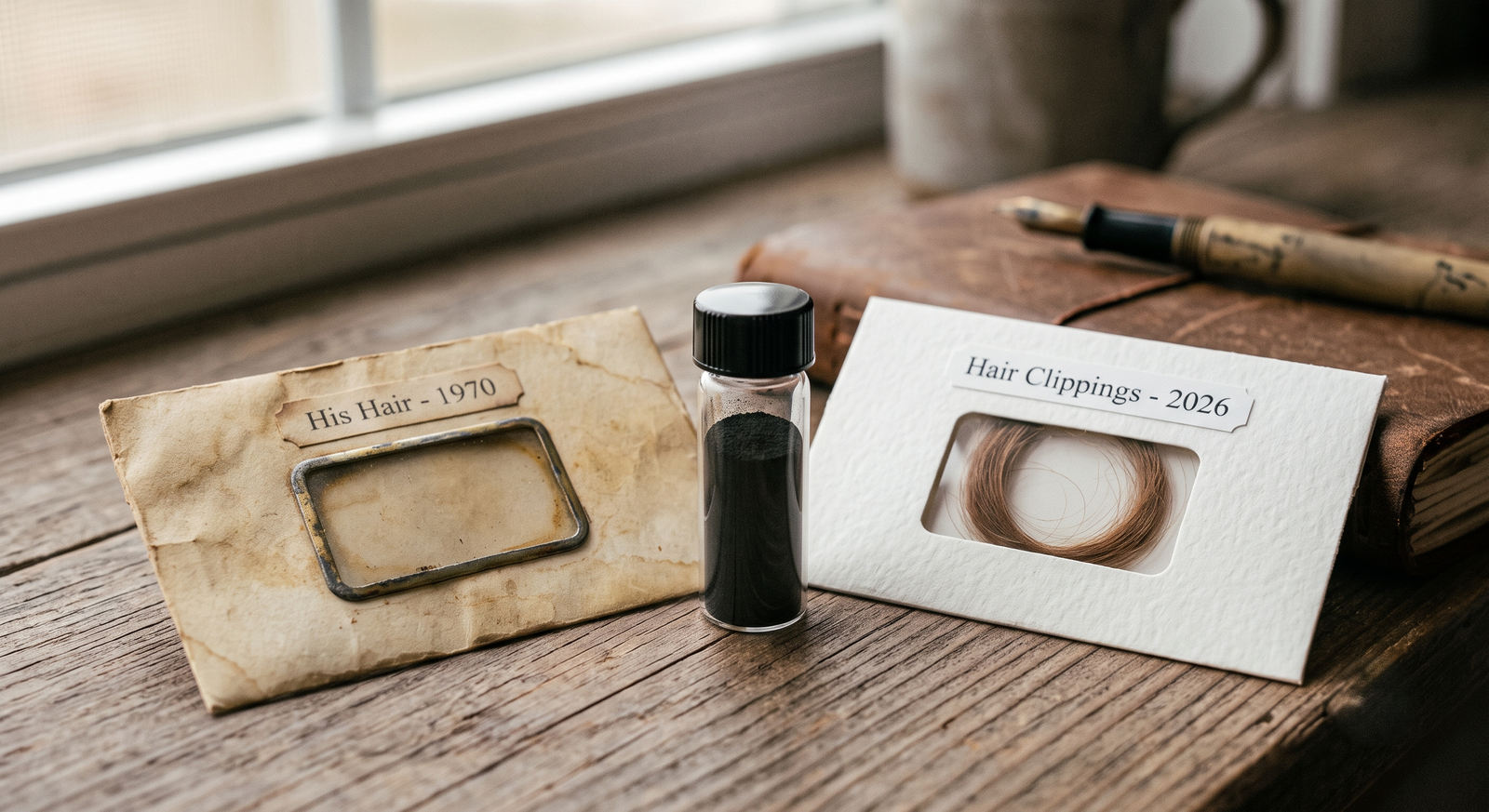
No. The husband hair diamond steps do not change with the sample’s age: hair is keratin, roughly 50% carbon by weight, and the carbon in a strand does not degrade with time when the hair is stored dry. Purification strips the strand to carbon at roughly 99.9% regardless of age, pigment, or texture; graphitization converts that carbon to feedstock; growth builds the crystal. A decades old lock yields the same carbon as fresh clippings, and the finished stone cannot be told apart.
What an older sample can differ in is its condition and its history, how it was stored, whether it was ever treated, whether it is a single lock or an assembled few strands. Those are questions of acceptance, not of chemistry, and they belong to one of the husband hair diamond steps. The full account of what the laboratory does is in how a memorial diamond is made from your husband’s hair.
The Husband Hair Diamond Steps, With the Branch Marked
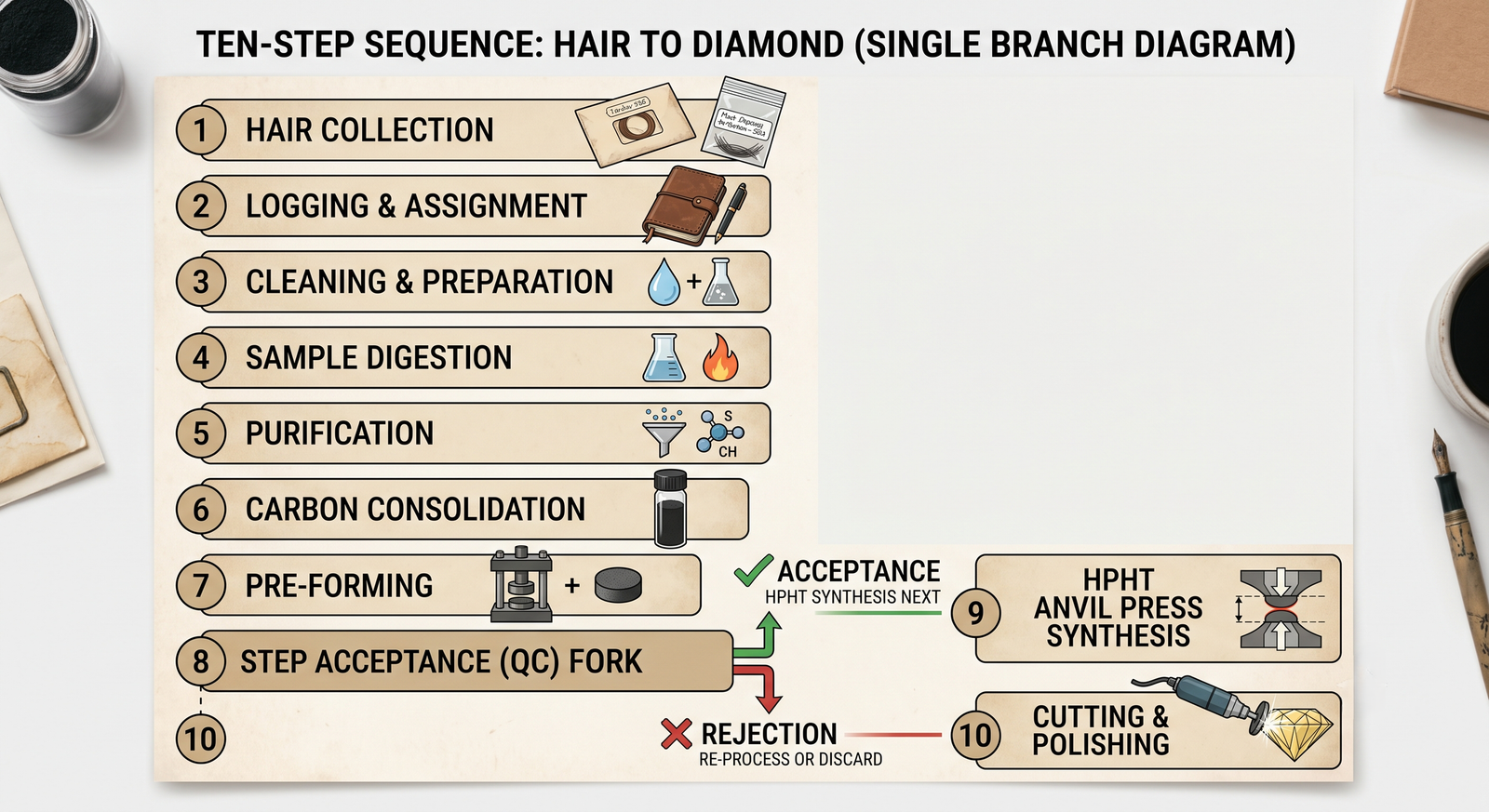
| # | Step | Who does it | Different for an older sample? |
|---|---|---|---|
| 1 | Secure the sample, dry, in a labelled envelope | You | No |
| 2 | Decide how many stones, and whether the sample can support them | You | No |
| 3 | Write your own record: date collected, source, weight if known | You | No, except that an old lock’s date is the date it was cut, not found |
| 4 | Ask the provider to assess the sample | You, then the provider | Yes, this is the branch |
| 5 | Settle the questions and place the order | You | No |
| 6 | Ship the sample | You, then a carrier | No |
| 7 | Intake and recorded weight | The provider | No |
| 8 | Purification and graphitization | The laboratory | No |
| 9 | Growth, cutting, and grading | The laboratory, then a cutter and grading lab | No |
| 10 | Return, with origin document and grading report | The provider | No |
One yes in ten husband hair diamond steps, and a half exception in row 3. Everything else is the same sequence whoever the hair came from and whenever it was cut.
Steps 1 to 3: Securing and Recording the Sample
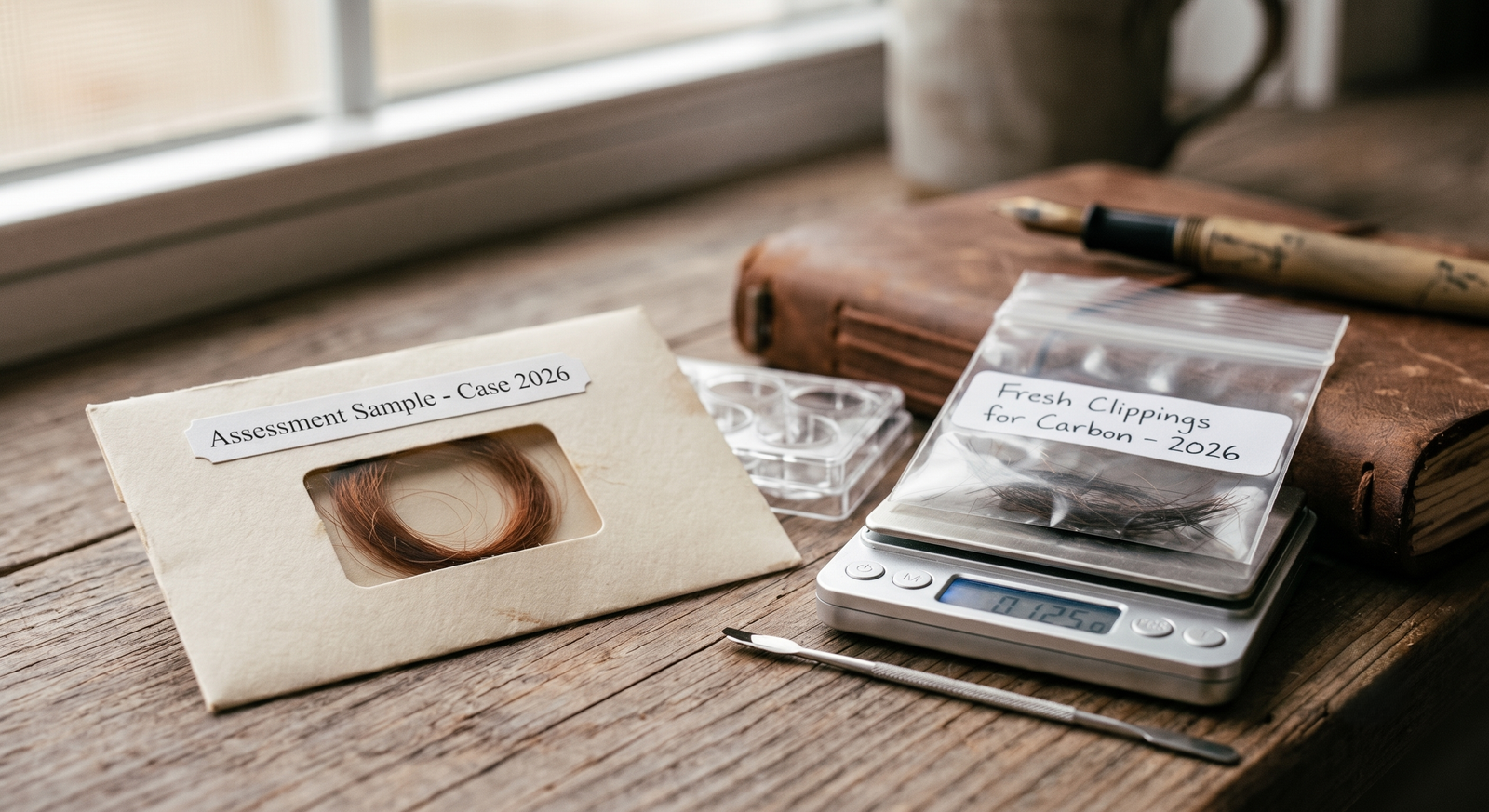
Step 1: Secure the sample. The first of the husband hair diamond steps is the simplest. Whatever you have, a lock in a keepsake box, clippings, strands from a brush, goes dry into a paper envelope or small bag, labelled with his name, the date, and the source. If there is hair from more than one place, use one envelope per place. Dry is the whole requirement; hair keeps indefinitely once it is. Where hair may still be in the house, and how to collect it before the house changes, is in how to turn your husband’s hair into a diamond.
Step 2: Decide how many stones. Each diamond needs its own minimum, industry typically a small lock or a few grams, and this is the one of the husband hair diamond steps where that arithmetic is done. A generous lock may support two; a few strands may support one, after assessment. Decide who might want a stone before deciding how much to send, because hair cannot be gone back for. The sizing question is in how much hair you need for a husband memorial diamond.
Step 3: Record it yourself. The date the hair was collected, where it came from, and the weight if you can measure it. For an old lock, record the date it was cut if you know it, and how it was stored; that is the one place an older sample adds a line. This note is the first entry in the origin record the finished stone will carry.
Step 4: The Acceptance Step, and the One Branch
This is where the husband hair diamond steps fork, and it is the only place they do. Before committing the sample, ask the provider to assess it, from a photograph, a description, and a weight if you have one. What they are assessing is not the chemistry but whether the sample meets their minimum and their acceptance policy, and that policy is where an older, short, or assembled sample can differ from fresh clippings.
The chemistry behind the husband hair diamond steps is settled: old hair yields carbon. The policy is not, and it varies by provider. So the branch is a set of questions, not a set of answers:
- Does the sample meet your minimum as it is, or only after pooling with other hair?
- Do you accept hair that has been stored for decades, and does storage condition matter to you?
- Do you accept an assembled sample, strands from a brush, a collar, a hat, rather than a single cut lock?
- Does prior dyeing or chemical treatment affect acceptance? It does not affect the finished stone, but some providers ask.
- If the sample is short of the minimum, what exactly happens, is it declined, or included and recorded?
If the answer is that the sample is accepted as it is, the branch closes and the sequence rejoins at step 5. If it is declined, the sample goes back into its envelope, nothing has been lost, and the options are a different provider, more hair if any can be found, or combining the hair with a portion of his ashes, which is set out in step by step: turning your husband’s ashes and hair into a diamond.
Steps 5 to 10: The Handover and the Laboratory
Step 5: Settle the questions and place the order. Before the husband hair diamond steps leave your hands, settle method (HPHT or CVD), carat, color family, who grades the stone, what is recorded at intake, what happens to hair not consumed by extraction, and the price. Ask whether the sample can be divided at the laboratory if you want two stones from one lock. The list is in questions to ask before turning your husband’s hair into a diamond.
Step 6: Ship the sample. Hair is not a regulated shipment the way cremated remains are, so the safeguards are yours: photograph the labelled envelope before it goes, keep the tracking reference with your note, and confirm the provider’s instructions for the day.
Step 7: Intake and recorded weight. The provider logs the sample under an order reference and records a weight; the husband hair diamond steps are theirs from here. Ask for confirmation, and compare it with your own figure from step 3.
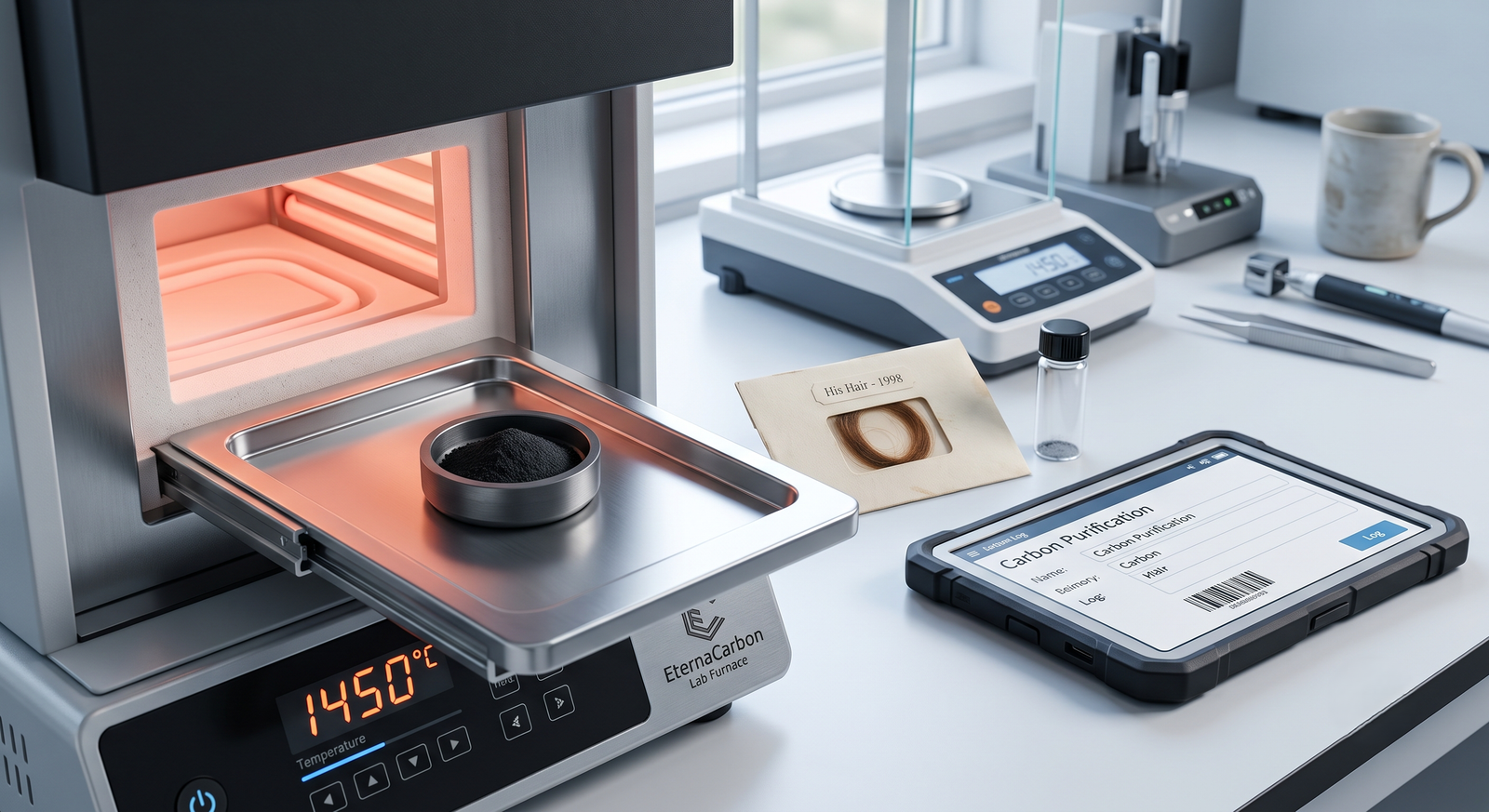
Step 8: Purification and graphitization. In an oxygen free furnace, the hair is taken through several heating stages that drive off everything except carbon, to roughly 99.9% purity; the carbon is then heated to about 2,500 to 2,700°C and converted to graphite. An old lock and new clippings arrive at the same graphite.
Step 9: Growth, cutting, and grading. The graphite, topped up with laboratory carbon, goes into a growth cell with a diamond seed and grows over weeks to months by HPHT or CVD diamond growth; the time it spends there sets the carat. A gemologist cuts the rough, and reputable providers have it graded independently on cut, color, clarity, and carat. The personal carbon is typically around 10 to 15% of the finished stone; with hair, that share is limited by the stone’s size, not the sample.
Step 10: Return. The stone arrives with a grading report and an origin document. Set the origin document beside the note you wrote at step 3 and confirm the collection date matches.
Why Doesn’t the Sequence Branch Again?
Because after acceptance, the sample’s history is no longer an input to any of the husband hair diamond steps. Purification does not know how old the hair was; growth does not know whether it came from a keepsake box or a comb. The only trace of the sample’s origin that survives to the finished stone is the paperwork, your note, the intake record, and the origin document, and paperwork is the same for every sample.
That is the reassurance hidden in the table. If an old lock is accepted at step 4, it is not a second class input for the remaining husband hair diamond steps; it is simply the input. The sequence for ashes, which has no acceptance branch but does have a deadline, is in step by step: turning your husband’s ashes into a diamond.
Frequently Asked Questions
Can a lock of hair that is decades old still be made into a diamond?
Yes, if it was stored dry. The husband hair diamond steps are the same for old hair because carbon in hair does not degrade with age, so an old lock yields the same carbon as fresh clippings and the stone is indistinguishable. Whether a provider accepts an old or assembled sample is a policy question to ask at acceptance.
Which of the husband hair diamond steps depends on the age of the sample?
Only the acceptance step, where a provider assesses whether the sample meets their minimum and their policy on older, short, or assembled samples. Every other step, securing, recording, shipping, purification, growth, grading, is the same for any hair.
What is a provider assessing when they look at my sample?
Not the chemistry, which is settled. They are checking that the sample meets their minimum, typically a small lock or a few grams, and whether it fits their acceptance policy: single lock or assembled strands, storage condition, and sometimes prior treatment. Ask them to assess from a photograph and weight first.
Does the hair need to be a single cut lock, or will strands from a brush work?
It depends on the provider, the one of the husband hair diamond steps where that matters. Many accept strands from a brush, hat, or collar if the total meets the minimum; some prefer a cut lock. Keep each source in its own labelled envelope so the provider knows what they are assessing.
What happens if the sample is declined at the acceptance step?
Nothing is lost, and the husband hair diamond steps simply pause. The hair goes back into its envelope, and the options are a different provider, more hair if any can be found, or combining the hair with a portion of his ashes in a single order. Hair keeps indefinitely once dry, so the decision can wait.
How long do the husband hair diamond steps take from shipping to return?
Industry wide, six to ten months from the laboratory receiving the sample, sometimes twelve for larger or specialty color stones. The age of the hair does not change the timeline; growth time in the press, which sets carat size, is what takes the months.
Final Thoughts on the Husband Hair Diamond Steps
Put the acceptance question first among the husband hair diamond steps. Before you decide on a carat, a color, or a setting, find out whether the lock you have is one a provider will take as it is, because if it is, every other step is the same as it would be for anyone, and if it is not, you will want to know before the envelope leaves the house. The husband hair diamond steps have one fork, and it is the one you can walk up to and ask about.
Learn More About Husband Memorial Diamonds
- How to Turn Your Husband’s Hair Into a Diamond
- How a Memorial Diamond Is Made From Your Husband’s Hair
- How Much Hair Do You Need for a Husband Memorial Diamond?
- Step by Step: Turning Your Husband’s Ashes Into a Diamond
- Husband Hair Diamond: The Complete Guide
Talk With Memorial Diamond
If what you have is an old lock and you are not sure it will be accepted, reach out to Memorial Diamond to talk through the acceptance step before anything else in the husband hair diamond steps.
Leave A Comment