
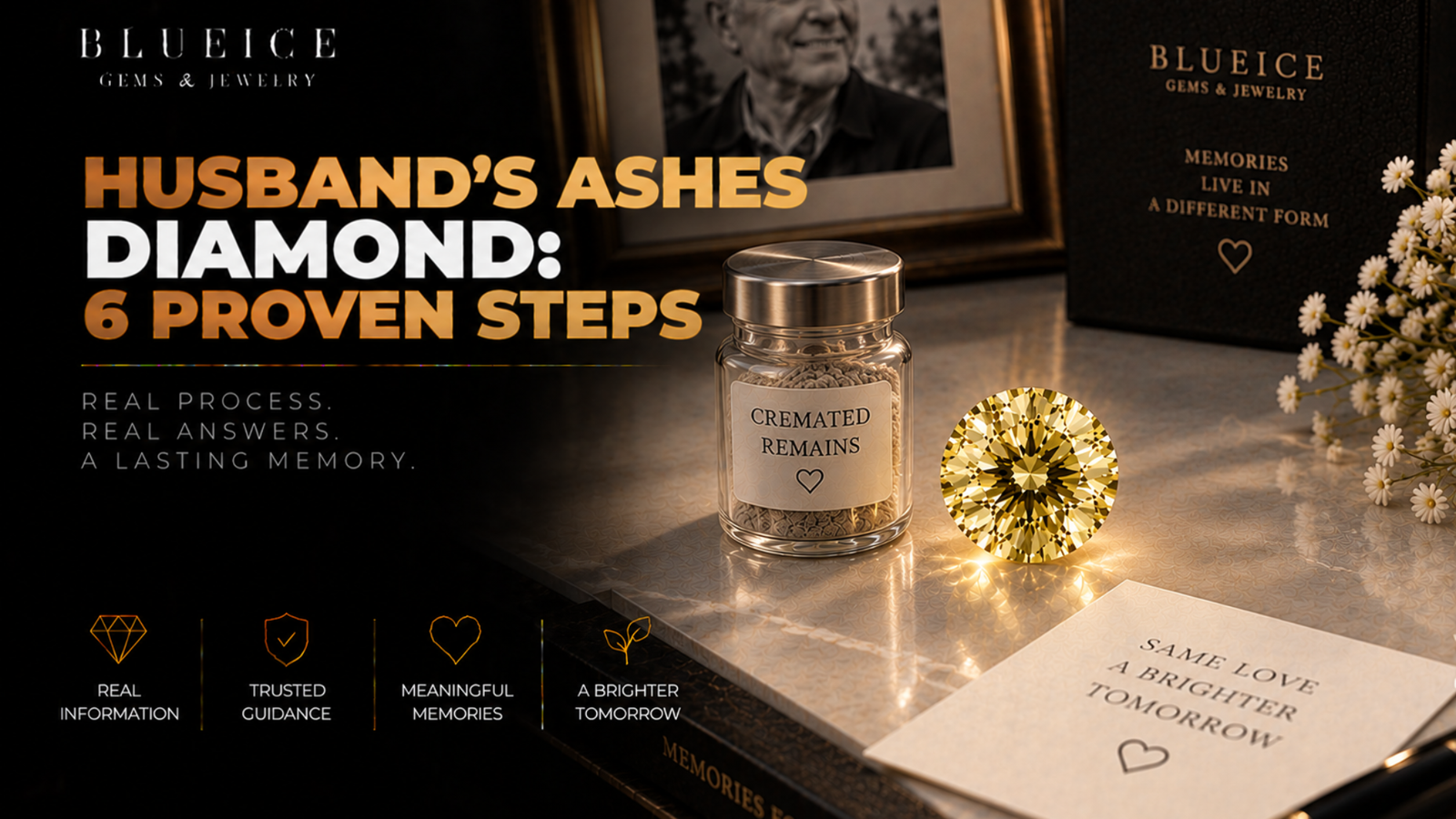
Every guide to this begins by telling you to ask whoever holds his remains to set a portion aside. If you were married to him, that person is usually you, and the container is usually in your house. To turn your husband’s ashes into a diamond, you set aside a small portion yourself, typically a few tablespoons up to about four ounces, send it to a laboratory, and receive a real lab grown husband’s ashes diamond back in roughly six to ten months. The step nobody prepares you for is the first one, because there is no funeral director standing between you and the urn.
Table of Contents
Where Are His Ashes Right Now?
Everything below assumes his ashes are already in your home, which is where most requests for a husband’s ashes diamond begin. If they are not, your first step changes.
| Where his ashes are | Your actual first step | Who to ask |
|---|---|---|
| In your home | Set a portion aside yourself | Nobody. This one is yours |
| Still with the funeral home | Ask them to hold a portion back before release | The funeral director. Whether they will separate, label, and hold it |
| Interred or in a niche | Ask what removal involves and whose consent it needs | The cemetery. Rules vary by state and by cemetery |
| Scattered, in whole or part | Ask what remains, or consider a hair sample instead | Whoever scattered them. See the hair route |
If a funeral home still holds them, ask about the deadline. Many release remains on a schedule, and a portion held back has to be requested before that date, not after.
Step 1: Decide How Much to Set Aside
Cremated remains are mostly calcium phosphate; usable carbon is roughly 0.5% to 4% by weight. That low yield is why providers of a husband’s ashes diamond ask for a measurable portion rather than a pinch, and why it is still a small fraction of a full cremation. Industry typical requests run from a few tablespoons to around four ounces, or about 100 grams.
Ask your chosen provider for their exact figure before you open the urn, and ask whether a second husband’s ashes diamond would need a second portion. If his children may want stones of their own, setting aside enough for all of them now saves reopening the container later. The quantity question is answered in detail in how much ash you need for a husband memorial diamond.
Step 2: Divide the Portion at Your Own Table
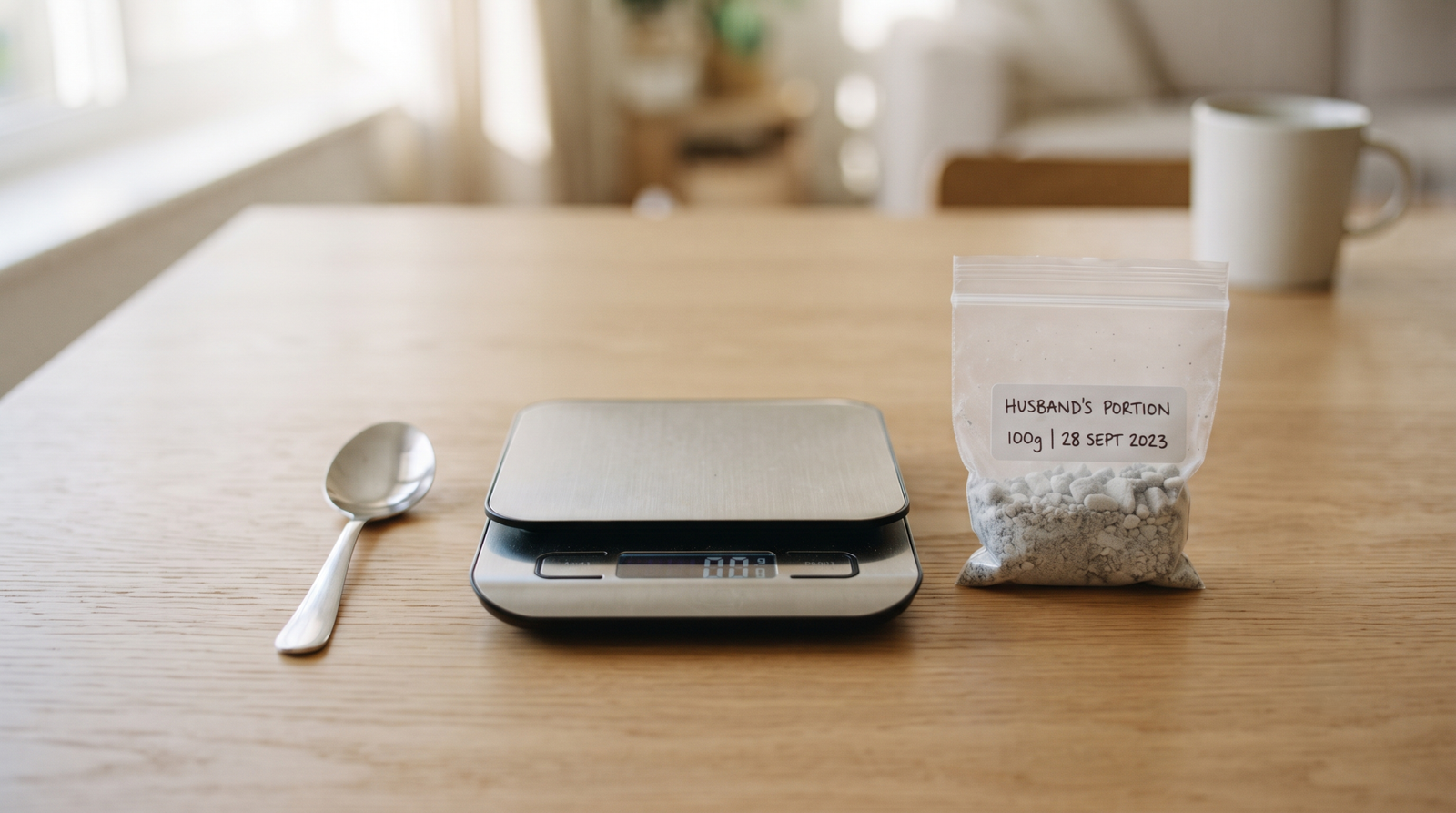
This is the job the guides to a husband’s ashes diamond skip. There is no ritual for it and no one to hand it to, so make it deliberate:
- Choose a time when you will not be interrupted, and decide whether you want someone with you.
- Lay out a clean surface, a kitchen scale, a new sealable bag or container, and a permanent marker.
- Open the urn and transfer the portion with a clean spoon. Do not sift or select; the remains are uniform.
- Weigh the portion, seal it, and label it with his name, the date, and the weight.
- Close the urn, and put the labelled portion somewhere it cannot be mistaken for anything else.
Some people find this unbearable and ask a funeral home to do it for a fee. That is a reasonable choice. Some find it the first thing since the funeral that felt like theirs to do. Neither reaction is wrong.
Step 3: Write Down What You Did
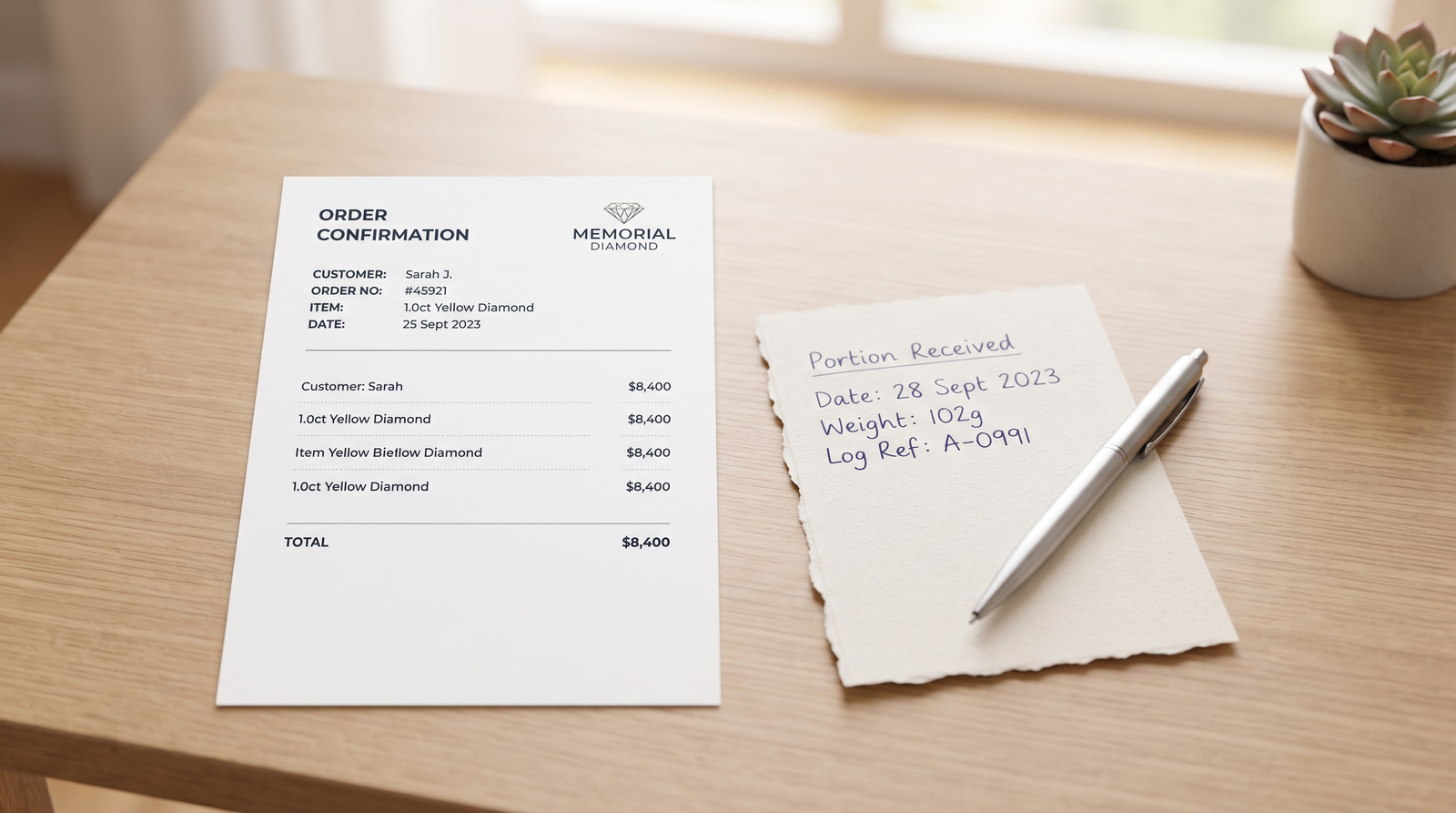
Once the portion leaves the urn, you are the only record that it existed. No funeral home logged it; no one else watched. Write down the date, the weight, and where the rest of his ashes are, and keep that note with the paperwork that comes back from the provider. A husband’s ashes diamond will eventually carry an origin document; your own note is the first entry in that chain.
Step 4: Choose and Brief a Provider
Providers of a husband’s ashes diamond differ on method, minimums, and what they return to you. Before you send anything, settle these in writing:
- Which growth method they use, and how HPHT and CVD diamond growth affects timeline and color.
- What they record at intake: a weight, a photograph, an order reference.
- What happens to any material not consumed by carbon extraction.
- Whether the finished stone is graded by an independent laboratory, and by whom.
- The carat size and color you are choosing, and the price for each, including any grading report or setting.
Color is worth understanding before you decide. Trace nitrogen produces yellow tones and boron produces blue; a colorless husband’s ashes diamond requires those elements to be excluded and typically costs more. Most memorial stones trend toward yellow, champagne, or blue. The full list of questions is in questions to ask before turning your husband’s ashes into a diamond.
Step 5: Send the Portion
Shipping rules for cremated remains vary by carrier and by country, so confirm the provider’s current instructions on the day rather than following a general rule. Most husband’s ashes diamond providers send a labelled collection kit. Photograph the sealed portion before it goes, keep the tracking number with your note from Step 3, and ask the provider to confirm receipt and the recorded weight.
Step 6: What Happens Once It Leaves You
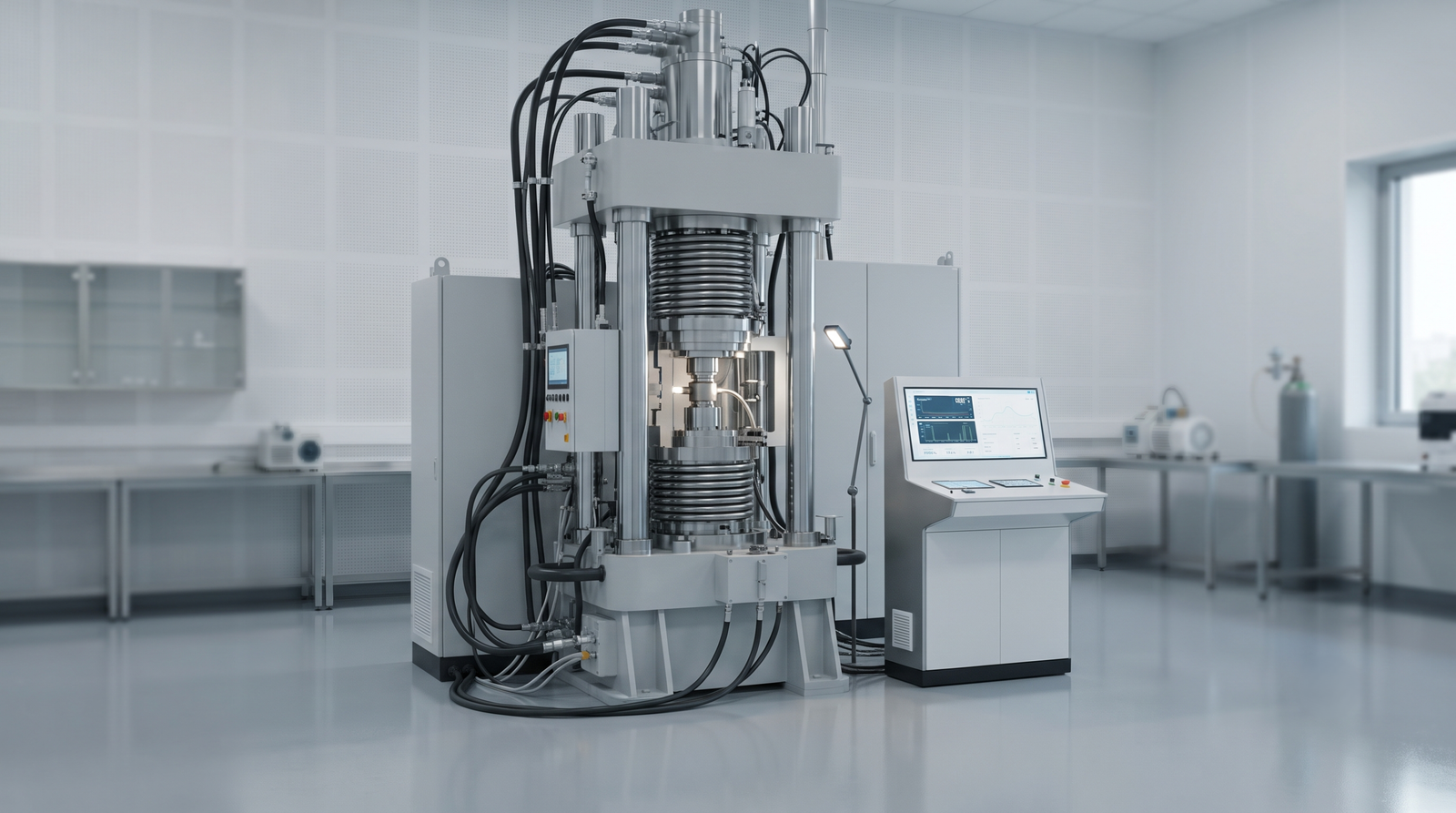
From here the husband’s ashes diamond is the laboratory’s work. The portion is heated in a controlled, oxygen free process that removes the calcium phosphate and leaves carbon at roughly 99.9% purity. That carbon is converted to graphite at around 2,500 to 2,700°C, blended with laboratory carbon to reach the volume a viable crystal needs, and grown around a diamond seed for weeks to months. A gemologist then cuts and polishes the rough stone, and it is graded on the same cut, color, clarity, and carat scale as any diamond.
Growth time in the press, not the amount of ash you sent, determines carat size; the whole picture, including settings and family decisions, is in the husband ashes diamond guide. Industry wide, a husband’s ashes diamond takes six to ten months, sometimes twelve for larger or specialty color stones. The stage by stage version, including who holds the material at each point, is in how a memorial diamond is made from your husband’s ashes.
How Much of a Husband’s Ashes Diamond Is Actually Him?
Less than you might hope, and more than a symbol. The carbon recovered from his ashes typically makes up around 10% to 15% of the finished stone’s mass, with the rest being laboratory carbon needed to grow a crystal of usable size. Some providers cite lower figures for larger stones. A husband’s ashes diamond is physically made in part from him, and the origin document should say exactly that. Any provider claiming the stone is entirely his ashes is overstating the physics.
Frequently Asked Questions
Can I divide my husband’s ashes myself, or does a funeral home have to do it?
You can do it yourself. Once cremated remains are released to you, dividing them is a private decision, though customs and cemetery rules may apply if they are interred. Many funeral homes will separate and label a portion for a fee if you would rather not.
How much of his ashes do I need for a husband’s ashes diamond?
Industry typical requests run from a few tablespoons to about four ounces, roughly 100 grams. That is a small fraction of a full cremation, so the remainder can be interred, scattered, or kept as planned. Confirm the exact figure with your provider before opening the urn.
Is the diamond really made from his ashes?
Yes, in part. Carbon is extracted from the ashes, purified, and grown into the crystal; that personal carbon typically makes up around 10% to 15% of the stone, with laboratory carbon supplying the rest. The stone is physically made from him, not a keepsake with ashes sealed inside.
How long does it take to turn my husband’s ashes into a diamond?
Six to ten months from receipt of the ashes to a finished husband’s ashes diamond is typical industry wide, with larger or specialty color stones sometimes taking up to twelve months. The time is spent mainly in the growth press, and carat size is set by that growth time.
What color will a husband’s ashes diamond be?
Most memorial diamonds trend toward yellow, champagne, or blue because trace elements from an organic carbon source remain during growth. Colorless is achievable with additional processing at a higher cost. Some providers also offer post growth irradiation for red, pink, green, or black.
Can his children get diamonds from the same ashes?
Usually, yes. Because only a portion is used per husband’s ashes diamond, several diamonds can be grown from one shared source if enough remains. Decide early how many portions to set aside so the urn is opened once rather than repeatedly.
Final Thoughts on Turning Your Husband’s Ashes Into a Diamond
The laboratory part of a husband’s ashes diamond is slow, documented, and out of your hands. The part that is yours is the first afternoon: the scale, the spoon, the label, and the note only you can write. Do that part carefully, and everything that follows has a record to stand on.
Learn More About Husband Memorial Diamonds
- Step by Step: Turning Your Husband’s Ashes Into a Diamond
- How a Memorial Diamond Is Made From Your Husband’s Ashes
- How Much Ash Do You Need for a Husband Memorial Diamond?
- Husband Ashes Diamond: The Complete Guide
- How to Turn Your Husband’s Hair Into a Diamond
Talk With Memorial Diamond
If his ashes are in your home and you are unsure whether a husband’s ashes diamond is right, or how much to set aside or how to send it, reach out to Memorial Diamond to talk through the first step before you open the urn.
Leave A Comment