

You may find yourself holding two pieces of him: a portion of ashes from the urn and a lock of hair saved along the way. A memorial diamond made from brother ashes and hair passes through seven lab stages, with each material logged as its own item and, depending on the lab, refined separately before the carbon is combined for growth. The industry-typical span is 6 to 10 months, and no published figure says how much of a blended stone comes from each source.
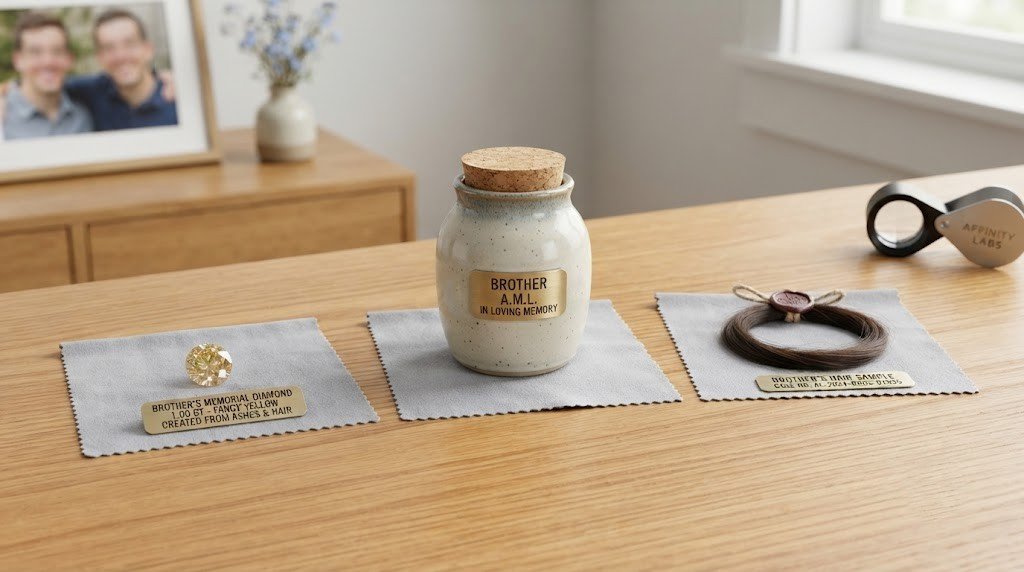
Table of Contents
What Are the Seven Stages for a Diamond Made From Brother Ashes and Hair?
The stages themselves are the same seven that any memorial stone goes through. What changes with two materials is the early part of the journey, when ashes and hair are handled as distinct items before their carbon meets. The table follows a diamond made from brother ashes and hair through each stage, column by column, so you can see where each material sits.
| Stage | His ashes | His hair |
|---|---|---|
| 1. Intake and chain of custody | A few tablespoons to roughly 4 oz (about 100 g), logged under his order | A small lock or a few grams, logged under the same order as a separate item |
| 2. Extraction and purification | Oxygen-free heating separates a little carbon from mostly calcium phosphate | Oxygen-free heating drives off the non-carbon parts of keratin |
| 3. Graphitization | Carbon from both sources, now refined past roughly 99.9%, goes into a furnace at around 2,5002,700°C to form graphite | The same step, possibly on carbon already combined, depending on the lab |
| 4. Diamond growth | Combined carbon, typically with supplemental lab carbon, grows on a seed in an HPHT press (CVD at a minority of labs) | Same crystal; the two sources are no longer separate |
| 5. Cutting and polishing | One rough crystal is faceted into your chosen shape | Same stone |
| 6. Optional irradiation | Offered on request to shift or deepen color | Same stone |
| 7. Grading and certificates | Origin certificate and, ideally, an independent grading report | Same paperwork |
Notice where the columns stop mattering. Once both materials have been refined to carbon, they are chemically the same element, and from the moment the lab combines them, a stone made from brother ashes and hair is handled as a single piece of work. That moment varies by provider, so it is worth asking. For a broader overview, our complete guide to a brother ashes and hair diamond covers cost, color, and family planning.
Why Would a Family Use Both Ashes and Hair?
Some people simply have both. A funeral home may have saved a lock before cremation, or a family member may have kept hair from an earlier haircut, and a stone made from brother ashes and hair can feel like it includes more of who he was. Others are drawn to the idea that the stone holds something of him from two different moments: the hair he grew while living and the ashes that came after.
There is no technical need to combine them. A single source is enough for a diamond, and each material can be grown into its own stone if you prefer. A diamond made from brother ashes and hair is a personal choice, not an upgrade, and no option here is more correct than another.
If you are still deciding, our separate guides on how a diamond is made from his ashes alone and how one is made from his hair alone show what each single-material path involves.
Who Needs to Agree When Two Materials Are Involved?
A diamond made from brother ashes and hair can involve two different people whose agreement matters. His ashes are usually under the control of whoever holds authority over his remains, and siblings frequently sit behind others in that order. A spouse or registered partner, adult children, and parents commonly have priority, though the sequence is decided state by state, and documents he left behind, like a will, a pre-need arrangement, or a designated agent form, can reorder it.
The hair in a stone made from brother ashes and hair follows its own path. When the funeral home did the trimming, the lock usually comes back through whichever relative or agent controls his remains. Hair that turns up in his home or among his possessions is a different matter: depending on the state, it may belong to his estate, which can bring the executor or estate representative into the decision.
If someone else holds authority, a respectful request for a small portion of ashes and a small lock of hair for a stone made from brother ashes and hair is usually the kindest starting point. If ashes are not available to you, hair alone remains a complete path. Faith can enter the conversation as well: no tradition has an official position on memorial diamonds specifically, practices vary, and a family’s own faith leader is the person to consult.
How Does the Lab Keep Two Materials Straight at Intake?
Intake is where the chain of custody for a diamond made from brother ashes and hair begins, and with two materials it carries a little extra detail. A reputable lab should open the package, check the paperwork, and log the ashes and the hair as separate items tied to one order reference, with each weighed, recorded, and stored sealed, apart from every other family’s material. Ask your provider to describe its own intake routine.
Logging them separately matters for two reasons. The materials need different extraction treatment, so the lab has to know which is which. And if any of either material is left over, you will want to know exactly what is returned or held. For a diamond made from brother ashes and hair, the intake record should make clear that both items arrived and were tracked from the first moment.
Ask how the lab labels an order for a stone made from brother ashes and hair and whether its paperwork will show both. That record is what lets the final origin certificate state with confidence what went into his stone.
Why Is Carbon Extracted Differently From Ashes and From Hair?
The two materials in a stone made from brother ashes and hair could hardly be more different in makeup. Cremated ashes are mostly calcium phosphate, the mineral that gives bone its structure, and industry figures put their carbon at roughly 0.5% to 4% by weight. Hair is built from keratin, a carbon-rich protein, and is roughly 50% carbon.
That difference shapes the work. With ashes, the lab is coaxing a small amount of carbon out of a large mineral mass, which is why a few tablespoons or more are typically requested. With hair, about half the weight is already carbon, so the task is driving off the rest of the protein, and a small lock is usually enough. For a diamond made from brother ashes and hair, each material is heated in a controlled, oxygen-free, multi-stage process suited to its makeup, so the carbon does not burn away while everything else is removed.
Both paths toward a diamond made from brother ashes and hair end at the same place: carbon refined to roughly 99.9% purity or higher. At that point, the carbon from his ashes and the carbon from his hair look and behave identically. Our post on how much ash and hair a brother memorial diamond needs goes further into quantities.
When Are the Two Carbon Sources Brought Together?
For a stone made from brother ashes and hair, the refined carbon from each source is typically combined before growth, along with supplemental lab carbon that brings the total up to the volume a crystal of your chosen size requires. Some providers may combine before graphitization, which heats the carbon to around 2,5002,700°C and turns it into graphite; others may combine the graphite just before it is loaded into a growth cell. The step is handled by the lab, and the exact point is worth confirming with your provider.
What matters for you is that, once combined in a diamond made from brother ashes and hair, the two sources cannot be pulled apart again. Carbon is carbon. There is no marker that keeps ash-derived atoms in one corner of the crystal and hair-derived atoms in another.
That is also why the decision to use both needs to be made before extraction is complete. If you later wanted a stone made from brother ashes and hair to become two separate stones instead, the carbon would already be mixed. Settling the plan at intake keeps every option open until you are sure.
What Does a Blend Mean in a Stone Made From Brother Ashes and Hair?
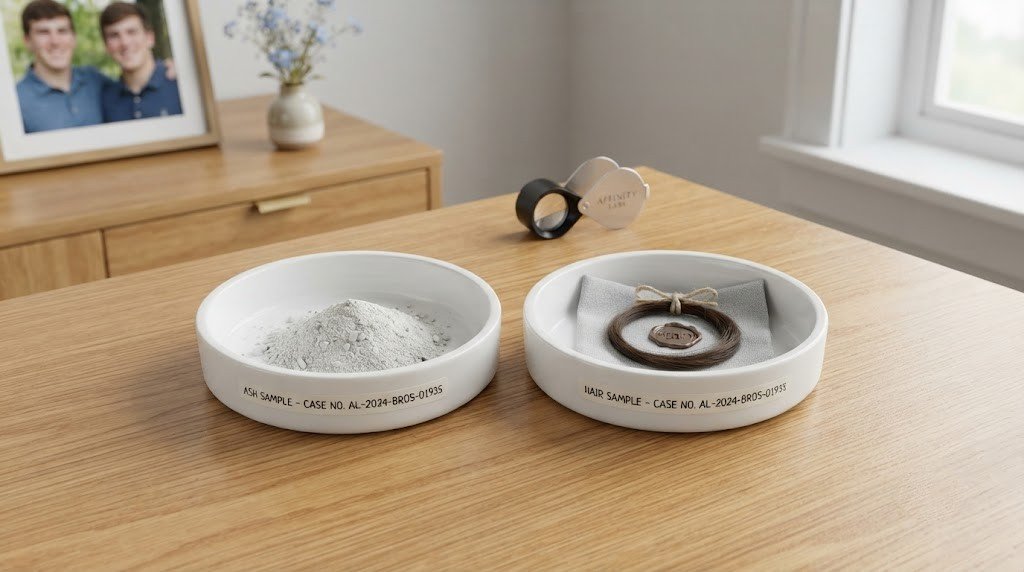
A blend means the finished crystal holds carbon from both of his materials, bonded together in one lattice with supplemental lab carbon. It is a single diamond made from brother ashes and hair, not two layers or two halves, and no one can point to a facet and say which part came from hair.
It also means there is no published percentage for how much of a diamond made from brother ashes and hair comes from each source, or from him in total. The ash figure you may come across, roughly 1015% of a finished stone’s mass, with some providers citing as little as about 3%, applies only to stones grown from ashes alone. It does not transfer to hair or to blends, and a provider should not suggest it does.
The honest summary is that in a diamond made from brother ashes and hair, a real share of his carbon, from both his ashes and his hair, becomes part of the crystal, and the size of that share depends on the provider and the stone. Ask the lab what it expects for your carat and how it records the inputs. Our post on whether a memorial diamond is really made from your brother’s ashes and hair takes that question on directly.
What Happens in the Press, and Does Using Two Sources Change It?
Most memorial providers grow a diamond made from brother ashes and hair with HPHT, high pressure and high temperature. The combined graphite is packed around a tiny diamond seed in a growth cell, and a press holds it at roughly 68 GPa and 1,4002,500°C. Carbon gradually crystallizes onto the seed, building a rough diamond over weeks to months. A minority of labs use CVD, where carbon becomes a carbon-bearing gas deposited onto a seed plate in a vacuum chamber; Wikipedia’s overview of lab-grown synthetic diamonds explains both methods.
Using two materials does not change how growth works, and it does not make the stone larger. Carat size comes from how long the crystal grows, not from how much material you send, so a stone made from brother ashes and hair is not automatically bigger than one from a single source. Memorial stones are generally offered from about 0.10 carats to 5 carats or more.
Color forms during growth too. Nitrogen tends to give yellow, boron gives blue, and colorless requires both kept out, which adds processing and typically cost. Memorial stones commonly lean yellow, blue, or champagne, and combining sources in a stone made from brother ashes and hair does not make the exact shade predictable. Our post on the color of a brother ashes and hair diamond explains the chemistry in more detail.
How Is the Finished Stone Cut, Colored, and Documented?
A rough crystal made from brother ashes and hair comes out of the press with a frosted surface and a shape set by growth. A cutter plans the facets and then cuts and polishes it into the shape you chose, from round or oval to cushion, princess, or another cut the provider offers. Fancy cuts commonly cost extra.
Irradiation is the optional extra some labs offer once cutting is done; treating the stone after growth can push its color toward red, pink, green, or black. You can decline it and keep the color that formed naturally. Either way, the finished diamond made from brother ashes and hair rates 10 on the Mohs scale, though a hard knock can still chip it.
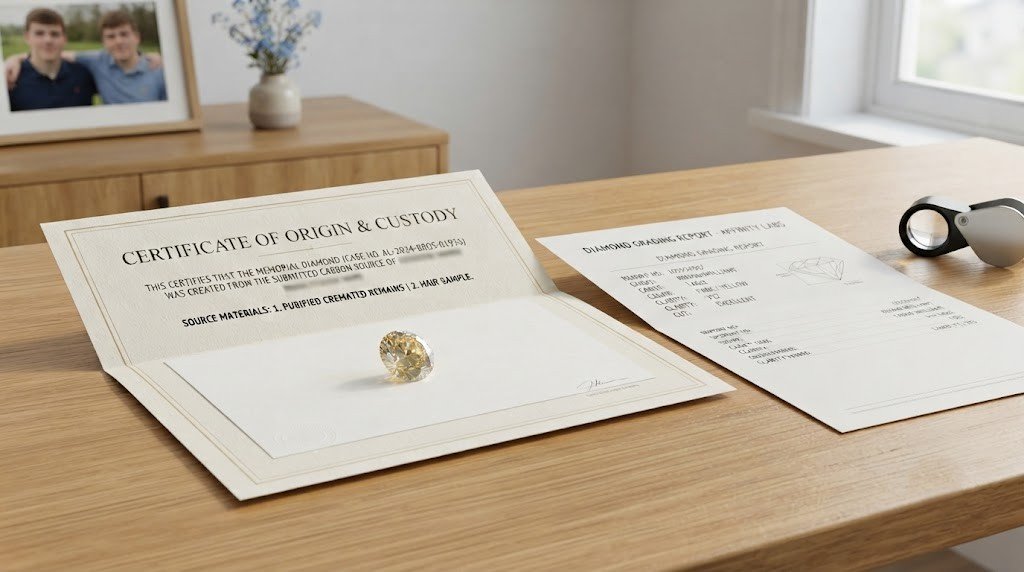
Two documents typically come back with the stone. An in-house origin or authenticity certificate records that it was grown from your family’s submitted material, and for a stone made from brother ashes and hair it is worth asking whether it names both the ashes and the hair. A grading report, ideally from an independent lab working to GIA or IGI standards, describes the cut, color, clarity, and carat; clarity for memorial stones typically falls between SI2 and VVS.
How Long Does It Take, and What Does It Cost?
Plan on roughly 6 to 10 months as the industry-typical span for a memorial diamond made from brother ashes and hair, counted from the day the lab has both materials in hand, with stones of about 2 carats or more, or specialty colors, taking up to around 12 months. No fixed duration applies to any single stage, and whether a second material adds time is a question only your lab can answer, so ask it directly.
Cost depends mainly on carat, color, and cut. General 2026 industry ranges, which are not this brand’s published prices, run roughly 1,5003,500 for about 0.100.25 ct, 5,00015,000 for 0.51 ct with colorless near the top, and 20,00075,000 or more for 25+ ct. Independent grading, engraving, fancy cuts, and settings are typically priced on top. Ask whether a two-material order carries any added handling fee.
Because carat comes from growth time, the size you choose shapes both the timeline and the price of a stone made from brother ashes and hair far more than the decision to include both materials.
What Should You Ask a Lab About a Two-Material Stone?
A few questions are specific to combining sources. Before sending anything for a diamond made from brother ashes and hair, consider asking:
- Will the ashes and hair be logged as separate items under one order, and will the paperwork show both?
- At what point do you combine the two carbon sources?
- Can you tell me roughly what share of the stone you expect to come from his material?
- What happens to any ashes or hair left over: returned, held, or reserved for another stone?
- How should each material be packaged and shipped, and which carriers do you accept?
- If a growth run fails to yield a usable crystal, what happens next?
- Will the origin certificate name both materials, and is independent grading included?
If other relatives also want stones from the same ashes or hair, our post on sharing a brother memorial diamond explains how several stones can often come from one source. A good provider will answer each question plainly and without pressure.
Frequently Asked Questions
Does a diamond made from brother ashes and hair become one stone or two?
One stone. After extraction, carbon from his ashes and his hair is typically combined, with supplemental lab carbon, and grown as a single crystal. If you would rather keep the materials distinct, ask about growing a separate stone from each instead.
Does using both ashes and hair make the diamond bigger?
No. The finished size comes from the length of the growth run you choose, so a heavier parcel of material changes nothing. Pairing hair with ashes neither enlarges the stone nor shortens the wait; your carat selection is what sets the timeline.
What percentage of a blended stone comes from him?
No published percentage exists for blended stones. The often quoted 10 to 15 percent figure describes stones grown from ashes alone. Ask your provider what share they expect for your chosen carat and how they record the inputs.
Why would a lab extract carbon from ashes and hair separately?
The two materials are very different. Ashes are mostly calcium phosphate with only about 0.5% to 4% carbon, while hair is roughly half carbon. Each needs extraction suited to its makeup before the refined carbon can be combined.
Can the hair come from a different place than the ashes?
Yes. The hair might come from a funeral home trim, an earlier haircut, or his belongings, while the ashes come from the urn. A funeral home trim generally goes through whoever holds authority; hair saved among his things may be part of his estate, depending on the state.
Will combining ashes and hair change the diamond’s color?
Not in a predictable way. Shade depends on trace elements, mainly nitrogen and boron, present while the crystal grows, and neither source lets anyone forecast the result. Yellow, blue, and champagne tones are common, while colorless takes extra processing.
Final Thoughts on a Diamond From Both His Ashes and Hair
Choosing both materials is a way of saying that more than one part of his story belongs in the stone, and the lab process honors that by tracking each one carefully until the moment they meet. A memorial diamond made from brother ashes and hair ends as a single crystal you can understand, not a mystery. If one material feels like enough, or none feels right yet, that is just as valid; the point is that whatever you choose, you choose it knowing what happens along the way.
Learn More About Blended Memorial Stones
- Brother Ashes and Hair Diamond: The Complete Guide the full overview for combining both materials
- How Much Ash and Hair Do You Need for a Brother Memorial Diamond? typical quantities of each
- Is a Memorial Diamond Really Made From Your Brother’s Ashes and Hair? the honest answer on what is his
- Provider questions for a brother memorial diamond grown from two materials what to raise before you sign anything
Talk With Memorial Diamond
If you have both his ashes and a lock of his hair and are wondering how they might come together, Memorial Diamond would be glad to talk through a diamond made from brother ashes and hair with you, including how each material would be handled. Reach out at memorialdiamond.us whenever you feel ready.
Word count: 3,152 words · Reading time: about 16 minutes
Leave A Comment