
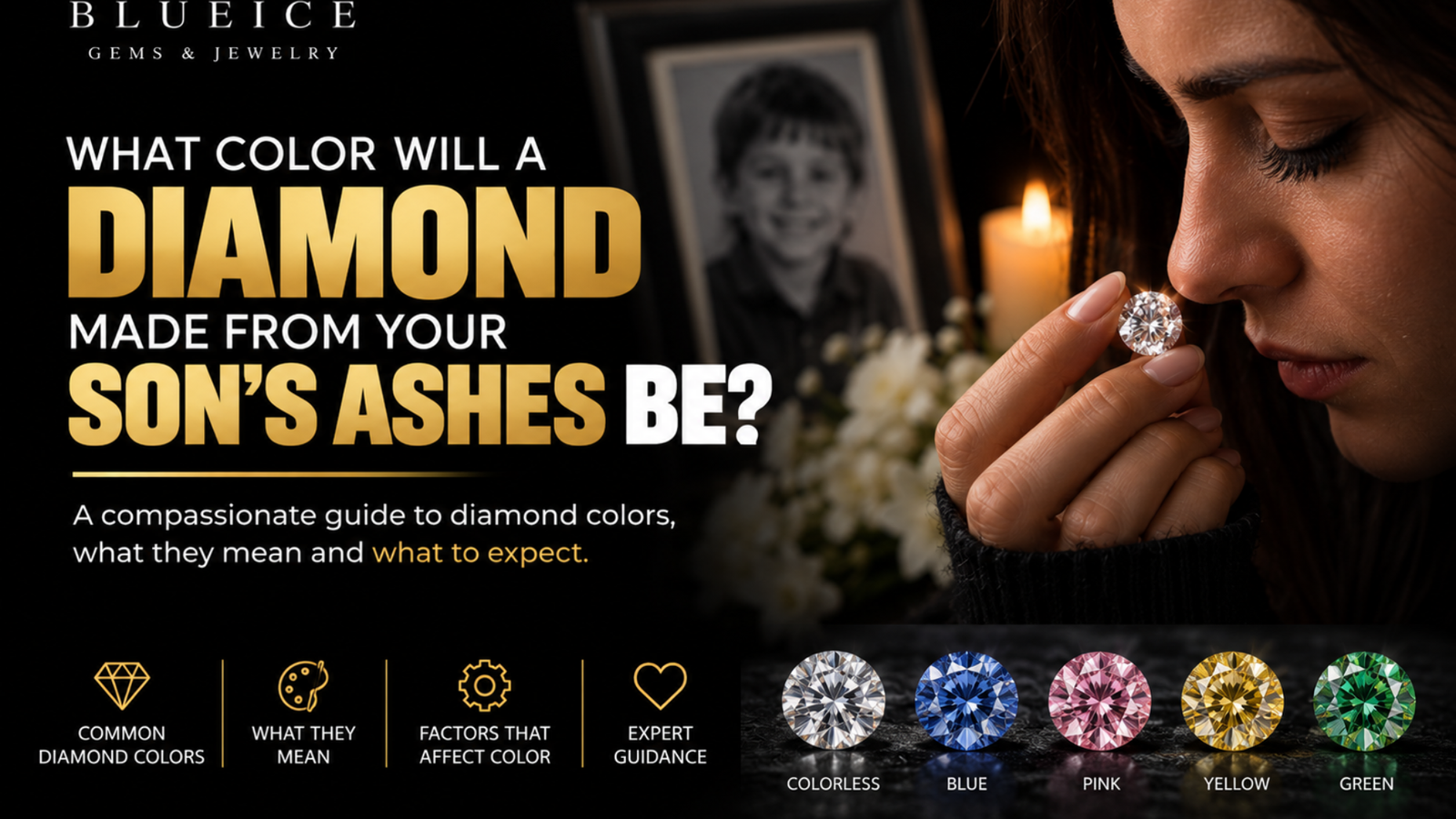
Parents usually picture something in particular before they ever ask, and then hesitate to say it out loud. Here is the plain answer: son ashes diamond color most often lands in the yellow, blue or champagne to brown family, because trace elements present during growth decide the shade and ash is an organic, individual starting material. Colorless is achievable with extra processing and usually costs more, and no honest provider will promise a particular son ashes diamond color in advance.
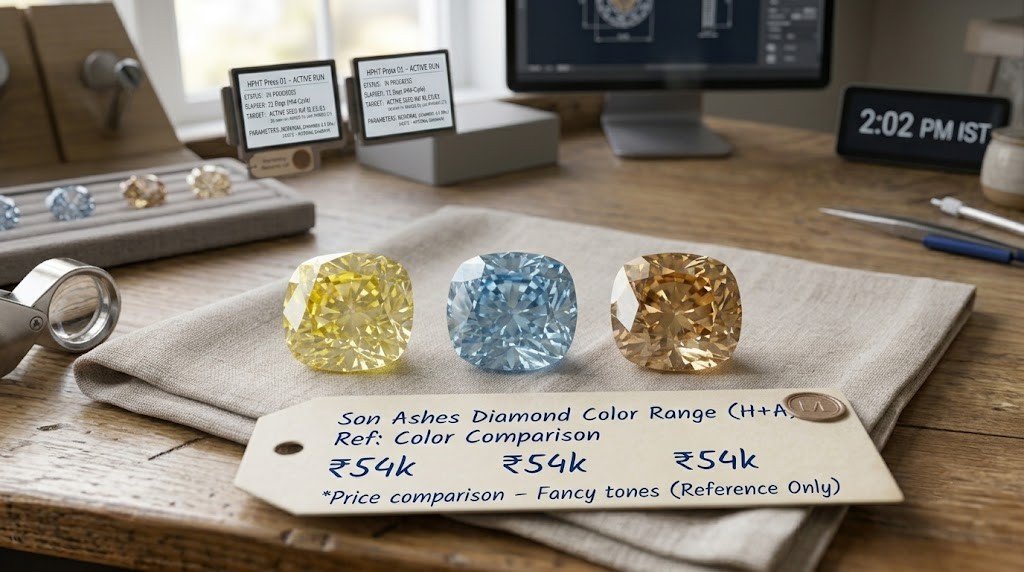
Table of Contents
Where Does Any Diamond’s Color Come From?
From tiny quantities of elements that are not carbon, caught in the crystal while it grows. Pure carbon in diamond structure, with nothing else caught in the lattice, is colorless. So every question about son ashes diamond color is really a question about what else was present.
Two elements do most of the work. Nitrogen produces yellow tones. Boron produces blue ones. The complete absence of both is what a colorless diamond requires. Colorlessness is not an added quality, it is the absence of everything else.
That single mechanism explains the entire son ashes diamond color question. Whatever trace elements are present in the growth cell as the crystal forms will express themselves as a shade, and the crystal takes on that character permanently.
It is also why this is not adjustable afterwards in the way a metal finish or a setting is. The son ashes diamond color you receive is structural. It is in the lattice, not on the surface. How a memorial diamond is made from his ashes follows the material through the growth stage in detail.
Why Do Memorial Stones Lean Yellow and Blue?
Because the carbon comes from a person rather than from a controlled industrial feedstock, and a person is not chemically tidy.
An industrial diamond manufacturer starts with carbon refined to exclude everything else. A memorial laboratory starts with cremated remains, purifies the recovered carbon to roughly 99.9% or better, and that remaining fraction of a percent is precisely where trace elements live. Nitrogen especially is common in organic material, which is a large part of why son ashes diamond color so often reads warm.
So a warm son ashes diamond color is not a defect or a shortcut. It is the visible consequence of the stone having come from someone instead of from a supply catalogue.
Champagne and brown tones arise the same way, from combinations of trace elements and the specifics of a growth run. Across the industry, yellow, blue and champagne are simply the shades that turn up most often, and a son ashes diamond color in that family is the expected result rather than a disappointment. Whether the stone is genuinely his covers the carbon question that sits underneath this one.
What Son Ashes Diamond Color Outcomes Are Most Common?
Five broad outcomes account for nearly everything families see. This is a map of the territory rather than a menu you order from:
| Shade family | What causes it | How common | Typical cost effect |
|---|---|---|---|
| Yellow to amber | Nitrogen present during growth | Very common | Baseline |
| Blue | Boron present during growth | Common | Baseline to modest premium |
| Champagne / brown | Combined trace elements and growth conditions | Common | Baseline |
| Near colorless to colorless | Nitrogen and boron both excluded | Less common | Meaningful premium |
| Treated shades: red, pink, green, black | Post growth irradiation offered by some providers | Provider dependent | Premium, longer wait for black |
Read the middle column as tendency rather than probability, not as a son ashes diamond color you can select. Nobody can tell you in advance which row your son ashes diamond color will land in, and a company presenting these as selectable options without heavy qualification is overselling its control.
What the table is genuinely useful for is setting expectations before you commission anything. A parent who knows that warm tones are the most frequent son ashes diamond color outcome is far less likely to be thrown by the stone that arrives.
Can a Colorless Stone Be Grown From Ashes?
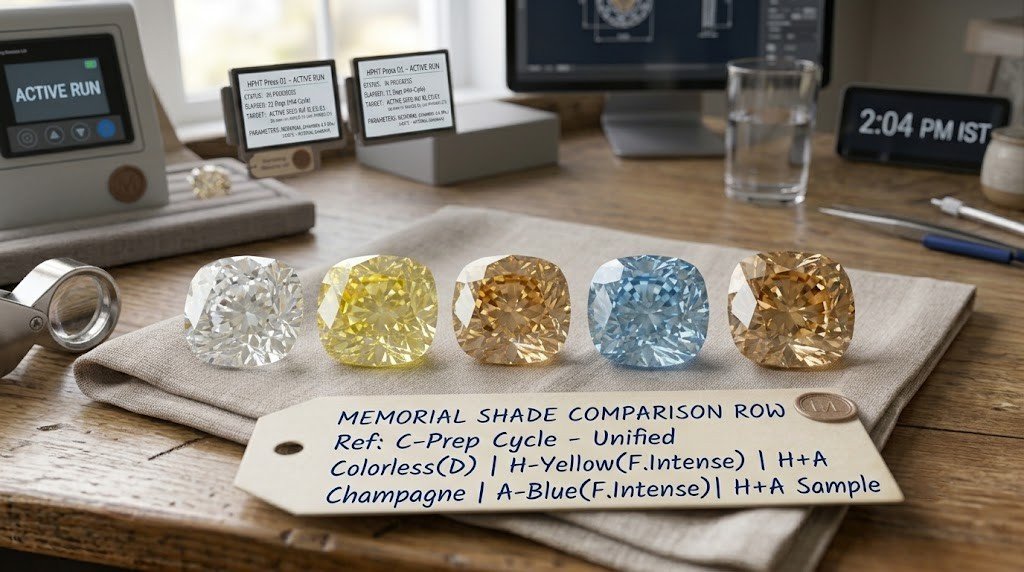
Yes. It is worth understanding what a colorless son ashes diamond color takes, though, because it is not simply a preference box on a form.
Achieving colorless means excluding both nitrogen and boron from the growth environment almost completely. That requires additional processing and tighter control than a stone where trace elements are allowed to express themselves, and across the industry a colorless outcome typically costs meaningfully more than a yellow, blue or champagne stone of the same carat weight.
It also introduces a different kind of uncertainty. Extra processing improves the odds. It does not convert son ashes diamond color into something a laboratory can guarantee at the point of order.
If colorless matters to you, raise it at the very first conversation rather than after a deposit. Ask what the provider’s actual success rate is at that outcome, what happens if the result comes out tinted, and whether the additional processing is charged regardless. What a son memorial diamond costs sets the pricing tiers out in full.
What About Red, Pink, Green or Black?
These come from a separate route entirely. Some providers offer post growth irradiation, a treatment applied after the crystal has formed, which can shift or intensify a stone into red, pink, green or black.
Two points are worth holding onto. First, this is an offering that varies between companies, so a particular treated son ashes diamond color may simply not be available from the provider you like most. Ask before assuming.
Second, a treated son ashes diamond color sits on top of growth rather than replacing it. The diamond is still grown from the carbon recovered from his remains. Irradiation changes the shade afterwards. It does not make the stone less genuinely his.
Black stones in particular tend to take longer. Specialty colors and larger carats are the two things most likely to push a project toward the twelve month end of the industry’s usual range. How long a son memorial diamond takes covers the waiting side of that.
Does Cleaner Material Make Son Ashes Diamond Color Predictable?
No. This is the single most common misunderstanding parents bring to the subject, usually because it sounds so reasonable.
The intuition goes like this: if trace elements cause color, then a cleaner, better prepared sample should produce a more predictable result. It does not follow. Purification already takes the recovered carbon to roughly 99.9% or better, and what determines son ashes diamond color is what survives in that final fraction plus the conditions inside the growth cell itself. Sending a larger or fresher portion of remains does not give you a lever over that.
So nothing you do at your end, how the ashes were stored, how much you send, how carefully you package it, makes the outcome forecastable. A laboratory can influence son ashes diamond color through process control, and even then only as a tendency rather than a certainty.
This matters practically, because it is the reason to be wary of anyone who implies that your preparation will shape the result. It will not. What your preparation affects is whether the run is viable at all, which is a different question entirely. The complete guide to a son ashes diamond sets that distinction out alongside the rest of the process.
Can Anyone Promise You a Shade?
No. How a company handles a request for a specific son ashes diamond color tells you a great deal about how it will handle every other question.
What a provider can legitimately offer is a target and a described process: an intention to aim for blue, say, with an explanation of what they control and what they do not. What nobody can honestly offer is a guaranteed son ashes diamond color written into an order form as though it were a size or a cut.
Before committing, get four things answered in writing:
- What shade family are you aiming for, and what influences that outcome at your end?
- What happens if the finished stone comes out noticeably different from that aim?
- Is any part of the fee adjusted, or a regrowth offered, in that situation?
- Will the stone’s final color be documented, and by whom?
That fourth point is worth a moment. An independent grading report assesses cut, color, clarity and carat on the same basis used for any diamond, which is the only genuinely third party record of what son ashes diamond color you actually received. It is normally an optional add on rather than something included by default, so ask.
Does the Color Differ Between Ashes and Hair?
Not in any way a family can rely on, which surprises people who expect hair to behave differently.
Hair is a much richer carbon source as a starting material, roughly half carbon by weight, against the small fraction recoverable from cremated remains. It is tempting to conclude that a hair grown stone must therefore come out cleaner and lighter. The chemistry does not support that leap. Both routes end in purified carbon carrying trace elements, and both are subject to the same conditions inside the growth cell.
So the same honesty applies to the hair version of this question as to son ashes diamond color: shades cluster in the yellow, blue and champagne families, colorless takes extra processing and money, and no route makes the outcome forecastable.
Where the two genuinely differ is upstream rather than at the color stage. Hair requires no cremation, which matters to families who chose burial or whose traditions do not permit it, and it needs far less material.
If you are weighing a submission of both materials, the same rule holds there too. Mixing sources does not narrow the range of possible shades, and any expectation about son ashes diamond color built on the idea that one material is tidier than the other is built on sand.
Does the Color Mean Anything About Him?
This question comes up quietly and deserves a direct answer: no, a son ashes diamond color is not a message, a verdict, or a reflection of who he was.
What it does reflect is that the carbon was his rather than generic. Trace elements vary between individuals and between growth runs, which is why son ashes diamond color varies at all. A manufactured feedstock would produce a far more uniform result, and that uniformity is precisely what this is not.
Plenty of parents find that framing genuinely helpful. The variation is a consequence of individuality, not of anything going wrong, and a warm yellow stone is not a lesser version of a colorless one.
It is also worth saying that no shade obliges you to feel a particular way about it. Some families love a color instantly; others take months. Both are ordinary responses to an object like this.
How Does Color Change Price and Waiting Time?
Son ashes diamond color moves the number, though less than carat weight does. Taking 2026 figures across the category as a whole, and not one firm’s price list: expect roughly $1,500 to $3,500 at 0.10 to 0.25 ct, roughly $5,000 to $15,000 between half a carat and a full carat, and $20,000 to $75,000 or more once a stone passes two carats.
Within any of those tiers, a colorless stone typically carries a meaningful premium over a yellow, blue or champagne stone of equal weight, because of the additional process control needed to exclude trace elements. Irradiated shades usually carry a premium of their own, and settings, engraving, fancy cuts and independent grading are quoted separately.
On timing, the industry typical range runs from about six months to ten from receipt of material. Specialty son ashes diamond color outcomes, black especially, and larger stones can extend that toward twelve months. Growth time drives size, and specialty treatment adds to the tail end of the schedule rather than the beginning.
Who Actually Chooses the Color?
Practically, whoever signs the commissioning paperwork picks the son ashes diamond color being aimed for. This is worth a moment’s thought before the form is in front of you, because it may not be the person you assume.
Most states set a statutory order of priority over what happens to a decedent’s remains. A surviving spouse or partner frequently sits at or near the top of that order, and your son’s own adult children can rank above his parents. Anything he left in writing can change the sequence, and it varies from state to state. Whoever holds that authority is the person a provider will look to for sign off on the ashes, including on the son ashes diamond color being aimed for.
Parents are also not always of one mind, and one parent arranging this alone is entirely ordinary. If two people who both care are pulling toward different shades, remember that a single submission can often support more than one stone.
Where any of this is unclear, a short conversation with the funeral director who handled the cremation, or with a local attorney, settles it faster than family debate will.
How Will It Look Once It Is Set?
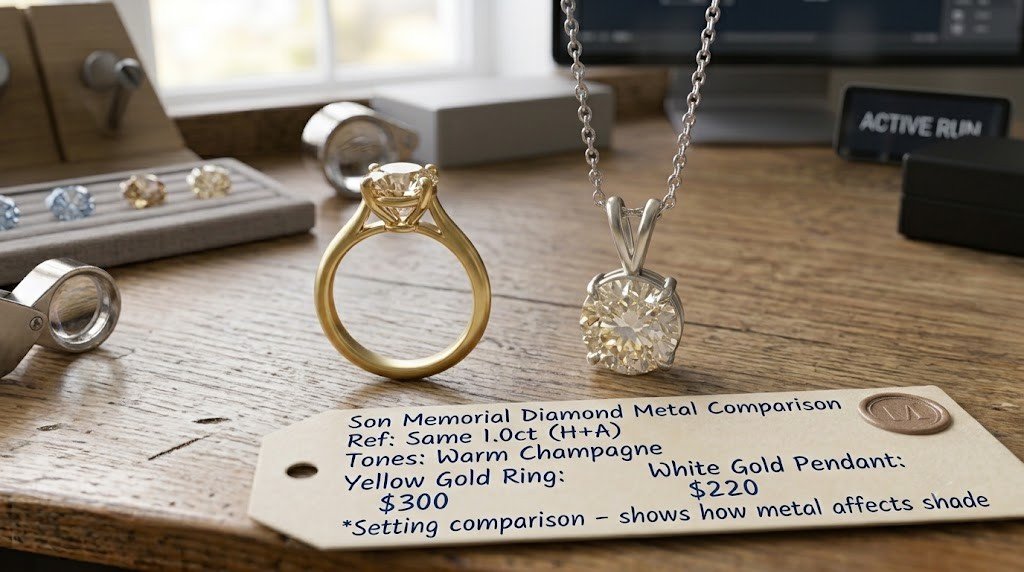
Differently from how it looks loose, which surprises people. The metal around a stone changes how a son ashes diamond color reads to the eye.
Yellow gold tends to warm a stone and can make a faint yellow tint recede. White metals like platinum or white gold tend to emphasize warmth by contrast. A blue stone often reads strongest against white metal, while champagne tones frequently sit beautifully in rose gold.
Ask to see the finished stone before the setting is finalized if that is possible, or ask what flexibility exists to change the metal once you have seen it in daylight. Photographs taken under laboratory lighting rarely match how son ashes diamond color appears on a hand by a window.
Size plays a part too: the same tint is more visible in a larger stone than a small one, simply because there is more material for light to travel through. Rings, pendants and other settings covers the options in more depth.
Frequently Asked Questions
Can I request a specific shade when I order?
You can state a preference, and a good provider will tell you honestly what they can aim for and what they cannot control. What you should not accept is a guaranteed shade written as a firm promise, since trace elements during growth decide the final son ashes diamond color.
Will two diamonds from the same ashes match?
Not necessarily. Separate growth runs can produce noticeably different results even from one submission, because conditions inside each cell vary. If matching stones matter for siblings or a couple, raise it before commissioning and ask what the provider can realistically achieve.
Does the color fade or change over time?
No. The shade comes from elements locked inside the crystal lattice during growth, not from a surface treatment or coating, so it is permanent. Ordinary wear, cleaning, sunlight and daily handling will not alter how the stone looks over decades.
Is a colorless stone better quality?
No. Colorless costs more because excluding trace elements takes additional process control, not because a tinted stone is inferior. Clarity, cut and carat are assessed independently of shade, and a warm toned memorial diamond can grade just as well overall.
Can a finished stone be changed to another color?
Sometimes, through post growth irradiation, which some providers offer to produce red, pink, green or black. Availability varies by company and it adds cost and time. Ask before assuming a treatment is possible, and ask whether it is documented afterwards.
What if the shade that arrives upsets me?
Say so to the provider, and ask what their policy allows, but also give yourself time before deciding. Many parents describe an initial reaction that softened considerably once the stone was set and worn rather than seen loose on a laboratory bench.
Final Thoughts on the Color of Your Son’s Diamond
Of all the decisions in this process, color is the one that resists control most stubbornly, and that is genuinely hard when so much else has already been out of your hands.
What is worth holding onto is why the shade varies at all. The stone reads warm, or blue, or somewhere in between, because the carbon in it came from a specific person and not from a drum of industrial feedstock. Uniformity would mean something had been substituted.
Ask for the intended son ashes diamond color in writing, ask what happens if the result misses it, and then let the growth run do what it does. Whatever son ashes diamond color arrives, it arrived because of him, and nobody else’s stone will be quite the same.
Learn More About Son Memorial Diamonds
- Son ashes diamond: the complete guide everything that sits around this question
- How a memorial diamond is made from his ashes where the shade is actually decided
- Whether the stone is genuinely his carbon, blending and verification
- What a son memorial diamond costs including the premium colorless carries
- Rings, pendants and other settings how a shade reads once worn
Talk With Memorial Diamond
Having a shade in mind is completely normal, and so is wanting to know whether it is realistic. Memorial Diamond can be found at memorialdiamond.us for an honest view of what is achievable and what is not. No commitment attaches to the question.
Leave A Comment