
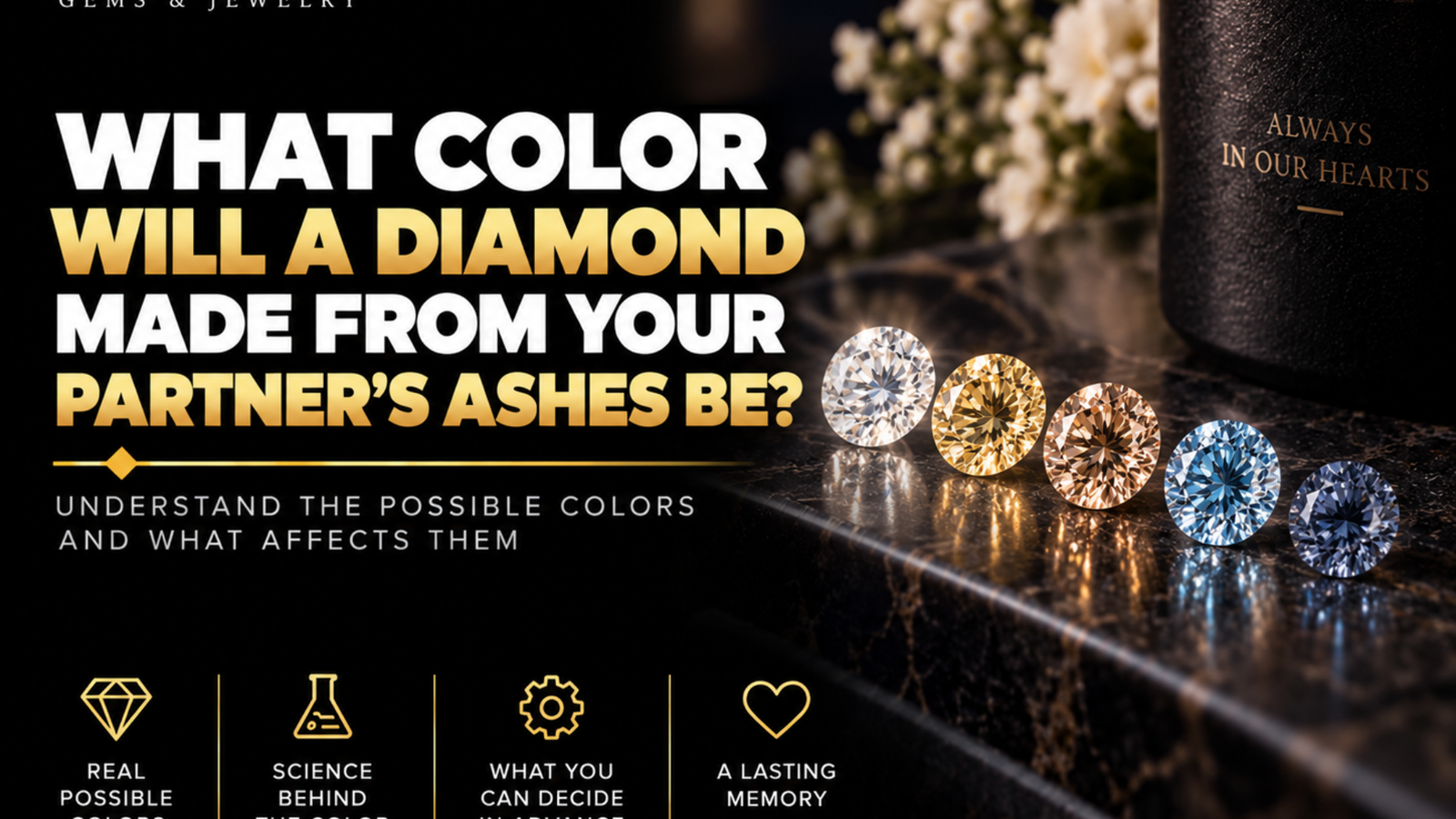
At some point after the arrangements are over, a smaller question arrives and refuses to leave: what will it actually look like.
Expect a tint. A partner ashes diamond color lands in yellow, champagne or blue far more often than colorless, and nobody can name the exact shade until the stone exists. The honest answer is a range with known edges, not a point on a chart. Colorless is available from an ash source, but it must be engineered, and it costs more at the same carat.
Memorial Diamond grows these stones commercially, so this page is not a disinterested referee. Where the honest answer is ask, because nobody writing a web page can know, it says so instead of filling the gap.
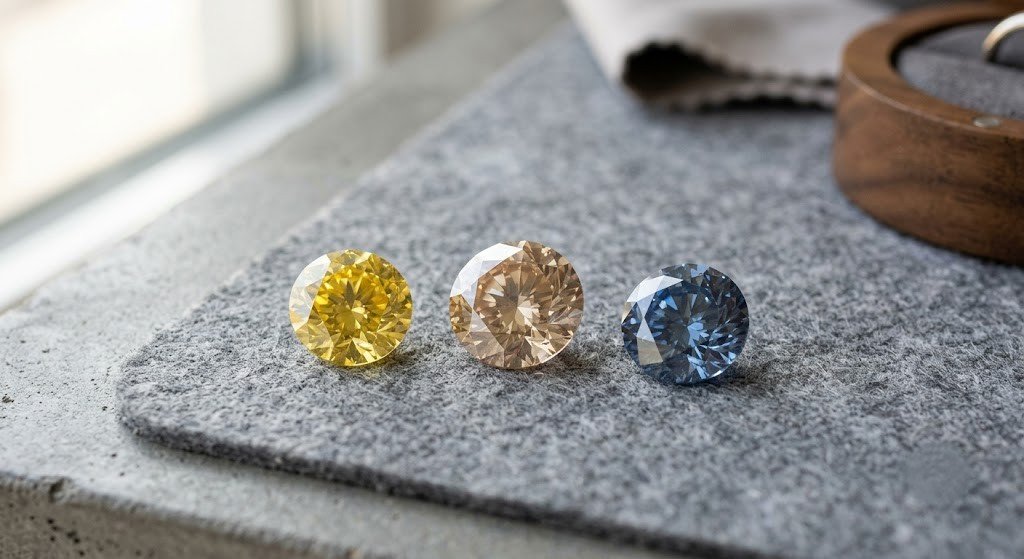
Table of Contents
Why Is a Partner Ashes Diamond Color a Range Rather Than a Point?
Because the inputs that decide a partner ashes diamond color are not fully characterized before growth, and some of them are not characterized at all.
Diamond color is set by trace elements sitting in the crystal lattice while it forms. In a controlled industrial feedstock, those trace elements are known quantities that a laboratory manages deliberately. An ash derived feedstock is different in kind: the carbon comes from a person, which means whatever survives purification arrives with it rather than being chosen.
That is the whole reason partner ashes diamond color behaves as a range. Nobody is being evasive. There is simply no measurement available at order time that would let anyone name a shade, and a company that offers you one should be asked what instrument produced it and which document records it.
A partner ashes diamond color range is not a shrug, though, and this is the part that usually gets lost. The edges of the range are known, the mechanisms are understood, and the things you can actually decide are decidable. What you cannot do is pick a point inside the partner ashes diamond color range.
Where Does the Color Come From When the Carbon Is Organic?
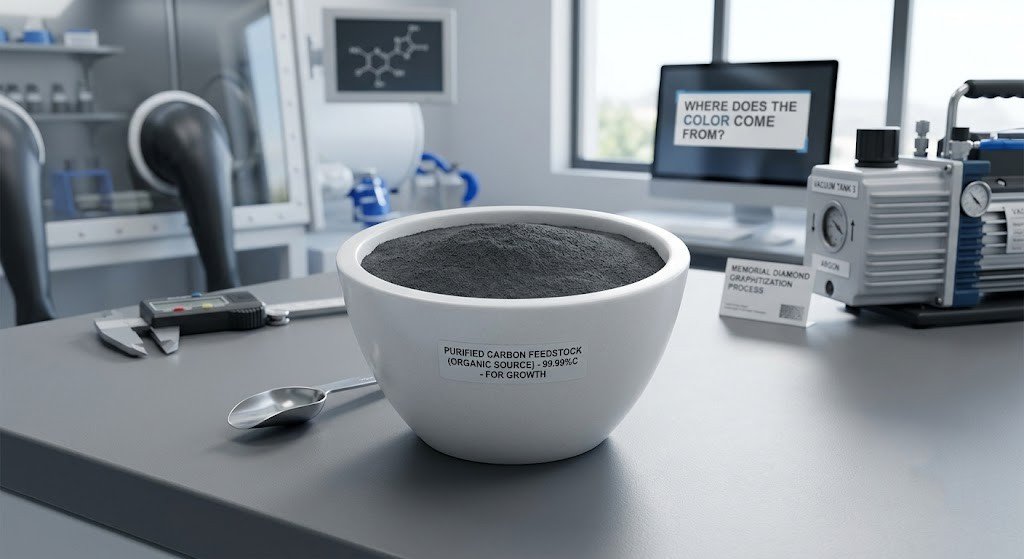
A partner ashes diamond color comes from three mechanisms, and organic carbon meets all three differently than a manufactured feedstock does.
- Nitrogen present during growth produces yellow tones.
- Boron present during growth produces blue tones.
- The near total absence of both is what a colorless stone requires, which is why colorless takes extra laboratory work and sits above the tinted colors on price at the same carat.
Those three are the whole of what decides a partner ashes diamond color during growth; everything else follows from them.
What sits in the urn is overwhelmingly calcium phosphate, and the carbon a laboratory can actually work with accounts for only about 0.5% to 4% of that weight, where a given person falls inside that band depends on them and on how the cremation was run. Extraction and purification lift what is recovered to roughly 99.9%+ carbon. The entire partner ashes diamond color question then lives inside the fraction of a percent that purification does not remove.
Because the carbon recovered from a portion of ashes falls well short of what a press consumes, it is extended with lab grown carbon until the growth cell is full, which is why no memorial diamond is entirely one person, and why the trace elements that came from them are a minority influence on a majority lab crystal. A minority influence that still steers the tone, which is exactly why ash derived stones trend toward warm and blue tones rather than sitting at white. How the extraction actually runs on a portion of ashes sets out the stages in order.
The Five Outcomes That Make Up the Realistic Range
These five are the whole of it. A partner ashes diamond color lands in one of them, and the fourth and fifth are reached deliberately rather than arrived at.
| Outcome | What has to be true for a stone to land here | Can you ask for it in advance? | The honest trade off |
|---|---|---|---|
| Yellow or golden | Nitrogen present during growth, the most commonly described result for organic feedstocks | Yes, as a color family rather than a shade | Saturation varies within the family, and two stones in it will not match |
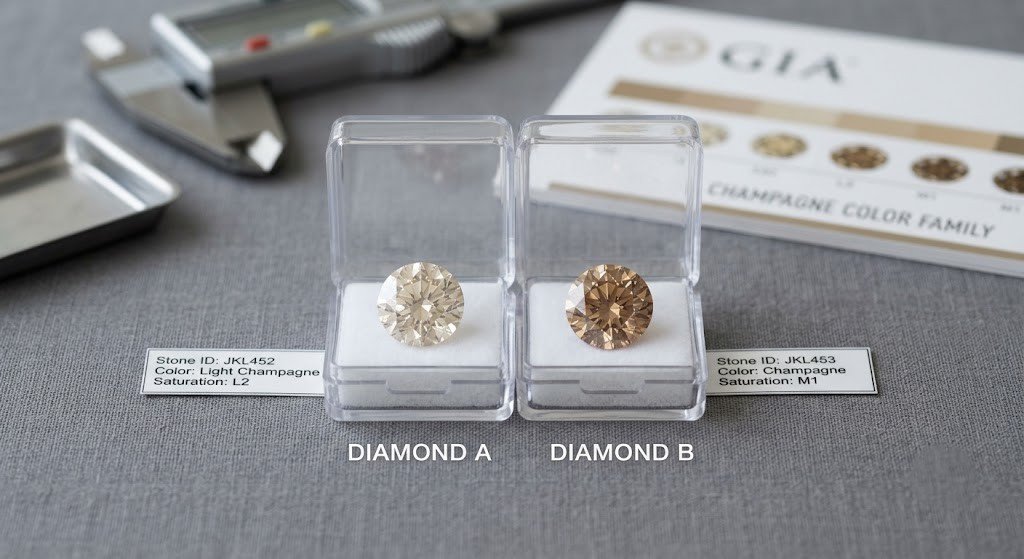
| Champagne or brown | A warm tinted outcome within the same broad territory as yellow | Yes, as a family | The words used to sell warm tones vary between companies; ask what grading language will actually appear on any report |
| Blue | Boron present during growth | Yes, as a family | Intensity is not selectable, and a pale blue and a deep blue are both blue |
| Colorless or near colorless | Both boron and nitrogen held down to almost nothing, which takes additional processing | Yes, and it is a specification rather than a hope | Costs meaningfully more at the same carat, and the extra processing is the reason |
| Red, pink, green or black | Post growth irradiation applied to a crystal that already exists | Yes, where a provider offers it | It is a different product from a color that grew in; ask which partner ashes diamond color you are being quoted |
Read the third column on its own. Every row says yes, which is the surprise for most people. The thing you cannot specify is not the family. It is where inside that family your particular partner ashes diamond color will sit.
What Does “Unpredictable” Actually Mean Here?
Three words get used interchangeably in this conversation and mean quite different things. Separating them removes most of the anxiety available in the subject.
Unpredictable means nobody can tell you the outcome in advance. That is accurate for partner ashes diamond color at the level of shade.
Random means the outcome is arbitrary and unrelated to its inputs. That is not accurate for partner ashes diamond color. The mechanisms are understood, the color family follows from what is present in the cell, and a laboratory setting up a run toward blue is not rolling dice.
Unmanageable means nothing can be agreed or relied on. Also not accurate, and this is the one that does real damage. A color family can be written into an order. A range can be defined. A remedy for a stone outside that range can be negotiated before growth rather than argued about after delivery.
So the honest shape of a partner ashes diamond color answer is: unpredictable at the level of shade, structured at the level of family, and manageable at the level of paperwork. A page that tells you a stone’s color is simply a mystery has stopped one step too early, and one that shows you a photograph and implies yours will match it has gone one step too far.
What Can You Settle in Advance?
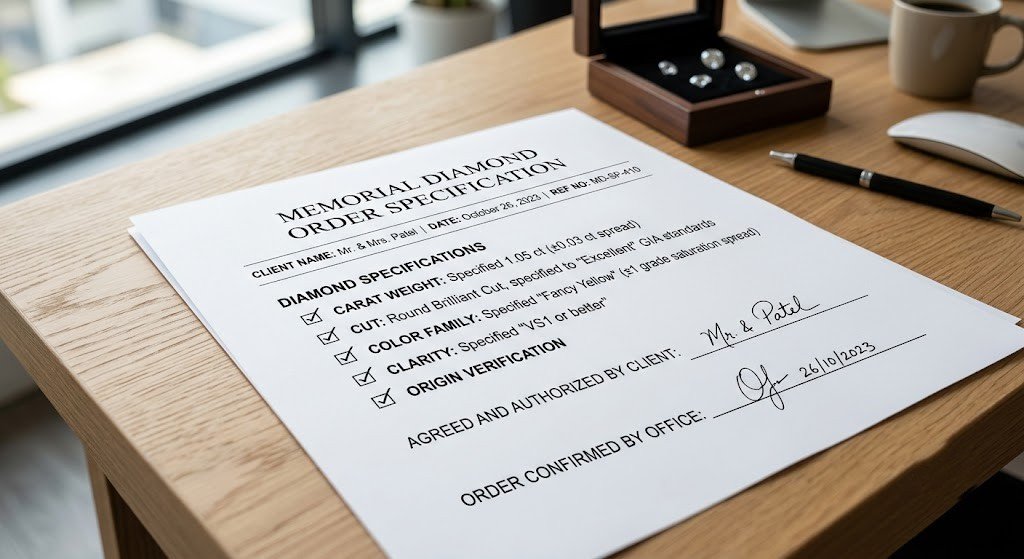
Five decisions about partner ashes diamond color are available to you now, and none of them requires knowing the shade.
- The partner ashes diamond color family you are buying, set down in the order document itself rather than left in somebody’s memory of a phone call.
- The width of that family. “Yellow” has to cover the same span of stones for the laboratory as it does for you, and the only way to check is to make someone define it out loud.
- The remedy if the finished stone lands outside that span, regrowing it, adjusting the price, a conversation, or explicitly nothing at all. Each of those four is a position you can work with. Silence on the point is not.
- Whether you are buying a tone that grew in or one applied to a crystal afterward. Red, pink, green and black arrive by irradiation once the stone already exists, and that is a different object from a partner ashes diamond color that formed inside the cell.
- Whether an independent grading report comes with the stone, and which color scale that report will use, since the vocabulary for a tinted stone and the vocabulary for a colorless one are not the same.
Not one of those five calls for expertise, and every one of them is easier to settle at the order stage than on the day the box arrives. The wider list worth putting to a provider before anything is sent ranges far wider than color alone, and how memorial diamonds are graded and certified is the place to find what a report covers and what it leaves out.
Does the Ash Itself Carry a Color Into the Stone?
No, and this is the single most common misconception about partner ashes diamond color.
Cremated remains are pale gray, and people reasonably assume a gray stone follows. It does not. The gray comes from mineral content, and purification removes the minerals before anything is grown, what enters the growth cell is elemental carbon, and elemental carbon has no memory of what it looked like as ash.
What does travel through is invisible: trace quantities of elements that survive purification. They are not the color you can see in the urn; they are parts per million in a crystal lattice. The visible gray and the eventual partner ashes diamond color are unrelated, and confusing the two is why some people expect a dark stone and are surprised by a warm yellow one.
The finished object is a genuine lab grown diamond graded on the same criteria as any other, and its color is described in the same language. Why memorial diamonds are rarely colorless makes the same argument for the category as a whole.
Does the Size of the Stone Change the Color?
Not in the way people expect, and the reasoning is worth following because it also settles a related worry about how much ash to send.
Carat is bought as growth time and total feedstock volume rather than as a quantity of personal material. A larger stone therefore needs more carbon overall, and almost all of that additional carbon is supplemental and lab grown, so the personal fraction of a two carat stone is proportionally smaller than the personal fraction of a half carat stone grown from the same submission. Whether that proportional shift changes the visible tint is not something any published figure settles, so treat it as a question to put to a provider rather than a rule to plan around.
What is settled is the cost interaction. Colorless requires additional processing at any size, so a colorless two carat stone is not simply twice a colorless one carat stone; the color decision and the carat decision push on each other. How to choose a carat size covers that trade in full.
The other half of the worry is easier to dispatch. Sending a larger portion of ashes does not change a partner ashes diamond color, and it does not make the stone bigger either. Recovery from ash runs at roughly 0.5% to 4% by weight, a growth cell holds what it holds, and the surplus simply is not used, which is why most of a cremation can still be interred, scattered or kept exactly as planned. How much ash is actually needed sets out the quantities.
So the honest summary is that carat changes the arithmetic of the blend and the price of colorless, and that partner ashes diamond color remains a range in either case.
Who Else Has a Say in the Color?
Practically, a partner ashes diamond color is decided by whoever is paying and whoever holds the ashes. Which in this cluster is not always a simple answer.
The portion of ashes you hold may be a share somebody else decided to give you, the ordinary situation wherever a relationship went unrecognized in law, went unacknowledged by their family, or was never fully known to everyone in it. There is no one American answer on who holds authority over remains: the statute that governs is the one where you are, and a direction your partner signed can override whatever that statute would otherwise say. So a partner ashes diamond color conversation can quietly turn into a standing conversation if you are not watching for it.
Two things are worth separating. Choosing a partner ashes diamond color family for a stone grown from a portion already in your possession is your decision. Whether other people are told, consulted, or invited to grow their own stone from the same source is a separate question with no technical answer at all. Where more than one stone is planned, it is worth knowing that a second run has its own conditions and its own recovered carbon, so two stones grown at different times should not be expected to match, the logistics of several people growing stones from one source are worth settling first, and how to talk to family about a partner memorial diamond covers the rest.
Nobody has to be consulted for you to be entitled to ask a provider what is realistic. That conversation costs nothing and commits you to nothing.
Frequently Asked Questions
Will partner ashes diamond color be gray because the ashes are gray?
No. The gray of cremated remains comes from mineral content that purification removes before growth begins. What reaches the growth cell is elemental carbon, and color is decided there by trace elements measured in parts per million.
Can a provider promise a specific partner ashes diamond color in writing?
Ask directly, because this is policy rather than chemistry and it varies between companies. What can reasonably be committed to is a color family with a stated spread, plus a named remedy if the finished stone falls outside it.
Is colorless a possible partner ashes diamond color from an ash source?
Yes, but it has to be engineered rather than hoped for, because it requires both boron and nitrogen to be held down to almost nothing. That additional processing is why colorless costs meaningfully more than tinted stones at the same carat.
Will a second stone grown later match the first?
Treat matching as unlikely. A later stone is a separate growth run with its own conditions and its own recovered carbon, so a visible difference in partner ashes diamond color is the expected outcome rather than a fault in either stone.
Does a tinted stone grade lower than a colorless one?
Not lower, described differently. A grading report records what a stone is rather than marking a tint as a failed attempt at colorless, and tinted and colorless stones are described on different scales. Ask which scale applies.
Can partner ashes diamond color be changed after growth?
In one direction only. A tone that grew in cannot be removed, but post growth irradiation can produce red, pink, green or black from a finished crystal. Ask whether that is offered before assuming it stays available later.
Final Thoughts on Partner Ashes Diamond Color
The part of partner ashes diamond color you control is not the shade, and chasing the shade is how people end up disappointed by a stone that was never going to be anything else. What you control is the sentence in the paperwork: which family was agreed, what spread counts as normal inside it, and what happens if the finished stone sits outside.
Get that sentence written before the run is set up and delivery has very little left to surprise you with. A range with agreed edges is a genuinely different experience from a shade someone implied.
And it is worth remembering what the tint actually is. It is the trace of an organic source in a crystal that would otherwise be indistinguishable from any other lab grown stone, the one part of the object that could only have come from them.
Learn More About Partner Memorial Diamonds
- How a Memorial Diamond Is Made From Your Partner’s Ashes
- What Color Will a Diamond Made From Your Partner’s Hair Be?
- Memorial Diamond Colors Explained: Why They’re Rarely Colorless
- Questions to Ask Before Turning Your Partner’s Ashes Into a Diamond
- How Memorial Diamonds Are Graded and Certified
Talk With Memorial Diamond
If you want to know what is realistic from the portion you actually hold, which families are available, what colorless would involve, and exactly how the agreed partner ashes diamond color gets written on an order, those are answerable questions and the answers belong in writing before anything is sent. Reach out to Memorial Diamond and ask. The conversation is allowed to end at the answers.
Leave A Comment