
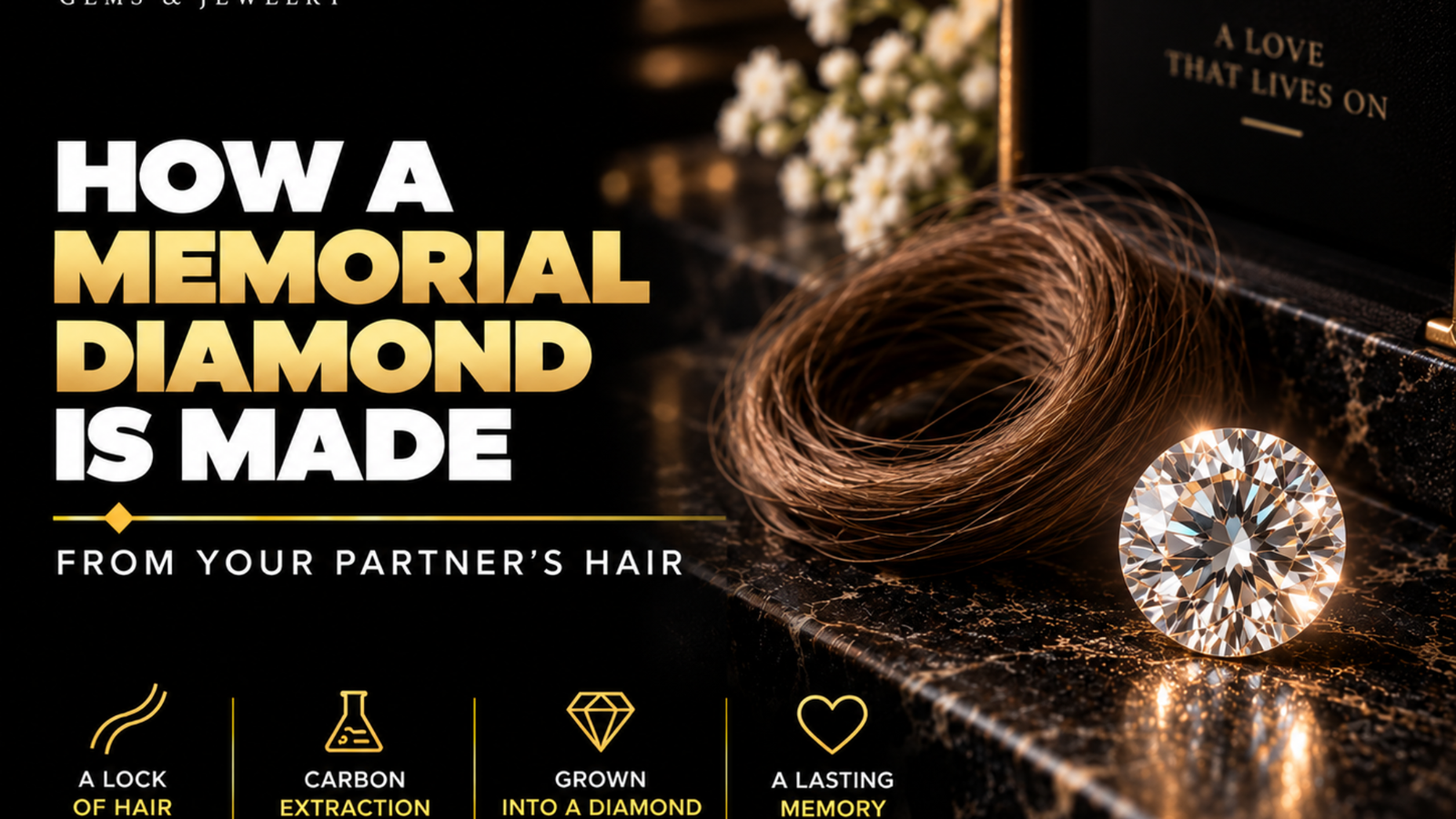
A lock of hair is usually the thing nobody thought to plan for and somebody kept anyway.
A memorial diamond made from partner hair is grown from keratin, which is roughly 50% carbon by weight. A small lock is purified to around 99.9% carbon, converted to graphite at about 2,500 to 2,700°C, and grown into a real diamond crystal at roughly 6 to 8 GPa and 1,400 to 2,500°C. No cremation is involved at any point. Six stages, typically six to ten months.
Because hair carries so much carbon, the difficult question in a memorial diamond made from partner hair is not whether there is enough of it. It is whether anyone can show that this particular lock was your partner’s, and that question has to be answered before the furnace, never after.
Table of Contents
Why Hair Solves One Problem and Creates a Different One
Hair is built from keratin, a protein that is roughly 50% carbon by weight. Cremated remains, by comparison, are mostly calcium phosphate and yield usable carbon at somewhere around 0.5% to 4% of ash by weight. The gap between those two numbers is more than an order of magnitude.
Three consequences follow. A diamond made from partner hair needs only a small lock rather than a measured portion of remains. Extraction is shorter and less lossy, because far less of the starting material is discarded as non carbon mineral. And no cremation is required at any point, so this route stays open whether your partner was cremated, buried, or is still living.
That last point is why hair matters so much in a partner’s situation specifically. No federal rule governs control of a person’s remains; each state writes its own, and whatever your partner set down in writing can redraw the picture over the top of it.
So a partner is not guaranteed to be the one with standing, and the gap opens most often where the relationship was never legally recognized, or was not something everyone involved knew about. A lock of hair in an envelope, or caught in a brush at the back of a drawer, is often the material you actually have. For plenty of people in that position, a diamond made from partner hair is less the preferred option than the available one.
But the same chemistry that removes the yield problem introduces a sharper one. Hair from any two people is chemically indistinguishable once it has been reduced to purified carbon. Nothing about a finished stone reveals whose hair went into it. So the entire question of whether a memorial diamond made from partner hair is genuinely theirs moves upstream, to handling and records, and away from the laboratory bench.
The Six Stages of a Memorial Diamond Made From Partner Hair
1. Intake, weighing, and identification. The lock arrives and is logged. Ask for a unique identifier assigned at this moment, a recorded weight, and a photograph of the material as received. Everything that can ever be said about whose hair this is gets fixed here, which makes intake the most consequential stage in a diamond made from partner hair.
2. Cleaning and preparation. Hair arrives with whatever was on it: product residue, dust, dye, oils from a brush. That is removed before extraction so it does not carry into the crystal.
3. Carbon extraction and purification. The hair is heated in a controlled, oxygen free environment that strips away the non carbon components of keratin, nitrogen, oxygen, sulfur, and hydrogen, until what remains is roughly 99.9% or higher carbon. Because the starting material is already about half carbon, a diamond made from partner hair loses far less of its submitted mass here than an ash based stone does.
4. Graphitization. The purified carbon is heated further, to roughly 2,500 to 2,700°C, and converted into graphite, the crystalline form a diamond press can use as feedstock.
5. Growth. The graphite, combined with supplemental lab grown carbon, goes into an HPHT growth cell around a tiny diamond seed at roughly 6 to 8 GPa and 1,400 to 2,500°C, for weeks to months. Carat size is a function of how long that cell runs.
6. Cutting, polishing, and grading. The rough crystal is cut and polished, then assessed against the same cut, color, clarity, and carat standards applied to any diamond, ideally by an independent third party laboratory. A diamond made from partner hair is graded on exactly the same scale as any other stone, with no separate standard. Some providers also offer post growth irradiation to shift color; ask whether it is being used and whether it will appear on the paperwork.

If Yield Is Not the Question, What Is?
For an ash based stone, the anxious question is quantity: is there really enough carbon in there to matter? For a diamond made from partner hair, that question essentially answers itself. Keratin is carbon rich, a small lock is enough, and nobody in the industry disputes it.
What replaces it, for a diamond made from partner hair, is a question about identity, and that one is harder.
Here is the part that is rarely said plainly. The purification stage destroys everything that is not carbon. That includes DNA, which is an organic molecule that cannot survive being heated toward graphitization temperatures. Once a lock of hair has been purified, there is no genetic material left in it, and therefore no test that can be run on the resulting carbon, or on the finished diamond, to confirm whose hair it was.
This is not a gap in one company’s process. It is a property of the physics. A memorial diamond made from partner hair cannot be retroactively verified by analysis, because the thing that would carry the evidence is precisely what purification removes.
What that means in practice is simple, and it is the single most useful thing to understand before starting. Identity is established by custody and documentation, in a window that opens when you cut or collect the lock and closes when the extraction furnace is sealed. Everything after that is a record, not a measurement. The question worth asking a provider is therefore not “can you prove it afterward”, nobody can, but “what exactly do you record, and when.”
How Do You Prove a Lock of Hair Was Your Partner’s?
The provenance of a diamond made from partner hair is established the way any chain of custody is established: by making each handover leave a trace, so no point in the chain rests on trust alone. The table below sets out where the handovers in a diamond made from partner hair are, and what is worth having written down at each.
| Handover point | Who holds the material | What should be recorded | What a weak answer sounds like |
|---|---|---|---|
| Collection | You, or whoever cut or gathered the lock | Who collected it, when, and from where, a note in your own handwriting is enough | “It doesn’t really matter, just send it in” |
| Packaging and shipping | You, then the carrier | Sealed and labeled container, tracked shipping, a photograph before sealing | “Ordinary mail is fine” |
| Intake at the facility | The provider | Unique identifier, recorded weight, dated photograph of the lock as received | “We’ll let you know when it arrives” |
| Cleaning and preparation | The provider | Confirmation the identifier travels with the material, not with the paperwork alone | “It’s all tracked in our system” with no detail |
| Extraction and purification | The provider | Batch record tying the identifier to a specific run | “Everything is processed together” |
| Growth, cutting, grading | The provider, then the grading lab | Identifier carried through to the finished stone and its certificate of origin | A grading report with no origin document alongside it |
Two clarifying questions are worth asking directly, without apology. First: is material from more than one client ever combined in a single growth run, and if so, what separates them? Second: what is returned to you at the end besides the stone? An origin or authenticity document is a different thing from a grading report, and a diamond made from partner hair should come with both.
These are ordinary logistics questions about a diamond made from partner hair, not accusations. A provider that answers them plainly is telling you something real. A provider that treats the questions as rude is telling you something too.
What Condition Does the Hair Need to Be In?
Hair is durable in a way that surprises people. It does not decompose on a shelf, and a lock kept in an envelope since 2009 is, chemically, very close to the hair that was cut that day. Age alone rarely disqualifies material for a memorial diamond made from partner hair.
What matters more is quantity and cleanliness:
- Amount. Industry guidance generally describes a small lock, a few grams, or a “palm sized” wisp, far less than most people expect a diamond made from partner hair to require. Confirm the actual requirement before cutting, so you are not left having taken more than was needed.
- Loose hair from a brush. Frequently usable, but it is also the material most likely to be mixed with someone else’s. If the brush was shared, say so at intake rather than hoping it does not matter.
- Storage. Dry, sealed, and out of direct light is ideal. Hair stored somewhere damp can grow mold, which is a contamination question rather than a carbon question.
- Root or no root. No root is needed. A diamond made from partner hair is built from the carbon in the shaft, and cut hair works exactly as well as pulled hair.
- Very short hair. Short does not mean unusable; total weight matters more than length. Clippings from a final haircut, or from a shave during illness, are workable material.
- Hair collected from someone still living. The same process applies with no change. The only real difference is that you can ask the person which lock they would want used.
If all you have is a single strand, say so at intake rather than sending it and hoping. Better to be told it is not enough than to find out in month five.
Does Dyed or Gray Hair Change a Diamond Made From Partner Hair?
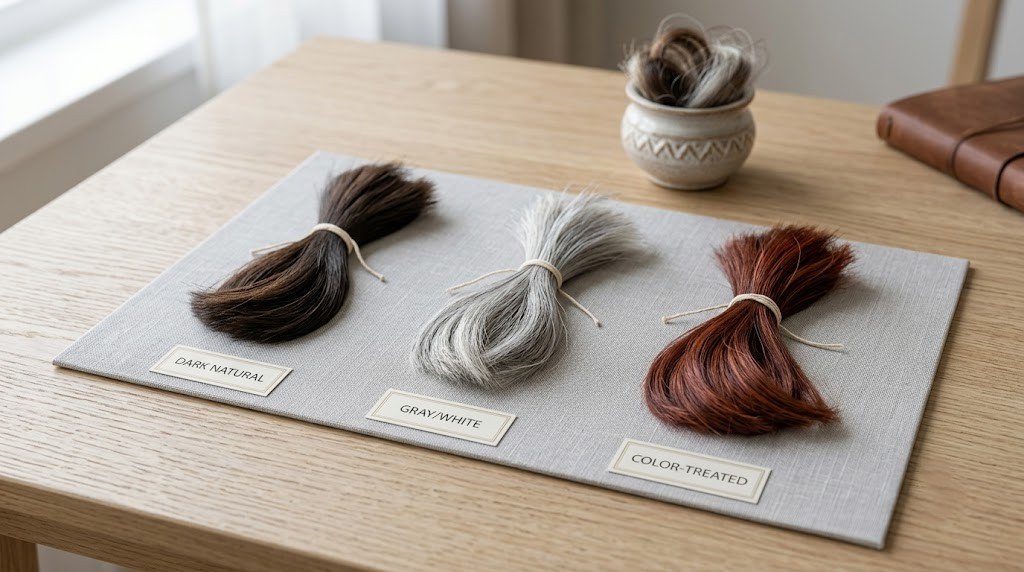
Dye, bleach, and permanent color are surface and cortex treatments applied to keratin. They do not change the fact that the shaft is carbon rich, and purification to 99.9% plus carbon removes them along with everything else that is not carbon. Treated hair generally works for a diamond made from partner hair, but mention it at intake, it is the kind of detail that belongs in the record.
Gray and white hair is the same material minus melanin, a pigment, not a structural difference. A stone grown from silver hair is not automatically paler than one grown from dark hair, and nobody can promise the reverse either.
The honest position on color is that it cannot be forecast precisely from any starting material. Nitrogen produces yellow tones, boron produces blue, and colorless requires the absence of both, and organic carbon sources bring trace elements with them. A memorial diamond made from partner hair will usually land somewhere in the yellow, blue, or champagne range, with colorless achievable but requiring additional process control and typically costing more. Choose a range you would be happy with rather than a shade you are expecting.
What Documentation Should Come Back With the Stone?
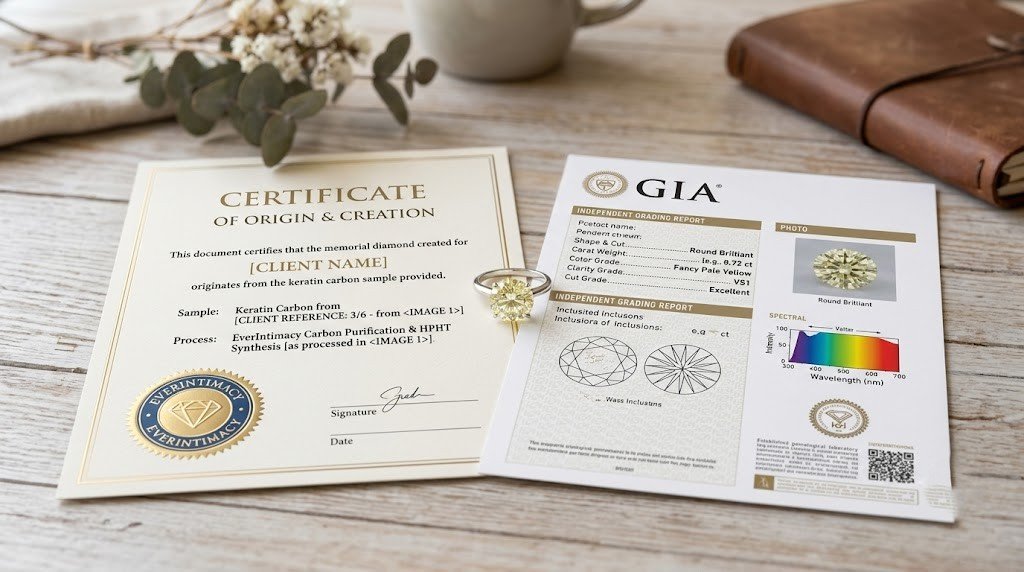
Two different documents can arrive at the end of a memorial diamond made from partner hair, and they answer two different questions. Confusing them is the most common way people end up feeling less certain than they should.
A grading report describes the diamond: cut, color, clarity, carat. Issued by an independent laboratory, it is a strong, verifiable statement about quality, and it says nothing whatsoever about origin. A grading lab assesses the stone in front of it, not the history behind it.
An origin or authenticity document describes the history: the identifier assigned at intake, the recorded weight, the batch the material was processed in, and a statement tying the finished stone to the lock you sent. This is the document that actually addresses whether a diamond made from partner hair is your partner’s, and it is usually issued in house rather than by a third party.
Ask for both, and ask what the origin document specifically asserts. A line that says “grown from submitted material” is weaker than one that names your identifier, the intake date, and the weight received. Neither document can prove identity after the fact, nothing can, once purification has run, but a specific, dated record made at the time is the strongest evidence a diamond made from partner hair can carry.
What a Diamond Made From Partner Hair Shares With Every Other Memorial Diamond
Three things are true of a diamond made from partner hair exactly as they are true of an ash grown one, and it is worth saying them plainly rather than letting hair sound like a shortcut.
It is not grown from your partner’s carbon alone. Hair gives up far more carbon than ash does, but a small lock still does not give up enough to fill a growth cell. The purified keratin carbon is combined with lab grown carbon until the charge reaches the volume a crystal of your chosen size requires. The personal carbon is real, verifiable, and genuinely part of the diamond’s lattice, it is not the whole of it, and any description that says otherwise is describing something that does not exist.
Size is bought as time, not as material. Sending a bigger lock does not produce a bigger stone. Carat is determined by how long the growth run lasts, which is why a larger diamond made from partner hair costs more and takes longer rather than simply consuming more hair.
The wait is the same. Industry wide, the full sequence typically runs six to ten months, sometimes twelve for larger stones. Hair’s easier extraction saves time at the front, not in the press, and the press is where almost all the months are.
Frequently Asked Questions About a Memorial Diamond Made From Partner Hair
How much hair is actually needed?
Typically a small lock or a few grams, often described as palm sized or a few wisps. Because hair is roughly 50% carbon by weight, far less material is required than for an ash based stone. Confirm the exact requirement before cutting anything.
Can a diamond be made from hair if my partner was buried?
Yes. A diamond made from partner hair involves no cremation at any stage, so a lock kept before or after the funeral works regardless of how your partner was laid to rest. This is often the only route available when the remains were interred.
Can anyone test the finished stone to confirm whose hair it was?
No. Purification destroys DNA along with everything else that is not carbon, so no post growth test can identify the source. Identity rests entirely on chain of custody documentation created before extraction begins.
Does hair that was dyed or permed still work?
Generally yes. Color treatments sit on and within the keratin shaft and are removed during purification along with other non carbon material. Mention the treatment at intake so it is recorded rather than discovered later.
Is hair from a brush usable?
Often, though it carries a higher chance of being mixed with someone else’s hair. Say so at intake if the brush was shared. A deliberately cut lock is cleaner evidence and a simpler custody record.
Will a hair grown stone look different from an ash grown one?
Not in any way a grader could identify. A diamond made from partner hair and an ash grown stone are chemically genuine diamonds assessed on the same 4Cs, and neither material produces a reliably lighter or better color. Color depends on trace elements, not on which material you started from.
Final Thoughts on a Memorial Diamond Made From Partner Hair
The chemistry behind a memorial diamond made from partner hair is generous. Hair is roughly half carbon, a small lock is enough, and nothing about the process requires a cremation to have happened. That is a genuinely lower barrier than most people assume when they first look into this.
What the chemistry cannot do is answer the question that actually keeps people up: is this really them. That answer lives in a paper trail created in the days before anything is heated, who cut it, when, what was written down, what was photographed, what identifier followed it through the building. Ask for those things while asking is still possible. After the furnace, there is nothing left to ask.
Learn More About Partner Memorial Diamonds
- Partner Hair Diamond: The Complete Guide
- How to Turn Your Partner’s Hair Into a Diamond
- Is a Memorial Diamond Really Made From Your Partner’s Hair?
- How a Memorial Diamond Is Made From Your Partner’s Ashes and Hair
- What Is a Memorial Diamond? The Complete Guide
Talk With Memorial Diamond
If you have a lock of your partner’s hair and want to know what a memorial diamond made from partner hair would involve, reach out to Memorial Diamond at memorialdiamond.us and ask what gets recorded at intake before sending anything. Those questions are easiest to ask early.
Leave A Comment