
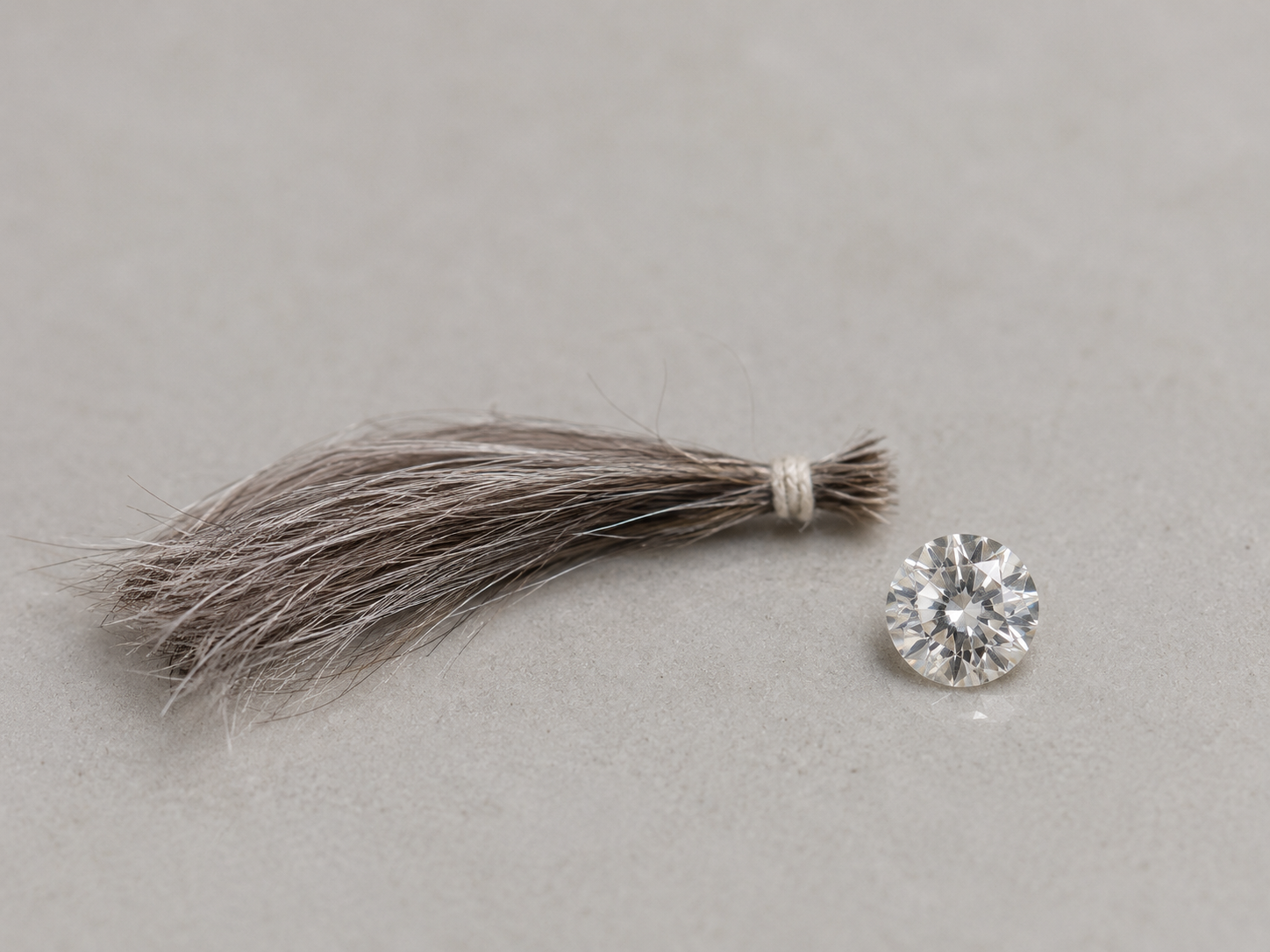
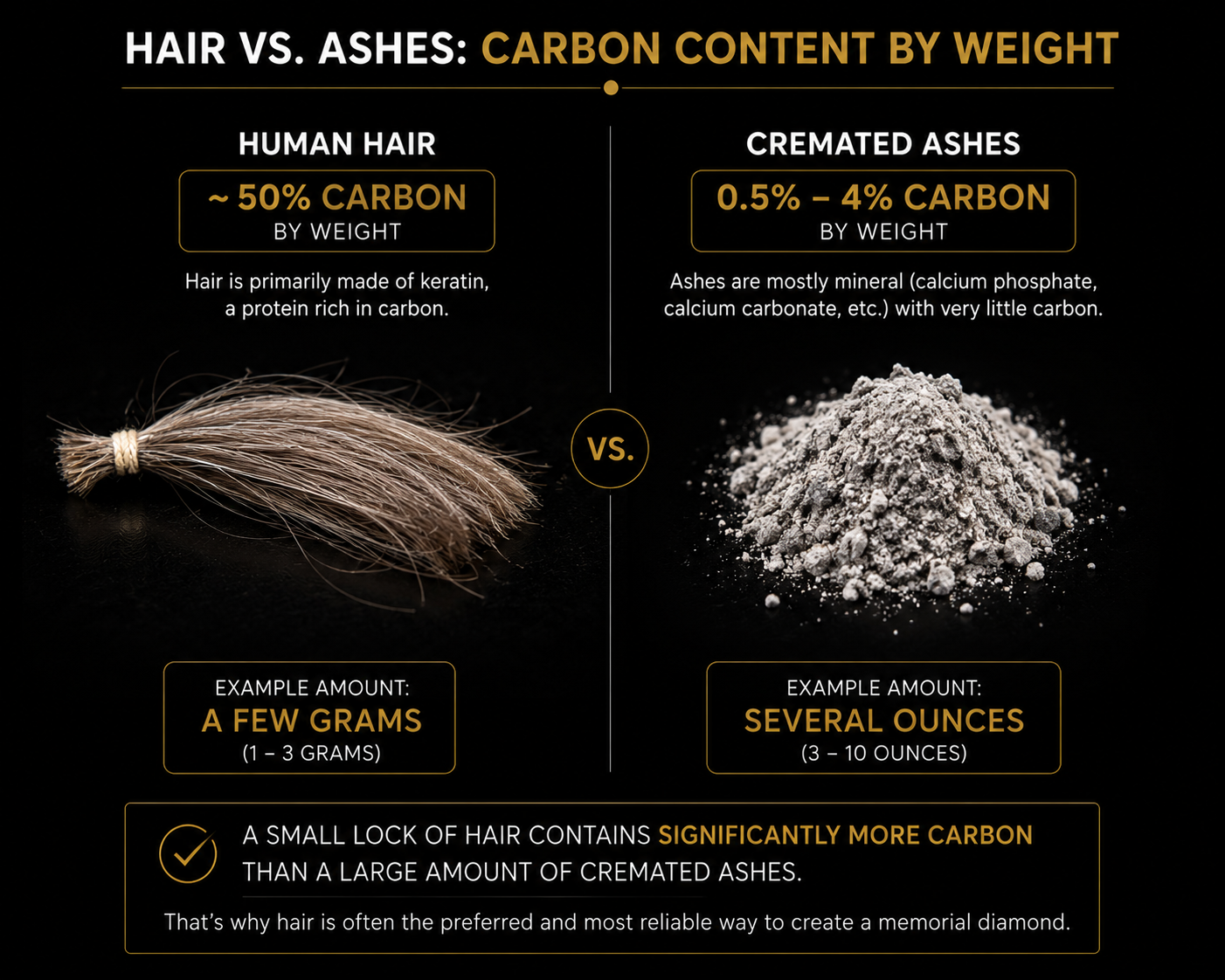
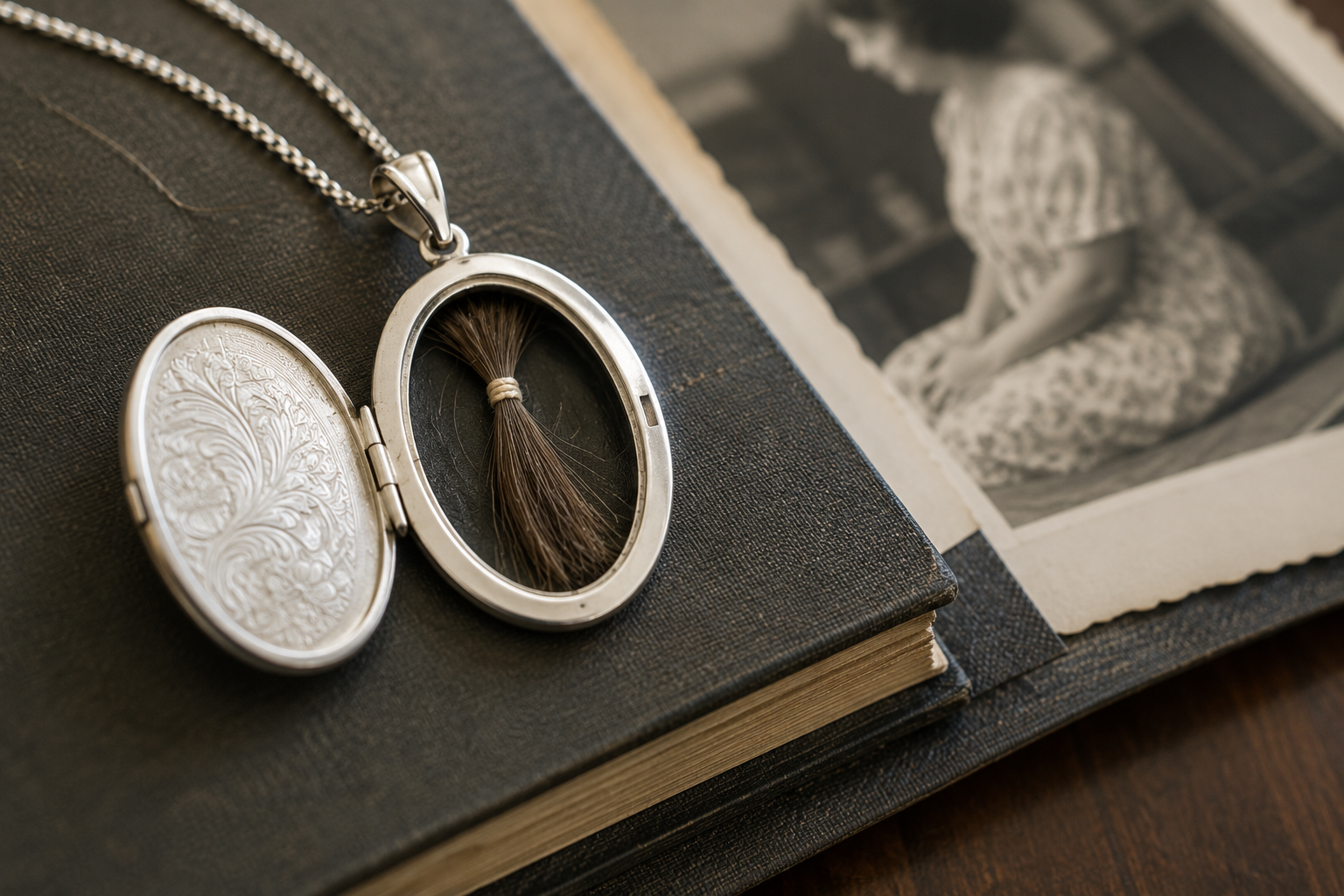
The lock is always smaller than you remember. It sits in an envelope, a locket, or taped inside a photo album, and it looks like almost nothing which is why the first honest question is whether almost nothing can become a diamond. It can. Hair is roughly 50% carbon by weight against 0.5% to 4% for cremated remains, so a few grams of hair can yield as much usable carbon as several ounces of ash and depending where a given cremation falls in that range, sometimes more. That carbon is extracted, purified, and grown into the crystal, alongside lab-sourced carbon, because no lock is large enough on its own.
Can a Small Lock of Hair Really Be Enough?
Yes. The reason is chemistry rather than generosity. Hair is built from keratin, a carbon-rich protein, and runs roughly 50% carbon by weight. Cremated remains are mostly calcium phosphate the mineral structure of bone and yield only 0.5% to 4% carbon by weight.
| Source | Carbon Content | Amount Typically Requested | Cremation Needed |
|---|---|---|---|
| Hair | ~50% by weight | A small lock a few grams, often described as palm-sized | No |
| Cremated ashes | ~0.5–4% by weight | A few tablespoons up to about 4 oz | Yes |
So the anxiety behind most of these searches surely they need more of her than that has it backwards. A hair submission looks small because it doesn’t need to be big. How much hair is actually required puts a number on it.
So Is the Whole Diamond Made of Her Hair?
No, and any provider saying otherwise is overselling. Purified carbon from her hair is blended with lab-sourced carbon before growth — not to dilute her, but because a growth cell needs a certain mass of graphite feedstock to produce a crystal of meaningful size, and a few grams of hair don’t fill it.
Notice what that changes. With ashes, the constraint is that the source is carbon-poor. With hair, the source is carbon-rich but there isn’t much of it. Same blend, different reason.
One thing worth pressing on: the industry publishes a figure for ash-derived stones personal carbon at roughly 10–15% of the finished mass. No comparable published figure exists for hair. That absence isn’t sinister, but it is fair to make a provider fill it in for your stone.
What If She Was Buried, or You Kept the Lock for Years?
Both readers belong here.
Hair needs no cremation, so a mother who was buried is not excluded from any of this. If a lock exists cut in a hospital room, taken by a funeral director, kept from a haircut a decade before she died that is the whole requirement. Hair-based options for a loved one who wasn’t cremated covers that route on its own terms, and none of it makes burial a lesser choice.
Age alone doesn’t spoil hair. Keratin is stable, and locks survive in Victorian mourning jewelry well over a century later. Storage is what causes problems: damp, mold, adhesive tape, product residue, and locks mixed with someone else’s hair over the years. Describe the condition of hers when you ask; that matters far more than the date.
Does Coloring, Bleaching, or Perming Ruin It?
Most mothers colored their hair, so this one comes up constantly.
Chemical treatment changes hair’s surface and structure, but it doesn’t stop hair being keratin, and purification strips everything that isn’t carbon anyway. What treatment plausibly affects is the trace-element profile carried into the growth cell and trace elements set a diamond’s color. Nitrogen produces yellow tones, boron produces blue, and the absence of both is required for a colorless stone.
The honest position: no provider can promise a specific color in advance from any organic source, treated or not. Whether a given lab accepts dyed, bleached, or permed hair is a policy question rather than a chemistry one, and policies differ. Ask before you cut anything.
How Would You Know They Used Her Lock?
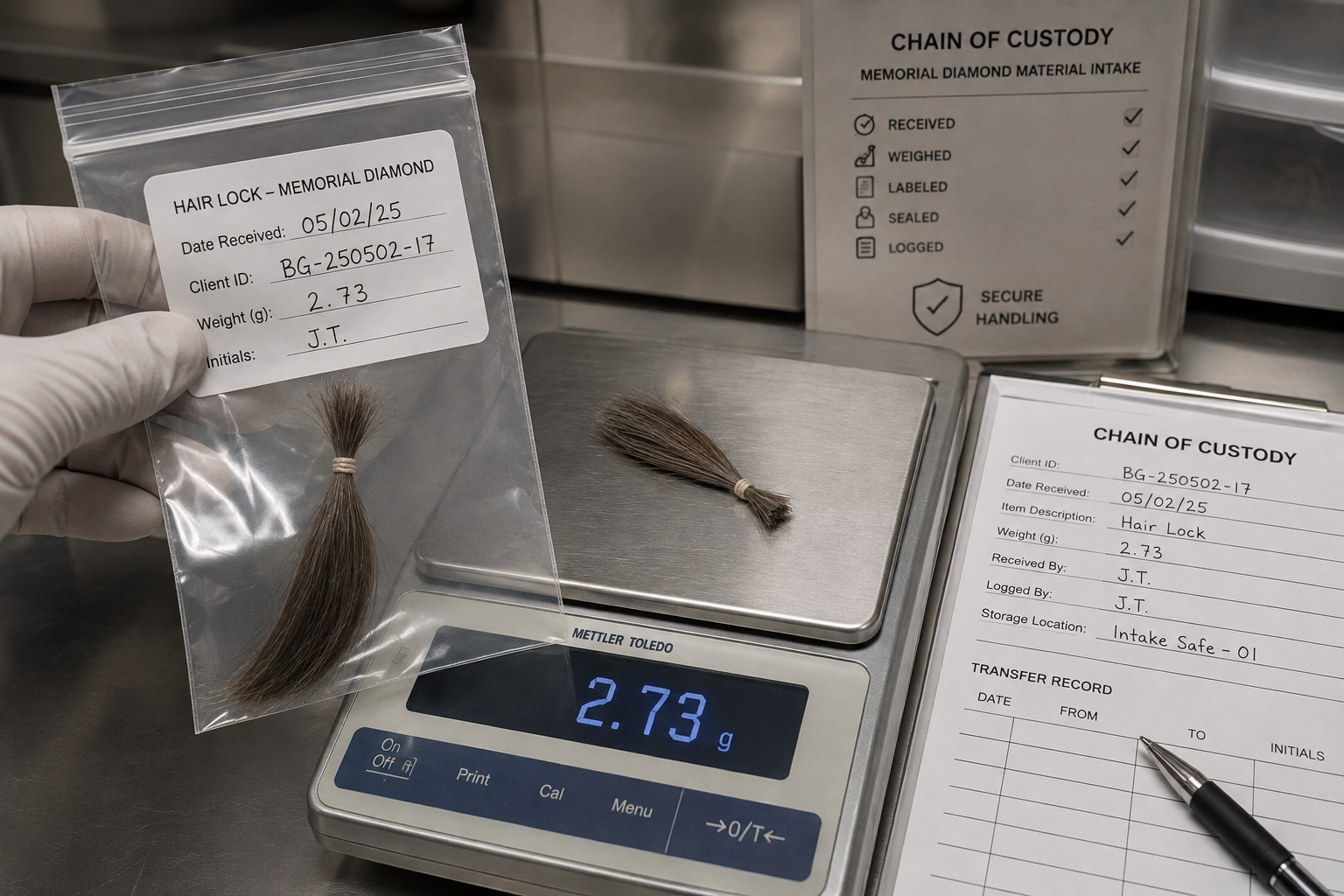
This is sharper for hair than for ashes, and it gets less attention than it deserves.
A lock of gray hair in a paper envelope is anonymous small, light, and easy to substitute. Unlike a cremation, no third party ever documented that it existed. Ashes arrive trailing paperwork: an authorization, a funeral director, a recorded transfer between institutions. A lock cut in your mother’s bedroom has none of that. You are usually the only witness.
So verification starts on your kitchen table, not at the lab:
- Photograph the lock beside a ruler and a dated note before it goes anywhere.
- Weigh it, even on a kitchen scale, and write the figure down.
- Ship it tracked, and keep the record.
- Ask for an intake confirmation stating the quantity received, not just that a package arrived.
An intake weight is the hair equivalent of a chain-of-custody anchor the first moment a second party puts on record what they are holding. From there, the tracking a provider keeps through extraction and growth does the rest, and an independent grading report speaks to the diamond’s quality while saying nothing about whose carbon it holds.
Which Questions Should You Ask Before You Send It?
Five questions specific to a hair submission. Vague answers are the signal.
- What weight do you need, and will you confirm in writing what you received? A confirmed intake quantity is the strongest document a hair family gets.
- How is a lock stored and identified between arrival and extraction? Sealed and labeled from the moment it lands, or held loose until someone gets to it?
- Do you accept colored, bleached, or chemically treated hair and does it change the process or the likely color?
- What disqualifies a lock? Mold, damp, adhesive residue, and hair possibly mixed with another person’s are the realistic failure modes.
- Is any of the lock returned? With ashes there is usually a remainder. With a few grams of hair there may not be.
A fuller checklist before turning your mother’s hair into a diamond goes wider, and the complete guide to a mother hair diamond covers color, timeline, and cost.
Frequently Asked Questions
Can this be done if my mother was buried rather than cremated?
Yes. Hair-based memorial diamonds involve no cremation at any stage, so burial doesn’t rule anything out. All that’s needed is a lock of her hair, whenever it was collected before her death or at the funeral home.
I’ve had a lock of her hair for fifteen years. Is it too old?
Age by itself isn’t the problem keratin is stable and hair survives for generations. Storage is what matters: mold, damp, adhesive tape, or a lock mixed with someone else’s hair. Describe its condition when you ask.
Can you be certain hairbrush hair is only hers?
Not always, and the doubt is about identity rather than chemistry. Brush hair is the same keratin, but a brush may hold strands from anyone who used it. A cut lock removes that question; ask what your provider accepts.
Can anyone prove the finished diamond came from my mother’s hair?
Not by testing the stone. Purification erases the difference between one carbon source and another. And unlike cremated remains, a lock carries no third-party paperwork behind it so your dated photograph and the lab’s intake record are the evidence.
Will a hair diamond look different from an ashes diamond?
Possibly. Color comes from trace elements present during growth, and hair carries a different profile than ash, without ash’s calcium-phosphate mineral load. No provider can promise a specific color in advance from either source.
How much hair does she need to have had?
Length matters less than quantity. A few grams is the industry-typical ask, which a short haircut can supply. Thinning hair, chemotherapy regrowth, or a very short style don’t automatically rule it out.
If You’re Not Sure Yet
Ask before you commit to anyone. The five questions above cost nothing to send, and the answers or the evasions tell you more about a provider than anything they have written about themselves.
That includes us. Reach out to Memorial Diamond at memorialdiamond.us and ask what documentation comes with a stone grown from your mother’s hair. The same question about her ashes has a different answer, and a different set of numbers.